



Liposomal Iron
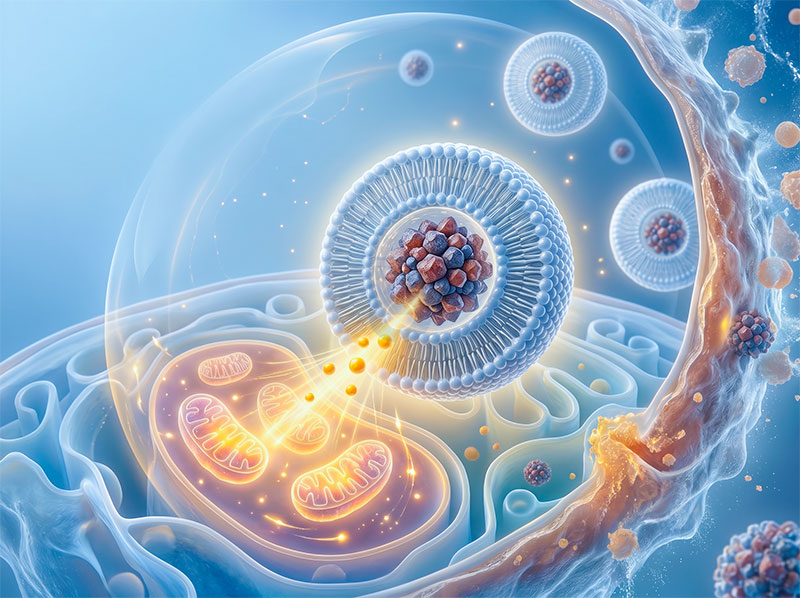
Advanced bioavailable iron developed for maximum absorption and tolerability, utilizing a liposomal delivery system designed to bypass the traditional DMT1 pathway, prevent gastrointestinal irritation, and ensure superior cellular uptake.
87.42%
Encapsulation Efficiency
71%
Loading Capacity
153.8 nm
Particle Size
-61.22 mV
Zeta Potential
WBCIL Liposomal Iron vs. Standard Iron Salts
The following table presents a head-to-head comparison between WBCIL’s liposomal formulation and conventional iron salts. The data demonstrates how liposomal delivery overcomes traditional barriers like the hepcidin block and gastric distress.
| Feature | WBCIL Liposomal Iron | Standard Iron Salts |
|---|---|---|
| Absorption Pathway | Bypasses DMT1; absorbed via intestinal lymphatic system / M-cells. | DMT1-Mediated; requires protein transporters on the enterocyte surface. |
| Hepcidin Influence | Low: Enters bloodstream even when hepcidin levels are high (effective in inflammation). | High: Elevated hepcidin blocks iron absorption via the "hepcidin-ferroportin" axis. |
| Stability in Gut | Protected: Phospholipid bilayer shields iron from inhibitors and gastric acid. | Reactive: "Free" iron interacts with stomach acid, tannins, and phytates. |
| Bioavailability | High: 3 to 5 times higher than conventional ferrous salts. | Low: 5%–15%; dependent on Vitamin C and gastric pH. |
| Tolerability | Superior: No direct gut mucosal contact; essentially eliminates gastric distress and constipation. | Poor: High incidence of nausea, metallic taste, and constipation. |
| Tolerability | Rapid: Faster restoration of ferritin and hemoglobin at lower elemental doses. | Slower: Requires months of therapy and large doses to see Hb increases. |
Analytical Validation Across Critical Quality Attributes
Extensive validated studies confirming nanoscale delivery behavior, colloidal stability, and molecular integration.
Encapsulation & Loading Efficiency
- Achieved an encapsulation efficiency of 87.42%, safely exceeding the NLT 70% acceptance criteria.
- Demonstrates a high loading capacity of 71% (0.71 mg of Iron API loaded per mg of total liposomal product) for optimized cost-efficiency and dosing.
Exceeds acceptance criterion
Particle Size Analysis (DLS)
- Dynamic Light Scattering confirms a mean particle size of 153.8 nm, falling well within the preferable nanoscale range (≤ 300 nm).
- Achieved a Polydispersity Index (PDI) of 0.2799, indicating a highly uniform particle distribution.
PDI 0.2799 - uniform dispersion
Colloidal Stability (Zeta Potential)
- Demonstrates a high absolute zeta potential of -61.22 mV.
- Provides strong electrostatic repulsion, effectively preventing particle agglomeration and ensuring stable dispersion.
Highly stable dispersion profile
Accelerated & Real-Time Stability
- Exhibited insignificant iron leakage over a 6-month accelerated study (40°C ± 2°C / 75% RH).
- Maintained robust integrity over a 6-month real-time study (30°C ± 2°C / 65% RH) with a target shelf life of up to 36 Months.
Strong projected shelf-life profile
Structural Morphology (SEM & EDAX)
- SEM: Reveals smooth, spherical morphology that enhances stability and reduces unwanted protein interactions.
- EDAX: Surface elemental analysis confirms the absence of detectable free iron on the surface, verifying true and complete encapsulation.
Thermal Integration (DSC & TGA)
- DSC: The sharp crystalline melting peaks characteristic of free iron are suppressed, confirming iron is embedded within the amorphous lipid bilayer.
- TGA: Leaves a high-temperature inorganic residue of ~44%, behaving distinctly as a hybrid of a lipid matrix and an encapsulated inorganic salt.
Bilayer incorporation confirmed
Analytical Evidence of Liposomal Integration
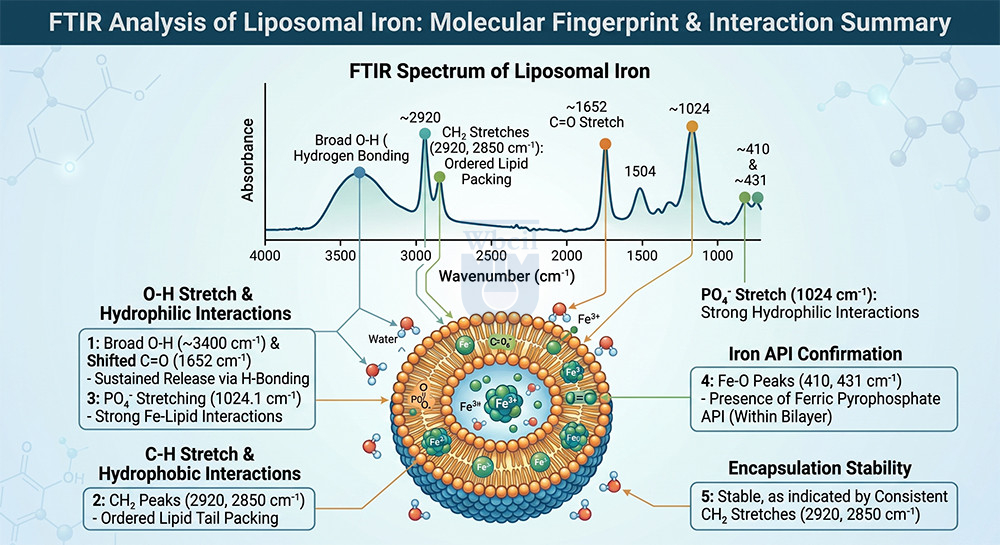
Fourier Transform Infrared Spectroscopy (FTIR) provides critical «fingerprint» validation that the iron salt is fully incorporated into the liposome, rather than merely physically mixed.
Lipid Bilayer Confirmation
Shows characteristic lipid structural peaks at 2920 & 2850 cm⁻¹.
Phosphate Environment Modification
The sharp Pyrophosphate (P-O/P-O-P) regions at ~1138 & ~1033 cm⁻¹ are broadened and redistributed, indicating confinement within the liposome.
Hydration Confinement
Strong, broadened O-H and H-O-H bands indicate a hydrated, confined micro-environment typical of liposomal inorganic loading.
Technical Questions About Liposomal Iron
Key answers covering encapsulation efficiency, pdiv size, zeta potential, thermal stability, shelf life, FTIR confirmation, and absorption performance.
WBCIL’s Liposomal Iron achieves a remarkably high loading capacity of 71% (0.71 mg of Iron API loaded per mg of total liposomal product). This high capacity is crucial for cost-efficiency, as it reduces the total volume of liposomes required per dose while improving the ultimate therapeutic outcome.
During periods of inflammation or infection, the body elevates hepcidin levels, which blocks traditional iron absorption through the DMT1 pathway. Because liposomal iron is absorbed via endocytosis and M-cells into the lymphatic system, it effectively bypasses this pathway, allowing it to enter the bloodstream even when hepcidin levels are high.
Zeta potential measures surface charge. A highly negative value of -61.22 mV creates strong electrostatic repulsion between the liposome particles. This repelling force prevents the particles from clumping together (agglomeration), resulting in superior colloidal dispersion and a greater shelf life.
Energy-Dispersive X-ray Analysis (EDAX) tests the surface composition of materials. While raw Iron API clearly shows iron on the surface, EDAX analysis of WBCIL’s formulation detected no iron on the exterior surface of the particles. This conclusively proves the iron is fully masked and sealed inside the phospholipid bilayer.
Thermal integrity is validated using Differential Scanning Calorimetry (DSC) and Thermogravimetric Analysis (TGA). DSC thermograms show that the sharp, heat-reactive peaks of free iron are suppressed, replaced by softer phase transitions typical of lipids. TGA confirms that the formulation degrades systematically like a lipid at lower temperatures but leaves a rich ~44% inorganic residue at high temperatures, confirming the dual nature of an encapsulated inorganic salt.
No. Because the iron is encased within a protective phospholipid bilayer, it does not come into direct contact with the gut mucosa. This eliminates the common «iron side effects» such as nausea, metallic taste, gastric irritation, and constipation, leading to vastly superior patient tolerability.
Yes. Dynamic Light Scattering (DLS) analysis confirms a Polydispersity Index (PDI) of 0.2799. A PDI well below 0.50 indicates a narrow, highly uniform size distribution, ensuring batch-to-batch consistency and predictable cellular uptake.
Download the Complete Technical White Paper
Access the full 18-page technical documentation including laboratory thermograms, FTIR spectra, DLS reports, and complete analytical validation data.
More Technical White Papers
Explore WBCIL’s broader portfolio of nutraceutical characterization and delivery research.
Liposomal Vitamin C
Encapsulation efficiency, pdiv behavior, and bioavailability insights for ascorbic acid liposomal delivery.
View White Paper →Liposomal Glutathione
Advanced antioxidant delivery study covering stability, uptake potential, and formulation performance.
View White Paper →Liposomal Curcumin
Technical evaluation of liposomal encapsulation to address low oral bioavailability and improve delivery efficiency.
View White Paper →