



Liposomal Iron
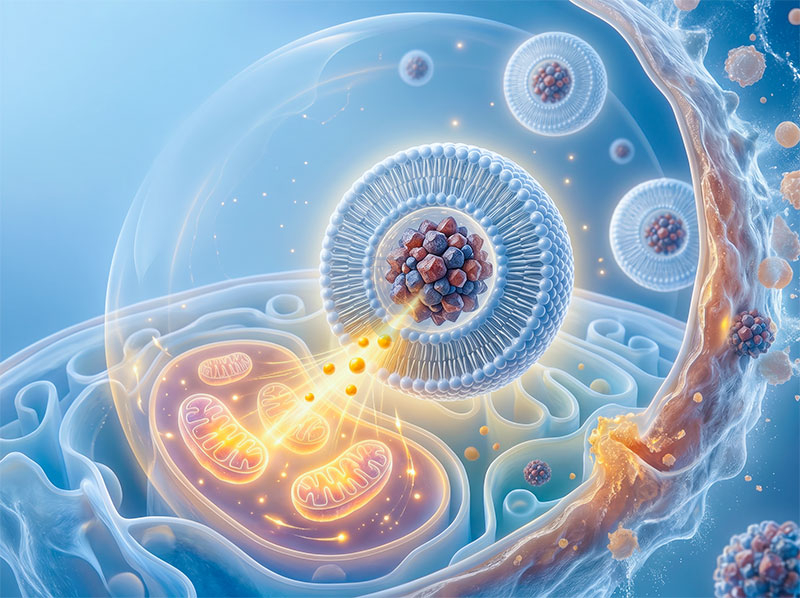
WBCIL’s Liposomal Iron uses advanced nanoscale encapsulation to bypass traditional digestion, maximizing cellular absorption and eliminating gastrointestinal irritation.
87.42%
Encapsulation Efficiency
71%
Loading Capacity
153.8 nm
Particle Size
-61.22 mV
Zeta Potential
WBCIL Liposomal Iron vs. Standard Iron Salts
The following table presents a head-to-head comparison between WBCIL’s liposomal formulation and conventional iron salts. The data demonstrates how liposomal delivery overcomes traditional barriers like the hepcidin block and gastric distress.
| Parameter | Liposomal Iron | Ordinary Iron |
|---|---|---|
| Absorption | Enhanced (liposomal uptake) | Limited |
| Absorption Pathway | Absorbs directly via the lymphatic system | Competes for limited digestive transporters like DMT1 |
| Hepcidin Influence | Unaffected; absorbs even during inflammation | Blocked by inflammation-induced hepcidin |
| Stability in Gut | Lipid bilayer protects against acid and food inhibitors | Reacts poorly with stomach acid and phytates |
| Bioavailability | 3 to 5 times higher absorption | Low (5%–15%); highly pH dependent |
| Tolerability | Zero gut contact; prevents nausea and constipation | Causes nausea, metallic taste, and constipation |
| Efficacy Speed | Rapid hemoglobin restoration at lower doses. | Slow; requires high doses over several months. |
| Particle Size | ~153.8 nm | ~1942 nm |
| PDI | 0.2799 (uniform) | 1.0 (broad distribution) |
| Zeta Potential | −61.22 mV (highly stable) | −26.85 mV (less stable) |
| Encapsulation Efficiency | 87.42% | Not Applicable |
| GI Tolerance | Reduced Irritation | High irritation risk |
| Oxidation Protection | Protected | Susceptible |
| Heat Stability | Stable at 105°C | Degrades |
| Shelf Stability | High (3+ years) | Moderate |
Analytical Validation Across Critical Quality Attributes
Rigorous testing confirms nanoscale stability, efficiency, and complete integration.
Encapsulation Efficiency
- Validated titrimetric method
- Exceeds NLT 70% requirement
- Ensures minimal mineral loss0
- Protects against oxidation and GI irritation
Significantly above acceptance criteria
Particle Size (DLS)
- Nanoscale size achieved
- Improved mucosal permeability
- Better cellular uptake
- Strong batch reproducibility
PDI 0.2799 — narrow distribution
Zeta Potential
- Strong electrostatic repulsion
- Prevents aggregation
- Improves suspension stability
Excellent colloidal stability
Shelf Life / Leakage Stability
- Tested over 36 months
- Encapsulation efficiency maintained (>84%)
- Minimal iron leakage observed
Stable under accelerated conditions
Thermal Stability
- Tested at 105°C for 4 hours
- Minimal assay variation (12% → 11.68%)
- Encapsulation retained (~85%)
High thermal robustness
DSC Thermal Analysis
- Reduced enthalpy change
- Strong lipid-iron interaction
- Improved thermal stability
Confirmed bilayer integration
Analytical Evidence of Liposomal Integration
Fourier Transform Infrared Spectroscopy (FTIR) provides critical “fingerprint” validation that the iron salt is fully incorporated into the liposome, rather than merely physically mixed.
C=O and OH Interaction
Shifted C=O (1652 cm⁻¹), PO₄⁻ (1024 cm⁻¹), and broad O–H (~3400 cm⁻¹) peaks confirm strong lipid–iron bonding enabling sustained release.
Hydrophobic Interaction
CH₂ peaks at 2920 and 2850 cm⁻¹ confirm ordered lipid tail packing around iron within the liposomal bilayer.
Hydrophilic Interaction
Broad O–H (3403–3418 cm⁻¹) and PO₄⁻ signals confirm strong hydrophilic interactions ensuring stable aqueous dispersion.
DSC Thermal Shift
Shifted thermal transitions and reduced crystallinity confirm successful encapsulation and enhanced thermal stability.

Technical Questions About Liposomal Iron
Key answers covering encapsulation efficiency, pdiv size, zeta potential, thermal stability, shelf life, FTIR confirmation, and absorption performance.
WBCIL’s Liposomal Iron achieves a remarkably high loading capacity of 71% (0.71 mg of Iron API loaded per mg of total liposomal product). This high capacity is crucial for cost-efficiency, as it reduces the total volume of liposomes required per dose while improving the ultimate therapeutic outcome.
During periods of inflammation or infection, the body elevates hepcidin levels, which blocks traditional iron absorption through the DMT1 pathway. Because liposomal iron is absorbed via endocytosis and M-cells into the lymphatic system, it effectively bypasses this pathway, allowing it to enter the bloodstream even when hepcidin levels are high.
Zeta potential measures surface charge. A highly negative value of -61.22 mV creates strong electrostatic repulsion between the liposome particles. This repelling force prevents the particles from clumping together (agglomeration), resulting in superior colloidal dispersion and a greater shelf life.
Energy-Dispersive X-ray Analysis (EDAX) tests the surface composition of materials. While raw Iron API clearly shows iron on the surface, EDAX analysis of WBCIL’s formulation detected no iron on the exterior surface of the particles. This conclusively proves the iron is fully masked and sealed inside the phospholipid bilayer.
Thermal integrity is validated using Differential Scanning Calorimetry (DSC) and Thermogravimetric Analysis (TGA). DSC thermograms show that the sharp, heat-reactive peaks of free iron are suppressed, replaced by softer phase transitions typical of lipids. TGA confirms that the formulation degrades systematically like a lipid at lower temperatures but leaves a rich ~44% inorganic residue at high temperatures, confirming the dual nature of an encapsulated inorganic salt.
No. Because the iron is encased within a protective phospholipid bilayer, it does not come into direct contact with the gut mucosa. This eliminates the common “iron side effects” such as nausea, metallic taste, gastric irritation, and constipation, leading to vastly superior patient tolerability.
Yes. Dynamic Light Scattering (DLS) analysis confirms a Polydispersity Index (PDI) of 0.2799. A PDI well below 0.50 indicates a narrow, highly uniform size distribution, ensuring batch-to-batch consistency and predictable cellular uptake.
Download the Complete Technical White Paper
Access the full 18-page technical documentation including laboratory thermograms, FTIR spectra, DLS reports, and complete analytical validation data.
