



Why WBCIL’s Research Points to Liposomal Zinc as the Future
Zinc is a foundational element of human health. From catalysing over 300 enzymatic reactions to stabilising DNA, its role is non-negotiable. Yet, for decades, the pharmaceutical and nutraceutical industries have hit a wall: bioavailability. You can pack a tablet with zinc, but you cannot force the body to absorb it. Traditional zinc salts—such as zinc sulfate or zinc gluconate—have long been the standard, but they come with significant drawbacks, including poor absorption and unpleasant gastrointestinal side effects.
This is where the science of encapsulation changes the game. By leveraging nanotechnology in zinc delivery, specifically through liposomal encapsulation, we are witnessing a paradigm shift in how essential minerals are delivered to the body. Based on recent data from the WBCIL whitepaper, this article explores why liposomal zinc is not just an alternative but a superior evolution of mineral supplementation. [1]
Takeaways:
The “Trojan Horse” Delivery System: unlike traditional zinc salts that face digestive roadblocks, liposomal zinc uses a phospholipid “shield” to mimic human cell membranes. This allows it to bypass harsh stomach acids and saturable transport channels, delivering the mineral directly into the bloodstream and cells.
Data-Backed Efficiency: According to the WBCIL whitepaper, their liposomal formulation achieves a massive 94.51% encapsulation efficiency (compared to the industry standard of 70%). This proves that the zinc is successfully locked inside the lipid layer, ensuring the dosage you take is the dosage your body actually utilizes.
All the Benefits, None of the Nausea: By encapsulating the zinc, the supplement avoids direct contact with the stomach lining. This eliminates the common gastrointestinal side effects—like nausea and cramping—often associated with Zinc Sulfate and Gluconate, making high-dose supplementation comfortable and sustainable.
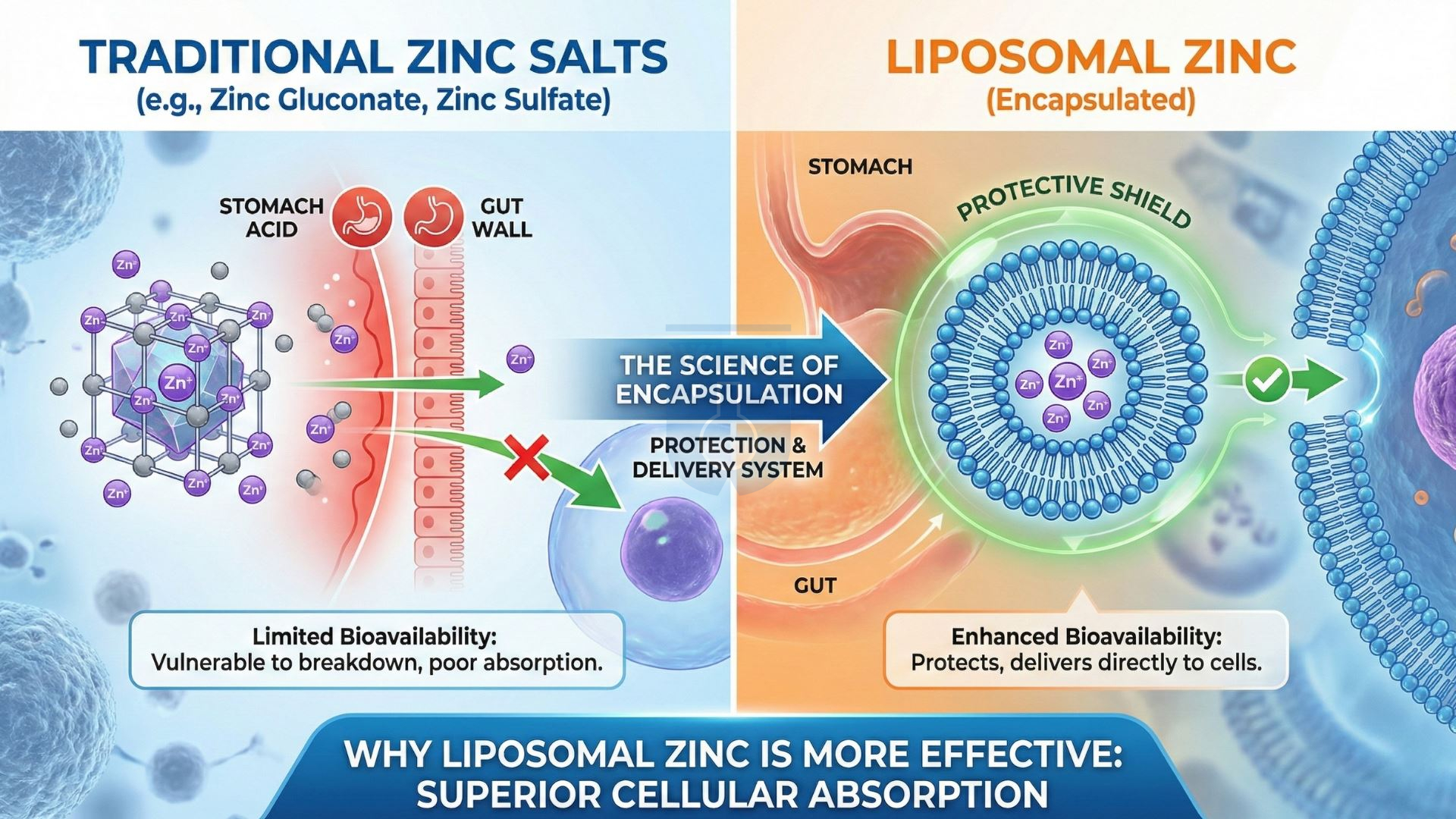
The Problem with the “Old Guard”: Zinc Salts
To understand the solution, we have to look at the problem. Traditional zinc supplements usually consist of zinc bound to an acid (like gluconate or sulfate).
When you ingest these, they must dissolve in the stomach. The free zinc ions are then released, but they face a hostile environment. They can bind with phytates in food, which blocks absorption, or they can irritate the stomach lining, leading to the nausea many people experience with high-dose zinc. [1],[3]
Furthermore, the body has strict gatekeeping mechanisms for the transport of minerals. If the transport channels are saturated, the excess zinc is simply excreted. This creates a ceiling on how effective traditional supplements can be, regardless of the dose.
The Liposomal Solution: A Trojan Horse for Health
Liposomal zinc benefits stem from its unique structure, as per the definition. A liposome is a spherical vesicle with a membrane composed of a phospholipid bilayer—the exact same material that makes up our own cell membranes. By encapsulating the zinc core within this lipid shell, we create a delivery vehicle that mimics the body’s own biology.
This is the core mechanism of liposomal drug delivery for minerals. The liposome protects the zinc from the harsh acid of the stomach and prevents it from binding to food particles that would otherwise render it useless. Because the liposome acts like a cell, it can fuse with the intestinal wall, delivering the zinc directly into the bloodstream and into the cells, bypassing the standard, limited transport channels.
Analysing the Data: The 94.51% Efficiency Breakthrough
Scientific claims need data, and the WBCIL whitepaper provides a compelling look at the characterisation of Liposomal Zinc.
Looking at the analytical data presented in the whitepaper, the distinction between raw Zinc API (Active Pharmaceutical Ingredient) and Liposomal Zinc is stark. [4]
In a direct comparison of Encapsulation Efficiency, the raw Zinc API naturally shows “Nil” efficiency—it has no protection. In contrast, the Liposomal Zinc formulation demonstrated a massive 94.51% encapsulation efficiency.
Why does this number matter?
The industry acceptance criteria for encapsulation efficiency is generally “Not Less Than (NLT) 70%.” A result of 94.51% suggests a highly sophisticated manufacturing process. It means that almost all the zinc used in the formulation is successfully tucked away inside the protective lipid layer. This high efficiency is the primary driver behind liposomal zinc for zinc deficiency, as it ensures that the mineral is actually delivered where it is needed, minimising mineral loss.[2]
Critical Quality Attributes (CQAs): It’s Not Just About Mixing
Creating a high bioavailability zinc supplement isn’t as simple as mixing zinc with fat. As detailed in the characterisation summary, rigorous testing defines the quality of the final product.
- Particle Size and Uniformity: Using Dynamic Light Scattering (DLS), scientists measure the mean particle size. Smaller, uniform particles circulate better in the blood and penetrate tissues more effectively.
- Surface Charge (Zeta Potential): This measures the electrical charge of the particle. A proper charge keeps the liposomes from clumping together, ensuring the stability of liposomal Zinc in liquid formulations. If the particles clump, they become too large to be absorbed effectively.
- Lamellarity: This refers to the number of lipid layers. The morphology analysis ensures the structure is optimal for holding the zinc payload until it reaches the target cells. [5],[6]
Bioavailability Wars: Liposomes vs. Gluconate and Sulfate
When comparing bioavailability of Zinc Gluconate and Liposomes, the liposome wins on two fronts: protection and cellular uptake.
Zinc Gluconate is better absorbed than Sulfate, but it still relies on active transport channels in the gut. Liposomes, however, can pass through via passive transport and fusion. This leads to higher plasma concentrations of zinc.
Moreover, the WBCIL white paper highlights that this efficient encapsulation provides “protection against oxidation and gastrointestinal irritation.” This addresses the most common consumer complaint: nausea. By hiding the zinc inside a lipid, it doesn’t come into direct contact with the stomach lining, effectively bypassing the irritation receptor sites.
Clinical Applications and Health Benefits
The superior absorption of advanced zinc formulations for supplements translates directly to better health outcomes.
1. The benefits of liposomal zinc for the immune system. Zinc is vital for the development and function of immune cells, such as neutrophils and natural killer cells. The rapid delivery of liposomal zinc ensures that during times of infection, the body has immediate access to the mineral reserves it needs to mount a defence.
2. The benefits of liposomal zinc in reducing oxidative stress. Zinc is a co-factor for Superoxide Dismutase (SOD), one of the body’s most potent internal antioxidants. Zinc antioxidant and anti inflammatory effects are amplified when the delivery system ensures the mineral reaches the intracellular space where SOD operates. This helps combat free radicals more effectively than standard salts. [3]
3. The benefits of liposomal zinc for healthy skin. Skin holds a high concentration of the body’s zinc. It is used for DNA synthesis and tissue repair. The enhanced bioavailability supports faster wound healing and creates a more substantial barrier against acne-causing bacteria. [4]
4. Zinc and critical illness support. In critical care scenarios, metabolic demand for zinc skyrockets. Zinc and cellular metabolism are intrinsically linked; without it, metabolic processes stall. The high liposomal zinc absorption makes it a candidate for supporting patients who cannot tolerate high volumes of oral supplements but need immediate mineral support.
WBCIL- Best Liposomal Zinc Manufacturer
The disparity in supplement quality often comes down to the liposomal zinc manufacturer. As outlined in the WBCIL whitepaper, producing true liposomal zinc requires identifying lipid species and quantifying the API that is encapsulated vs. unencapsulated. You will get a performing stability analysis at high temperatures (up to 105°C). We who adhere to these strict Critical Quality Attributes (CQAs) can guarantee a product that offers the stability and bioavailability promised by science. [6]
To know more, please connect with us via WhatsApp- our WhatsApp number is 7980671939, or simply email us at wbcil@wbcil.com.

- https://www.wbcil.com/wp-content/uploads/2025/04/Liposomal-Zinc-29.10.2025.pdf
- https://pmc.ncbi.nlm.nih.gov/articles/PMC2277319/
- https://link.springer.com/article/10.2119/2008-00033.Prasad
- https://pubmed.ncbi.nlm.nih.gov/28049940/
- https://pmc.ncbi.nlm.nih.gov/articles/PMC3724376/
- https://pubmed.ncbi.nlm.nih.gov/23914218/
Zinc sulfate dissolves rapidly in the stomach, releasing free zinc ions that react strongly with the stomach lining (gastric mucosa). This irritation triggers the vagus nerve, resulting in nausea and cramping. Liposomal zinc shields the stomach from these ions.
It mimics the body’s cell membranes. This allows the zinc to pass through the intestinal wall using different pathways than regular minerals, protecting it from being broken down by digestion or blocked by food interactions.
Yes, scientifically speaking. It offers higher absorption rates, better stability in the blood, and fewer side effects. It ensures that the dosage you take is the dosage your body actually uses.
Zinc salts (gluconate, citrate, sulfate) are simple chemical compounds that rely on standard digestion. Liposomal zinc is a complex delivery system using nanotechnology to encapsulate the mineral in a fat bubble for direct cellular delivery.
It is easy to download WBCIL’s whitepaper. Search www.wbcil.com, go to our liposomal technology page, choose any liposomal product and go to the Whitepaper in menu.
Download our whitepaper.
