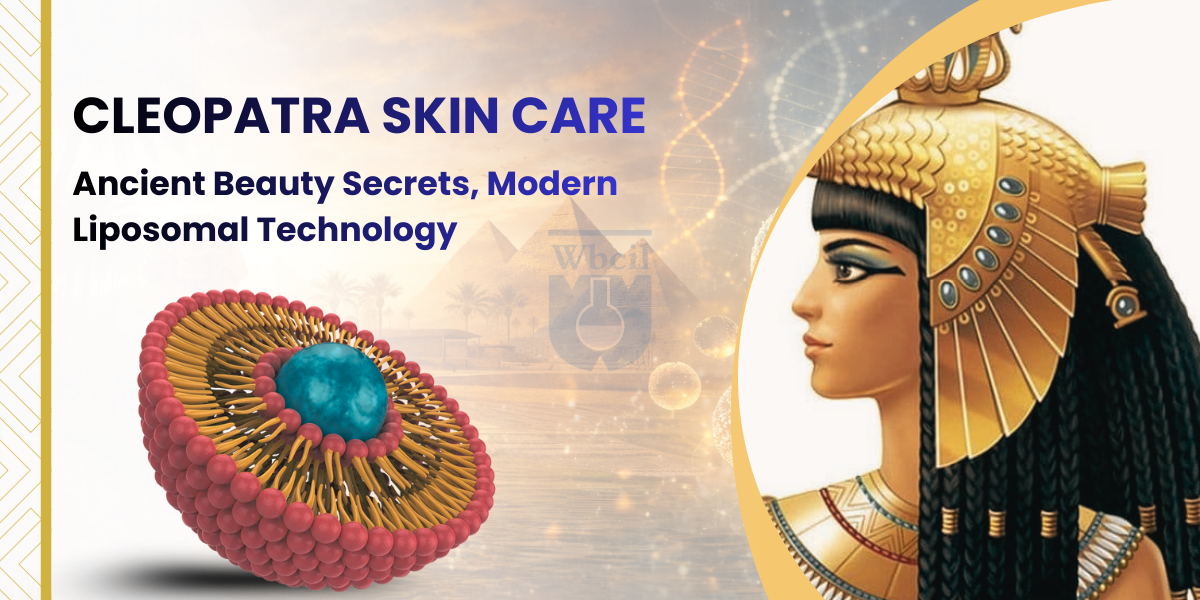
Cleopatra Skin Care: Ancient Beauty Secrets, Modern Liposomal Technology
Ancient beauty standards and rituals culminate in appropriate observations, consistency, and efficiency, long before the modern precedents of today’s cosmetics. Among historical practices, Cleopatra is well-known for her skincare practices, which resonate with sound ingredient choices and blended luxury.
Ancient Egyptian hieroglyphics mention the early awareness of exfoliation, nourishment, and skincare through natural ingredients. In this blog, explore how Cleopatra skin care connects ancient beauty wisdom with liposomal cosmetics and modern formulation science.
Also read: Why Liposomal Technology is Revolutionising the Cosmeceutical Industry?
Key Takeaways:
Cleopatra skin care routine and practices depend on ingredient choice, purpose-shaped early concepts of skin health and beauty.
Modern cosmetic science reflects these ancient beauty secrets through liposomal technology that supports stability and targeted delivery.
Liposomal technology takes inspiration from heritage and history for measurable performance within skincare formulations.
The Legacy of Cleopatra’s Skin Care in History
Cleopatra’s beauty secrets are legendary, and history tells us she used natural ingredients such as milk, honey, olive oil and rose petals in her skin care rituals. These choices mirror many aspects of modern skincare practice.
Here are some of the key elements of Cleopatra skin care:
- Cleopatra was known for flawless, luminous skin and bathed in a mix of milk, honey, olive oil and rose petals, each ingredient chosen for its natural benefit.
- Milk in her baths offered a gentle exfoliant effect through lactic acid, a compound that softens and smooths skin.
- Honey is a natural humectant having antibacterial properties, and olive oil, on the other hand provide deep nourishment and antioxidant support.
- Rose petals added a calming scent and a gentle effect on the skin, enhancing both the ritual and sensory experience.
Some of her more unusual practices, such as a paste made from donkey’s milk and crocodile dung, reflect the bold, experimental nature of ancient beauty lore, though modern practice prefers safer alternatives
What Cleopatra’s Beauty Secrets Teach About Skin Health?
Cleopatra skin care approach to skincare with natural ingredients and bathing rituals shows early understanding of exfoliation, moisture support and barrier care.
- Cleopatra followed regular, ritual-based skin care, which highlights the importance of consistency over sporadic product use for visible skin quality.
- The ancient beauty secrets combined cleansing, protection, and nourishment. This suggests that skin care is a multifaceted task and differs from a single treatment protocol.
- The use of region-specific materials shows how environmental awareness shaped her routines, a concept now seen in climate-adaptive skincare.
- Beauty rituals also served a preventive role, aiming to preserve skin condition rather than correct damage after it appeared.
- Cleopatra skin care revolves around overall well-being and status, mirroring today’s premium skincare positioning, which often draws inspiration from ancient techniques.
Let’s now explore how the ancient world influences modern cosmetic science.
How Ancient Beauty Wisdom Connects to Modern Cosmetic Science?
Cleopatra’s historic practices, such as the use of mineral salts, botanical oils and simple natural masks, reflect early ideas about skin health and nourishment.
- Cleopatra used Dead Sea salts for their rich mineral content and natural support for skin clarity and texture, a method that echoes today’s use of mineral-rich masks and exfoliants.
- Traditional milk-and-honey facial masks helped soften and support surface smoothness, a principle now pursued by moisturisers and humectants in modern serums.
- Natural botanical oils such as sesame, castor, and moringa were part of her beauty approach and reflect ancient recognition of nourishment and emollient support, now achieved by targeted lipid-rich actives.
- The use of henna for nail care hints at early appreciation for multifunctional botanicals. It closely resembles today’s interest in compounds that condition, protect, and enhance appearance.
- Regular milk baths introduced lactic acid naturally to her skin routine, a basic form of exfoliation and renewal that today’s acids and mild surface treatments aim to offer.With advancements in science and technology, liposomal technologies and formulations are shaping the next generation of cosmetics.
Liposomal Anti-Ageing Beauty and Advanced Delivery Technology
Research shows that nano-based delivery systems, including liposomes, feature in about 38 studies out of 265 screened on anti-ageing cosmetics technology [1]. The data showcases the rise of targeted formats in skin care science and reflects a shift toward liposomal anti-ageing beauty approaches.
Liposomes and other nano-carriers help protect active compounds from breakdown and support a more sustained presence at the target site on the skin compared with traditional creams.
Some studies found that nano-enabled formulations may reduce melanin synthesis and inhibit enzymes involved in skin ageing, suggesting functional benefits beyond simple miniaturisation.
Multiple formulations used liposome-like vesicles to support deeper delivery of antioxidants, peptides and other actives that aim to counteract free-radical damage and structural breakdown linked to ageing.
The primary emphasis suggests that liposomal drug delivery technology and active design are key drivers of performance claims in anti-ageing products.
Liposomal and related systems are widely studied not only for delivery but also to improve hydration, elasticity, and antioxidant action, which are central goals in modern cosmetic science.

Why Cleopatra’s Skin Care Inspires Today’s Innovation?
Recent research suggests 1.65× higher skin retention for vitamin D3 in liposomes versus a vitamin D3 solution. It reflects why Cleopatra skin care still points to modern dermal penetration technology.
- Liposomal structures safeguard active pharmaceutical ingredients (APIs) from heat, light, pH shifts, and oxidation.
- A well-designed liposome delivery system improves skin interaction, flux, and retention, which supports consistent results in liposomal anti-ageing beauty products.
- Certain actives show more than threefold higher skin penetration over 24 hours when delivered through liposomal formats compared with free forms.
- Some vitamins demonstrate up to 1.65× higher skin retention in liposomal form, reinforcing the value of advanced dermal penetration technology.
- This delivery approach suits antioxidants and skin-support ingredients such as liposomal glutathione and liposomal niacinamide, where a gentle feel and dependable on-skin delivery matter.
WBCIL’s Liposomal Cosmeceutical Developments in Modern Skincare?
WBCIL extends its liposomal products expertise into skincare, using decades of liposomal API work to support formulations that protect, stabilise, and deliver actives within skin layers. Its role as a liposomal skincare actives manufacturer shows in a portfolio with liposomal Vitamin C and glycolic acid, designed to support stability and absorption for visible results. Through high-quality, scalable liposomal actives and FSSAI, WHO-GMP-backed systems, WBCIL offers cosmetic manufacturers a dependable base for cosmeceutical formulations.
Final Thoughts
Cleopatra skin care nowadays serves as a benchmark for cosmetics and highlights how simple ingredients and their mode of delivery can make all the difference for natural beauty. With advancements in cosmetic science, experts pair proven actives with advanced delivery systems, such as liposomes, to help extract the best from ingredients.
In today’s modern cosmeceutical industry, the principles for development depend on protection, stability, and deeper penetration within the skin for visible outcomes. For cosmetic manufacturers and formulators, heritage-inspired concepts with advanced delivery and a reliable liposomal skincare actives manufacturer offer a clear path from story-driven products.

https://pmc.ncbi.nlm.nih.gov/articles/PMC11510423
https://aocs.onlinelibrary.wiley.com/doi/full/10.1002/aocs.12907
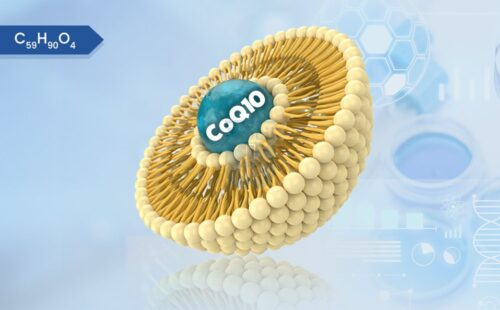
Liposomal cosmetics use microscopic lipid vesicles that transports compound deep within the skin layers. The benefits of liposomal cosmetics also include better stability of actives and more consistent on-skin performance.
They work by enclosing active ingredients within lipid structures similar to skin membranes, which supports controlled release. This explains how liposomal skincare works by improving contact between actives and skin.
Liposomal serums often show improved retention and delivery compared with conventional serums that remain mainly on the surface. This difference supports their role in evidence based cosmeceutical skincare rather than perception-led results.
Liposomal systems rely on biocompatible lipids commonly used in pharmaceutical and cosmetic applications. When properly formulated, they suit regular routines focused on evidence based cosmeceutical skincare.
Liposomal carriers help actives move beyond the surface layers and remain longer within the skin barrier. This mechanism highlights how liposomal skincare works compared with traditional topical formats.
Cleopatra did not use modern technology, but her routines showed an early understanding of exfoliation, nourishment, and protection. These ancient Egyptian beauty secrets explained reveal structured rituals rather than random practices.
Modern research confirms that many historically used natural materials support hydration, barrier care, and renewal. This connection helps translate Cleopatra-inspired skincare rituals into scientifically refined formulations.
Pharma-grade inputs ensure controlled quality, reproducibility, and safety in advanced formulations. This standard supports reliable outcomes for brands focused on evidence-based cosmeceutical skincare.