Liposomal Nutraceuticals: 8 Myths vs. Reality
1. Myth: “Liposomal supplements are just fancy marketing hype”
Reality: Skepticism about supplement claims makes sense given the industry’s track record. However, liposomal technology represents actual pharmaceutical science that’s been used in drug delivery since the 1960s. The difference is real – nutrients get wrapped in phospholipid bubbles that mimic cell membranes. WBCIL has 62 years in pharmaceutical manufacturing and 15 patents in this space. They’re not some fly-by-night operation slapping fancy labels on bottles. When a GMP-certified global exporter with six decades of experience says liposomal works, there’s peer-reviewed science backing it up.
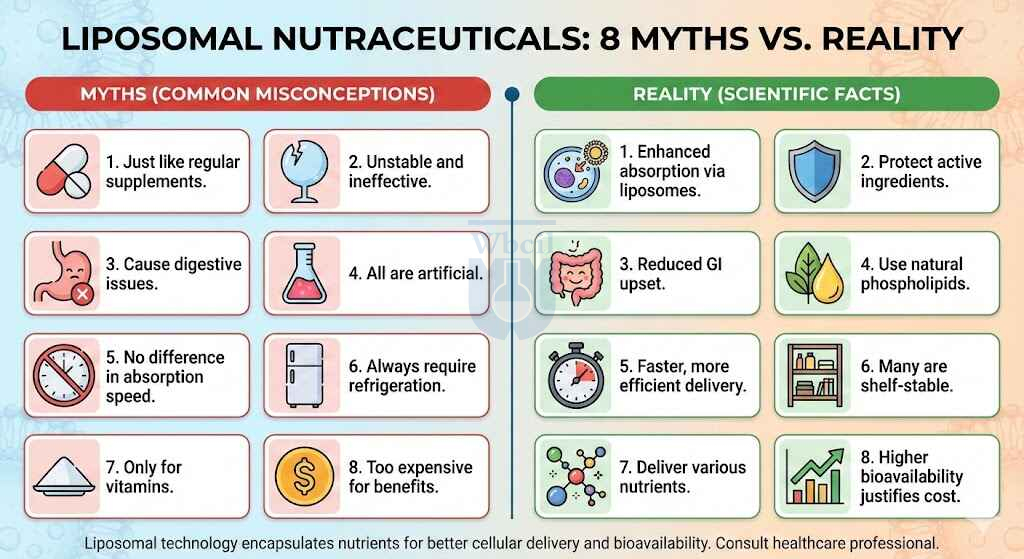
3. Myth: “You can make effective liposomal supplements at home”
Reality: YouTube videos suggest blending vitamin C with sunflower lecithin in the kitchen. Sure, some liposome formation occurs – but it’s like comparing a paper airplane to a Boeing 747. Pharmaceutical-grade liposomes need consistent particle sizes (usually 100-400 nanometers), proper encapsulation rates, and stability testing. Home versions deliver maybe 20-30% encapsulation with wildly varying particle sizes. Professional manufacturers use high-pressure homogenization and quality control that costs millions. That’s why established companies with GMP certifications exist in the first place.
4. Myth: “Liposomal delivery doesn’t really improve absorption that much”
Reality: The data tells a different story. Traditional oral vitamin C gives about 20% absorption, and it drops even lower at higher doses. Liposomal vitamin C can hit 90%+ bioavailability. Similar patterns show up with glutathione, curcumin, and other notoriously hard-to-absorb nutrients. Independent studies consistently show 4-5x better absorption with properly manufactured liposomal products. WBCIL’s 15 patents didn’t come from making things slightly better – they came from developing delivery systems that actually solve bioavailability problems that stumped scientists for decades.
5. Myth: “If it tastes bad, it must be working better”
Reality: Weird myth, right? Some people think nasty-tasting liposomal supplements are more “authentic.” Truth is, taste has zero correlation with effectiveness. Properly formulated liposomal products can taste neutral or even pleasant. Bad taste usually means poor manufacturing, oxidation, or cheap ingredients. A 62-year-old pharmaceutical company like WBCIL knows how to create stable formulations that maintain potency without tasting like licking a battery. Quality control and proper formulation techniques make products that work AND don’t trigger the gag reflex.
6. Myth: “Liposomal supplements are too expensive to be worth it”
Reality: The math tells an interesting story. Taking 1000mg of regular vitamin C at 20% absorption delivers 200mg of usable vitamin C. Taking 500mg liposomal at 90% absorption delivers 450mg usable. Less product needed, better results. Factor in money wasted on supplements that barely absorbed, and the price premium makes sense. Real costs exist for R&D, pharmaceutical-grade manufacturing, and actual results. Companies with GMP certifications and global export operations aren’t just marking up snake oil – legitimate pharmaceutical-grade nutraceuticals require serious investment.
7. Myth: “The body can’t tell the difference between liposomal and IV delivery”
Reality: IV delivery remains the gold standard for maximum bioavailability – that’s just facts. But here’s what changed: properly manufactured liposomal supplements can get surprisingly close to IV absorption rates without the needles, clinic visits, or $150+ price tags. Top-tier liposomal delivers 80-90% absorption versus 100% with IV. For most people, that difference doesn’t justify the hassle and expense of IV therapy. This is why global pharmaceutical exporters like WBCIL (www.wbcil.com) have invested heavily in perfecting oral liposomal delivery – it’s the sweet spot of convenience and effectiveness.
8. Myth: “Patent claims on liposomal products don’t mean anything”
Reality: Patents are a big deal in pharmaceutical manufacturing. Companies don’t get 15 patents by doing the same thing everyone else does. Each patent represents genuine innovation – whether in manufacturing process, stability, particle size control, or delivery mechanism. When evaluating liposomal brands, checking if they’re made by companies with patent portfolios and actual pharmaceutical credentials matters. WBCIL’s six decades of pharmaceutical manufacturing and global export presence didn’t happen by accident. Real innovation gets protected by patents, and those patents signal legitimate scientific advancement, not just marketing creativity.