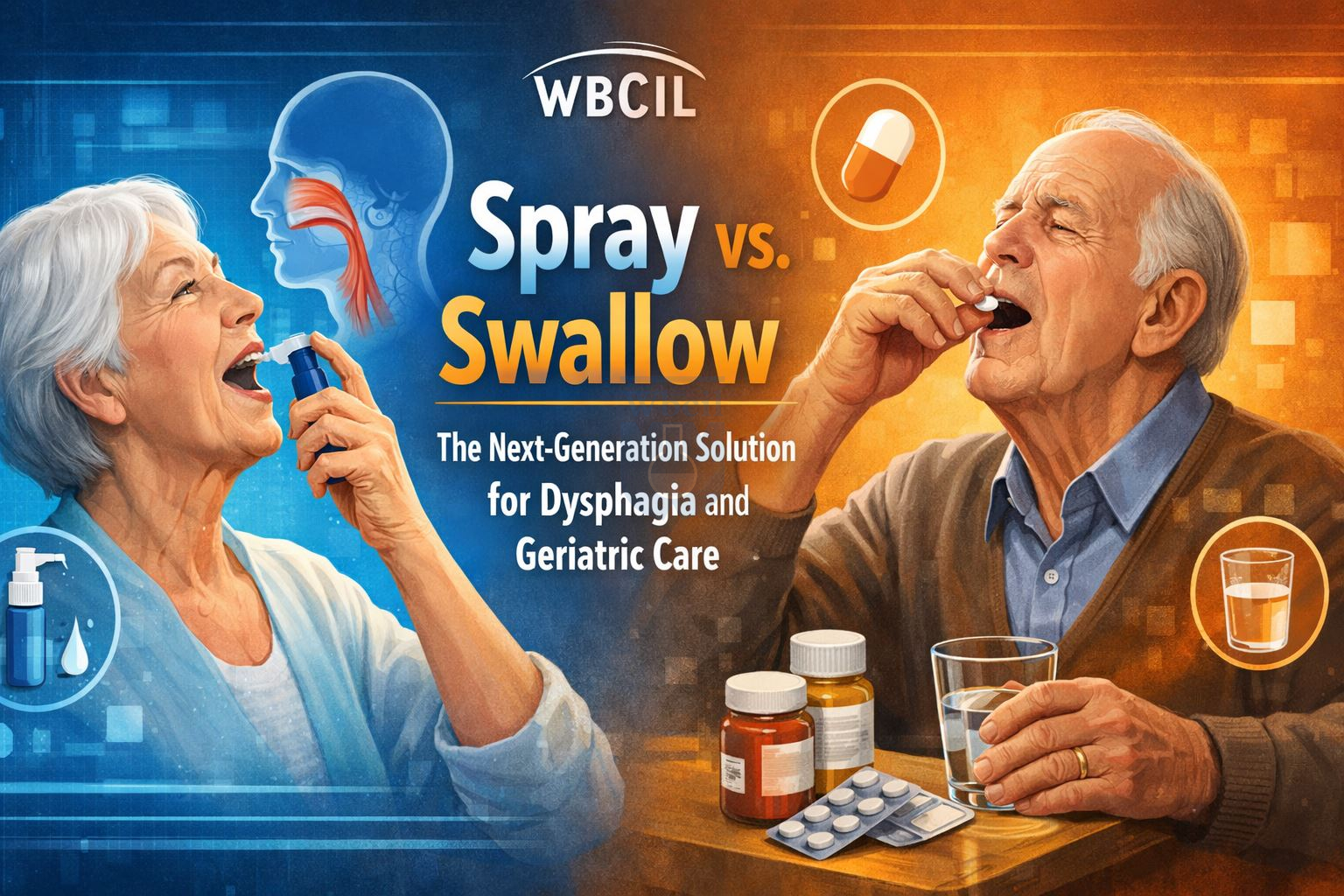
Spray vs. Swallow: The Next-Generation Solution for Dysphagia and Geriatric Care
The Silent Struggle of Pill-Taking
Liposomal melatonin administered as a mouth spray is rapidly transforming how clinicians approach sleep support for vulnerable populations. By combining advanced encapsulation with patient-friendly delivery formats, liposomal melatonin benefits address both therapeutic efficacy and real-world usability challenges. Its benefits extend beyond pharmacology, offering a practical administration solution for patients who cannot swallow conventional tablets.
Dysphagia, or difficulty swallowing, affects millions of elderly and pediatric patients worldwide. In geriatric populations, decline in neuromuscular functionality, neurodegenerative disorders, and reduced saliva production make swallowing tablets physically challenging. Even small solid dosage forms can trigger choking anxiety, aspiration risk, or outright refusal.
This leads to a widespread yet underrecognized issue of poor adherence. Patients prescribed sleep aids often skip doses simply because administration is uncomfortable or frightening. The result is fragmented sleep, caregiver burden, and diminished quality of life.
This is where the application of liposomal melatonin for dysphagia as a mouth/ sublingual spray emerges as a meaningful breakthrough. By combining nanotechnology encapsulation with spray-based delivery, therapy becomes swallow-free, gentle, and patient-friendly.
The emergence of mouth-spray formulations of liposomal melatonin for geriatric care signals a paradigm shift in patient-friendly sleep therapy. Instead of forcing tablets, caregivers can administer a simple oral or sublingual spray that dissolves instantly on mucosal surfaces. This modern oral transmucosal drug delivery system enables melatonin to enter systemic circulation without swallowing, chewing, or gastric processing.
Key Takeaways
- Spray-based liposomal melatonin improves dysphagia management among the geriatric population
- Liposomal melatonin benefits include higher bioavailability and stability
- Transmucosal sprays enhance absorption and patient compliance
WBCIL enables advanced liposomal melatonin delivery innovation
Why “Just Swallowing” Melatonin Isn’t Enough?
Even when patients can swallow tablets, conventional melatonin therapy is pharmacologically inefficient. Standard oral melatonin exhibits low systemic availability, typically around 10–15%, primarily due to extensive hepatic first-pass metabolism.
This means most of the swallowed dose is metabolized before reaching circulation. The bioavailability gap is further widened by gastrointestinal degradation processes.
Melatonin is susceptible to:
- Gastric acid hydrolysis
- Enzymatic metabolism in the intestine
- Variable dissolution in aged GI environments
These factors collectively reduce active exposure. For elderly patients with impaired digestion, the variability becomes even greater. In dysphagic patients, the issue compounds. Tablets may be crushed or mixed with food, which alters release profiles and further reduces absorption. This creates unpredictable pharmacokinetics.
Therefore, spray formulation of liposomal melatonin for elderly patients with difficulty swallowing addresses two problems simultaneously: administration feasibility and absorption efficiency.
This challenge is extensively discussed in the journal review comparing liposomal melatonin oral with sublingual spray bioavailability on the “Current Status and Future Directions of Liposomal Melatonin in Transmucosal Delivery Systems: Emphasis on the Active Ingredient from West Bengal Chemical Industries Limited”, by Agarwal et al., which identifies GI degradation and first-pass metabolism as major barriers to conventional therapy.
The Science of Liposomal Encapsulation
Liposomes are spherical vesicles composed of phospholipid bilayers structurally analogous to cell membranes. Their amphiphilic architecture enables encapsulation of lipophilic molecules, such as melatonin, within their protective lipid bilayer. This structural mimicry underpins the core liposomal melatonin benefits observed in advanced delivery systems.
Key liposomal encapsulation benefits include:
- Protection from degradation: Encapsulated melatonin is shielded from gastric acid and enzymatic hydrolysis, preserving active integrity until absorption.
- Sustained release kinetics: Bilayer diffusion slows release, enabling smoother plasma profiles and reduced dosing frequency.
- Enhanced cellular uptake: Liposomes fuse with mucosal membranes or enter via endocytosis, improving intracellular delivery efficiency.
Improved dispersion stability: Nanoscale vesicles maintain uniform distribution in liquid spray formulations.
Importantly, liposomes also facilitate transport of actives across mucosal epithelium, a critical feature for oral transmucosal drug delivery systems designed for spray administration.
Thus, oral or sublingual spray formats make liposomal melatonin for dysphagia-affected patients both easier to administer and pharmacologically superior.
The Spray Advantage: Direct to the Bloodstream
Sublingual and buccal sprays deliver active molecules directly onto highly vascularized mucosal tissue beneath the tongue or inside the cheek. These regions provide rapid systemic access without GI transit.
This addresses the common liposomal melatonin formulation challenges- enzymatic breakdown and poor absorption, enabling more reliable therapeutic exposure. This approach fundamentally changes melatonin pharmacokinetics.
Unlike swallowed tablets, sprays:
- Bypass hepatic first-pass metabolism
- Avoid gastric degradation
- Enable rapid absorption
- Provide predictable plasma levels
Clinical comparisons consistently show that sublingual melatonin sprays achieve faster absorption and higher systemic exposure than prolonged-release tablets. A typical outcome is approximately a two-fold increase in bioavailability and significantly shorter Tmax. This pharmacokinetic advantage explains why liposomal melatonin for dysphagia management strongly favours spray delivery.

For dysphagia management, sublingual sprays provide both safer administration and superior pharmacokinetics compared with tablets, supporting the clinical value of liposomal transmucosal melatonin delivery.
These characteristics make liposomal melatonin for geriatric care particularly valuable in dementia, Parkinsonian syndromes, stroke recovery, and frailty-associated dysphagia.
Because liposomes enhance mucosal permeability, combining them with spray delivery amplifies liposomal melatonin benefits further. Encapsulated vesicles interact with mucosal membranes and facilitate transmucosal transport.
This synergy between liposomal encapsulation and mucosal delivery defines next-generation oral transmucosal drug delivery systems.
WBCIL: Pioneering Next-Generation Transmucosal Delivery
Achieving clinically meaningful liposomal melatonin benefits requires precise manufacturing science. Liposomal performance depends on encapsulation efficiency, vesicle size, and colloidal stability.
West Bengal Chemical Industries Limited has developed specialized processes to produce high-purity liposomal melatonin designed specifically for transmucosal therapies.
- Encapsulation Efficiency: Effective liposomal melatonin requires active loading within the lipid bilayer rather than surface adsorption. WBCIL maintains encapsulation efficiency of not less than 80%, ensuring consistent protection and delivery. This structural integrity is central to reproducible liposomal encapsulation benefits in transmucosal systems.
- Particle Engineering: Liposome diameter directly influences mucosal uptake. WBCIL engineers nanometric vesicles within optimal biological transport ranges, improving diffusion across buccal and sublingual membranes.
- Colloidal Stability and Zeta Potential: Spray formulations require long-term dispersion stability. Liposomes can aggregate if electrostatic repulsion is insufficient.
WBCIL maintains:
• Polydispersity Index (PDI) < 0.5
• Zeta potential < −30 mV
These parameters ensure strong colloidal stability, preventing vesicle aggregation during storage and formulation. Stable vesicles preserve liposomal melatonin benefits across shelf life and product formats.
- Stability Against Degradation: Poorly engineered liposomes rupture under temperature, pH, or oxidative stress. WBCIL stabilization strategies protect vesicle integrity, enabling reliable transmucosal delivery performance.
- API Purity and Supply: WBCIL operates as a certified WHO-GMP melatonin API bulk manufacturer providing pharmaceutical-grade liposomal melatonin suitable for buccal/sublingual transmucosal delivery systems.
Through stringent quality control and nanotechnology validation, WBCIL’s melatonin API supports pharmaceutical and nutraceutical developers seeking advanced dysphagia medication solutions.Conclusion: Setting New Standards in Care
Dysphagia and poor bioavailability have long limited the effectiveness of conventional melatonin therapy. Tablets are difficult to swallow and pharmacokinetically inefficient, especially in elderly populations.
The combination of liposomal encapsulation with spray-based transmucosal delivery solves both barriers simultaneously. In spray-based systems, liposomal melatonin benefits encompass protection from degradation, enhanced bioavailability, faster absorption, swallow-free administration, and improved patient compliance. These advantages make liposomal melatonin for geriatric care and for dysphagia clinically meaningful innovations rather than incremental formulation changes.
As oral transmucosal drug delivery systems continue to evolve, liposomal sprays are poised to become the preferred route of administration for vulnerable populations.WBCIL plays a critical enabling role in this transition. By supplying high-purity, stable, and efficiently encapsulated liposomal melatonin, the company supports global development of next-generation dysphagia medication solutions. Shifting from swallow-dependent dosing to spray-based delivery improves both treatment efficiency and patient dignity, with clinically relevant liposomal melatonin benefits that redefine how melatonin therapy is delivered in dysphagia and geriatric populations.
Beyond manufacturing, WBCIL also contributes to scientific education through Lipoedge, its knowledge platform dedicated to liposomal technology. Lipoedge provides insights into liposome integrity testing, encapsulation validation, and stability characterization, helping formulators understand the science behind effective liposomal delivery.

Agarwal S, Roy R, Chakraborty A, Kar T. Current status and future directions of liposomal melatonin in transmucosal delivery systems: Emphasis on the active ingredient from west Bengal Chemical Industries Limited. Indian Journal of Pharmacy and Pharmacology [Internet]. 2026 Feb 2;12(4):206–11. Available from: https://doi.org/10.18231/j.ijpp.14872.1769489469
Liposomal melatonin is melatonin encapsulated within phospholipid vesicles that protect it from degradation and enhance mucosal and cellular uptake. Unlike regular melatonin tablets that rely on gastrointestinal absorption, liposomal forms enable more efficient delivery and improved systemic availability.
Swallowed melatonin undergoes extensive hepatic first-pass metabolism and gastrointestinal degradation, leaving only about 10–15 % of the dose available systemically. Variability in gastric conditions and enzymatic breakdown further reduces consistent absorption.
Key liposomal encapsulation benefits include protection from enzymatic and acidic degradation, improved membrane permeability, sustained release, and enhanced bioavailability. These properties enable more reliable therapeutic exposure compared with conventional formulations.
Yes. Sublingual or oral sprays avoid swallowing, dissolve directly on mucosal surfaces, and eliminate choking risk, making them more suitable for dysphagia management. They also provide faster and more efficient absorption than tablets.
Transmucosal sprays deliver melatonin directly through highly vascularized oral mucosa, bypassing gastrointestinal and hepatic barriers common in aging physiology. This results in faster onset, improved bioavailability, and easier administration in geriatric care.
WBCIL’s liposomal melatonin API is manufactured under WHO-GMP conditions with ≥80 % encapsulation efficiency, nanometric particle engineering, PDI < 0.5, and zeta potential < −30 mV. These parameters ensure structural integrity, colloidal stability, and reproducible delivery performance.
Yes. When delivered as a sublingual or oral spray, liposomal melatonin is absorbed through buccal mucosa directly into systemic circulation, avoiding gastrointestinal degradation and first-pass liver metabolism.
Future oral transmucosal drug delivery systems will focus on optimized liposomal stability, targeted mucosal permeability, and patient-friendly spray formats. These advances are expected to expand melatonin therapy in dysphagia, geriatric, paediatric, and neurological care populations.