

The 60-Year Voyage: Liposome History from Discovery to Delivery
Liposome history showcases how observations of cell membranes evolved into one of the most reliable delivery platforms in modern healthcare. The concept of liposomes began with a curiosity towards better nutrient delivery and laboratory expertise.
We understand that conventional drugs struggle with solubility, controlled transport and stability when it comes to maintaining efficacy of active compounds. With the latest developments in modern science, liposomes earned clinical and commercial trust across pharmaceuticals, nutraceuticals, and cosmeceuticals.
This blog examines how liposomal science developed, why it continues to matter, and what it means for today’s B2B decision-makers.
Key Takeaways:
Liposomal technology and its history highlight how advanced lipid-based deliveries are a dependable mode of delivery for modern pharmaceutical needs. Advanced nanoliposomal formulations address challenges in stability and solubility that are common with traditional drugs.
Liposome history and its evolution send signals to liposomal nutraceutical manufacturers and others for scalable and consistent quality.
How Liposomes Became a Breakthrough Delivery System
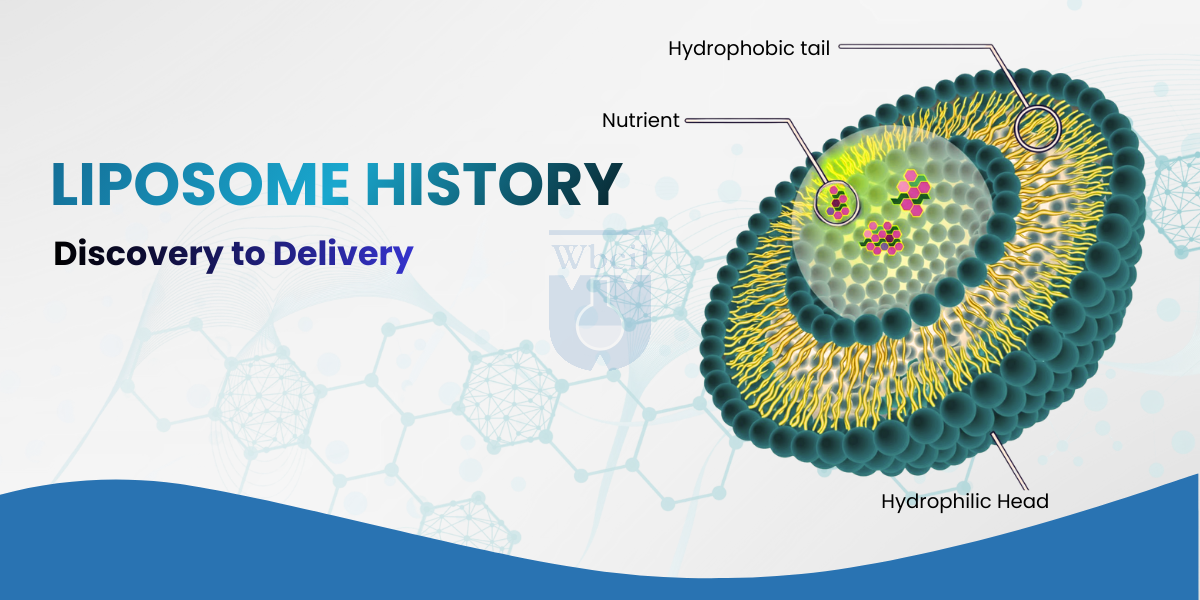
Each cell in our body has a membrane which is composed of a lipid bilayer. The membrane performs many functions, from protecting cells to allowing nutrients to pass through. Liposomes deliver while maintaining bioavailability and stability that traditional formulations could not solve, making it a critical chapter in liposome history.
- Dual Loading Capacity: The liposomal architecture is synthesised to enable encapsulation of water-soluble actives in the middle and fat-soluble actives in the outer bilayer. It is a highlighted characteristic of liposomes.
- Sensitive Actives Protection: Liposomes protect drugs, vitamins, and antioxidants from pH changes, enzymatic reactions, and other instabilities during storage and after administration.
- Delivery Routes Adaptability: Liposomal technology is nowadays prominent within pharmaceutical industries for injectable drugs, oral nutraceuticals, topical cosmeceuticals, and emerging nano-delivery formats.
- Reduced toxicity for potent molecules: Liposomes hallmark characteristic is to protect healthy tissues from aggressive drugs, particularly in oncology and antifungal treatments.
- Higher Bioavailability: Liposomes in medicine reduce the overall premature breakdown and cellular uptake. Moreover, liposome-based therapeutics also enhance the overall fraction of active ingredients.
To understand the history of liposomes in drug delivery, we must know how they became the first proven nanomedicine.
Liposomes as the First Proven Nanomedicine
Lipid-based drug delivery systems are shaping the history of liposomes and are a critical nanomedicine that attracts the interest of pharmaceutical manufacturers. Mostly, it is due to the advantages of liposomes, such as their solubility and bioavailability.
- 1995 FDA approval milestone: The US FDA approval of liposomal doxorubicin (Doxil®) in 1995 marked the first time a nanomedicine entered routine clinical practice, demonstrating that lipid-based carriers could meet regulatory, safety, and quality expectations [1].
- Clinical validation over theory: Once liposomes demonstrated consistent performance in patients, they moved from experimental research into mainstream pharmaceutical development.
- Improved solubility profile: Lipid bilayers enabled the delivery of drugs with poor water solubility, a limitation that had previously restricted many promising molecules.
- Bioavailability Enhancement: Encapsulation safeguards active ingredients and enables better uptake within the target site, especially within the circulatory systems, which helps in advancing therapeutic reliability.
- Manufacturing confidence: The ability to reproduce particle size, stability, and drug loading at scale makes liposomes a dependable nanomedicine platform for drug discovery and development.
Next, let’s examine some of the advantages of liposomal drug delivery, along with the challenges it faces in the pharmaceutical sector.
Benefits and Limits of Liposomal Drug Delivery
Liposomal drug delivery systems are critical for the pharmacokinetics and targeting of certain medications. A recent study suggests that 90% of newly discovered active pharmaceutical ingredients (APIs) are poorly classified, giving liposomes an advantageous position over the modern pharmaceutical industry [2].
Let’s understand some of the prominent benefits of liposomes, which make them a critical choice for liposomal nutraceuticals, liposomal nanomedicine, and liposomal cosmeceuticals.
- Enhanced Drug Solubility: Liposomal advantage over conventional drugs lies in its superior water solubility. Moreover, liposomes can improve the overall solubility of the drugs by trapping compounds in the core, ultimately increasing distribution and absorption.
- Drug Stability: Liposomes protect encapsulated drugs from enzymatic and chemical degradation. Mostly, such actions occur in the bloodstream and gastrointestinal tract, thereby increasing overall shelf life and reducing drug frequency for certain medications.
- Combination Therapy: Liposomes allow multiple actives with different solubility profiles to coexist within a single delivery system. This makes them suitable for combination therapies. Moreover, combinational drugs require synchronised delivery and consistent exposure are without compromising formulation integrity.
- Targeted Drug Delivery: Liposomal carriers influence bio distribution by altering circulation time and tissue interaction. In therapeutic use, this enables higher drug concentration at the intended site while reducing exposure to healthy tissues.
Here are some advantages of liposomes that you should know, which will help you understand their history and extrapolate their future.
- Manufacturing complexity: Scale-up requires precise control over process parameters to maintain batch consistency, underscoring the importance of experienced manufacturing partners.
- Stability considerations: Lipid oxidation, leakage, or molecular aggregation and disruption within the potency rates can occur if storage conditions and excipient quality are disrupted.
- Formulation sensitivity: Liposomal systems are highly dependent on lipid composition, particle size, and encapsulation method. Minor deviations can affect stability and release behaviour.

With a clear understanding of liposome history and its benefits, let’s examine how it plays a vital role across different sectors.
Liposomal Technology Across Medicine, Nutrition, and Skincare
Liposomal technology has moved beyond preliminary research and entered its juvenile stage, becoming a versatile platform across medicine, nutrition, and skincare.
Medicine
In medical use, liposomes enhance pharmacokinetics, protect sensitive actives, and can even focus delivery to specific tissues to improve outcomes and reduce side effects.
- Liposomal CoQ10: A liposome-encapsulated form of ubiquinone designed to improve the stability and bioavailability of this lipid-soluble compound for cardiovascular and cellular energy support in therapeutic formulations.
- Liposomal Alpha Lipoic Acid: Pharma-grade antioxidant with high purity (>99%) that allows for systemic antioxidant defence with carefully synthesised liposomal carriers, reducing oxidative stress-linked conditions.
- Liposomal Curcumin: Curcumin encapsulated in phospholipid vesicles enhances its delivery.
Nutrition
Advanced liposomal systems of West Bengal Chemicals Industries (WBCIL) help increase bioavailability and reduce digestive loss.
- Liposomal Vitamin C: Encapsulation boosts uptake and cellular delivery of vitamin C, improving antioxidant support and potential immune function enhancements.
- Liposomal Glutathione: One of the most potent forms of antioxidant for modern supplements with enhanced absorption, offering improved cellular protection and detox-support compared to standard glutathione supplements.
- Liposomal Zinc: Mineral delivery in a liposomal format supports immune function and metabolic pathways with better uptake and tolerance than traditional zinc forms.
- Liposomal Iron and Calcium: Liposome encapsulated minerals provide energy within the required tissues and bones, which makes it a critical choice for pharmaceutical manufacturers.
Skincare
In cosmeceuticals, liposomal carriers enhance the penetration of active ingredients into the skin, enabling them to reach deeper layers where they can exert measurable effects.
- Glycolic Acid Serum: Advanced liposomal cosmeceuticals use liposome-actives to improve skin penetration, which helps tackle fine lines, uneven tone, and dullness better than conventional skincare products.
- Liposomal Creams: Cream formats that leverage liposomal tech offer improved delivery of anti-ageing or protective ingredients while maintaining skin comfort and hydration.
What Liposome History Means for Today’s B2B Buyers?
Liposome history shows that delivery success relies on formulation precision and manufacturing discipline, not novelty alone. For today’s B2B buyers, liposome history highlights why proven process control ensures consistent quality, scalability, and compliance. Understanding liposome history helps buyers choose partners who deliver stable, reproducible liposomal products in fundamental markets.
Why Choose WBCIL for Liposomal Technology?
Partnering with WBCIL substantiates your position in the liposomal world and enriches you with technical know-how for resilient solutions. Built on decades of WHO-GMP, ISO, and HACCP-certified manufacturing excellence. For B2B buyers, WBCIL liposomal drug delivery expertise depends on commitment to consistent performance, customizable solutions, and documented stability, making it a trusted source for advancing liposomal formulations across industries.

Liposomes were discovered by British haematologist Dr Alec D. Bangham in the mid-1960s, when studying cell membranes with an electron microscope.
The name liposome derives from two Greek words: ‘lipos’, meaning fat, and ‘soma’, meaning body. There is a variety of sizes with unilamellar or multilamellar constructions.
The concept of liposomes relies on spherical lipid sacs that encapsulate active ingredients for targeted delivery of medicines, gene therapies and diagnostics.
Five critical roles of lipids, which ultimately influence liposome functionality, include serving as energy reserves, regulating hormones, facilitating nerve signal transmission, supporting vital organs, and transporting fat-soluble nutrients.
Three of the most common lipids include triglycerides, which help store energy, and phospholipids, a critical lipid component of cell membranes. Sterols, on the other hand, have a vital role in maintaining cell structure and hormones. They form the foundation of lipid functions.