



Ferric Pyrophosphate Uses: From Food Fortification to Sensory Stability
Iron deficiency remains a global challenge and therefore requires effective and sustainable strategies for iron fortification. Ferric pyrophosphate (Fe4(P2O7)3) offers a solution due to its superior sensory stability and reduced reactivity. In contrast to other iron compounds, ferric pyrophosphate maintains the taste and colour of fortified foods. This makes ferric pyrophosphate an ideal choice for fortifying food products and helps in providing nutritional benefits without compromise in taste and appearance.
In this blog, we will understand the ferric pyrophosphate uses, along with a focus on bioavailability and nutrient delivery for sensory acceptance in food fortification.
Takeaways:
● Ferric pyrophosphate enhances bioavailability in food fortification, maintaining taste, colour, and texture without compromising nutritional benefits.
● It solves sensory challenges by reducing metallic taste, preventing browning, and preserving food appearance in sensitive products like dairy.
● Pairing ferric pyrophosphate with enhancers like EDTA and ascorbic acid improves absorption, making it effective for large-scale fortification.

Ferric Pyrophosphate Uses in Food and Beverages Industry
Ferric pyrophosphate uses in food and beverages centre on clean taste and matrix stability, with microencapsulation as a critical tool in sensitive recipes. A trial in Peru for a blueberry-quinoa drink with ferric pyrophosphate indicated a rise in ferritin from 40.67 to 54.19 ng/ml over six months [1].
Here are some ferric pyrophosphate uses in beverages and foods:
● Microencapsulation for Stability: Microencapsulation of ferric pyrophosphate ensures particles are within a carbohydrate or lipid coating. This ensures iron gets protection against oxidation and preserves the flavour of colour in fortified beverages.
● Dairy and Plant-Based Beverages: Ferric pyrophosphate is a suitable compound for milk, soy and oats because of its reduced reactivity. Moreover, the formulation ensures nutritional consistency without changes in taste during storage.
● Cereal and Bakery Products: Baked products and cereal mixes can be fortified with iron pyrophosphate, as it offers high thermal stability and reduced levels of sensory interference. Moreover, controlled particle size enhances its overall integration within extrusion-based products such as fortified rice or biscuits.
● Bioavailability Enhancement with Cofactors: Appropriate integration of ferric pyrophosphate with sodium EDTA, citric acid, and ascorbic acid improves nutrient absorption in the gut. These chelating agents help enhance solubility in the gastrointestinal tract and maintain sensory stability in the food products.
Ferric pyrophosphate with minerals addresses key fortification hurdles by ensuring stable nutrition, product safety, and consistency in taste.
3 Challenges in Iron Fortification and How Ferric Pyrophosphate Helps
Iron fortification in food products often involves bottlenecks while retaining the sensory quality and nutritional value of the product. A study suggests fortified food products can decrease the chances of iron deficiency anaemia among children and decrease prevalence by up to 10% [2]. Ferric pyrophosphate provides a more controlled solubility and neutral flavour within various food systems.
Here are some of the challenges for iron fortification to maintain colour stability and other characteristics of food products:
1. Sensory Challenges
Soluble iron salts, when fortified with food products, provide a metallic taste and often discolour the food particles. In certain cases, it often leads to a rancid taste. In such conditions, ferric pyrophosphate retains its stability, especially within fat-rich food products and enhances the visual efficacy of the fortified products.
2. Difficulty in Nutrient Delivery
The absorption rate of ferric pyrophosphate is quite linear and has a stable nutrient delivery, in contrast to ferrous sulphate. Fortification with cofactors such as EDTA and citric acid helps the iron compounds to release in a stable form without compromising the taste and texture of food products.
3. Maintaining Efficacy in Formulations
Ferric pyrophosphate is an economic choice for organisations aiming for large-scale fortification, and a major example is the use of ferric pyrophosphate in rice fortification due to the maintenance of the neutral taste of rice. With the availability of several iron compounds for fortification, it is critical to isolate the right compound to maintain taste and nutritional efficacy.
Now, let’s explore how ferric pyrophosphate allows enhanced iron absorption within fortified food products.
Enhancing Iron Bioavailability from Ferric Pyrophosphate in Fortified Products
Dietary modifications with fortified foods allow for up to 70% of iron storage, which is far greater than other strategies [3]. Another research suggests that the bioavailability of ferric pyrophosphate is 57% in fortified rice [4]. The research indicates a definite need for cofactor and vehicle adaptation to deliver a nutritional impact.
Here are some of the key considerations for ferric pyrophosphate absorption and bioavailability:
● Particle Size: Microionised forms of ferric pyrophosphate have a relative bioavailability (RBV) of 15% to 75% in a clinical trial compared to ferrous sulphate [5]. Such a difference is due to the particle size, along with the matrix and vehicle of delivery.
● Co-fortification with Enhancers: In extruded rice fortified with ferric pyrophosphate and zinc sulphate, the fractional absorption was recorded as 4.5% and RBV of 62% compared to ferrous sulphate.
● Management of inhibitors: Calcium and polyphenols are responsible for reducing iron absorption. Ferric pyrophosphate is a vehicle with low inhibitors, making it easier to add ascorbic acid.
Next, let’s understand how ferric pyrophosphate retains sensory stability by the appropriate preservation of the colour and texture of food and beverages.
Sensory Stability of Ferric Pyrophosphate
Ferric pyrophosphate helps preserve the colour, flavour, and texture of food products at demanding storage conditions.
Here’s how ferric pyrophosphate maintains uniform sensory attributes during food fortification:
● Neutral Taste: A low solubility of ferric pyrophosphate makes it a suitable choice for fat and protein-rich foods. Moreover, it is the preferred iron source for flavoured milk, fruit beverages, and cereal mixes.
● Colour Preservation: Traditional ferrous salts tend to darken food products; however, ferric pyrophosphate retains the visual appeal of food and prevents the occurrence of browning.
● Oxidation Control: Oxidative catalysis is reduced due to the use of ferric pyrophosphate, and the inert nature of the compound helps avoid the development of pungent odours that are predominant with fortified formulations using ferrous compounds.
● Heat and pH Stable: Ferric pyrophosphate is not heat labile and can sustain rapid variations in pH levels. Therefore, is a stable compound for large-scale production and distribution of fortified foods.
Let’s explore the difference between ferric pyrophosphate and traditional iron compounds, which are popular in large-scale food industries for fortification.
Ferric Pyrophosphate vs. Other Iron Sources in Food Fortification
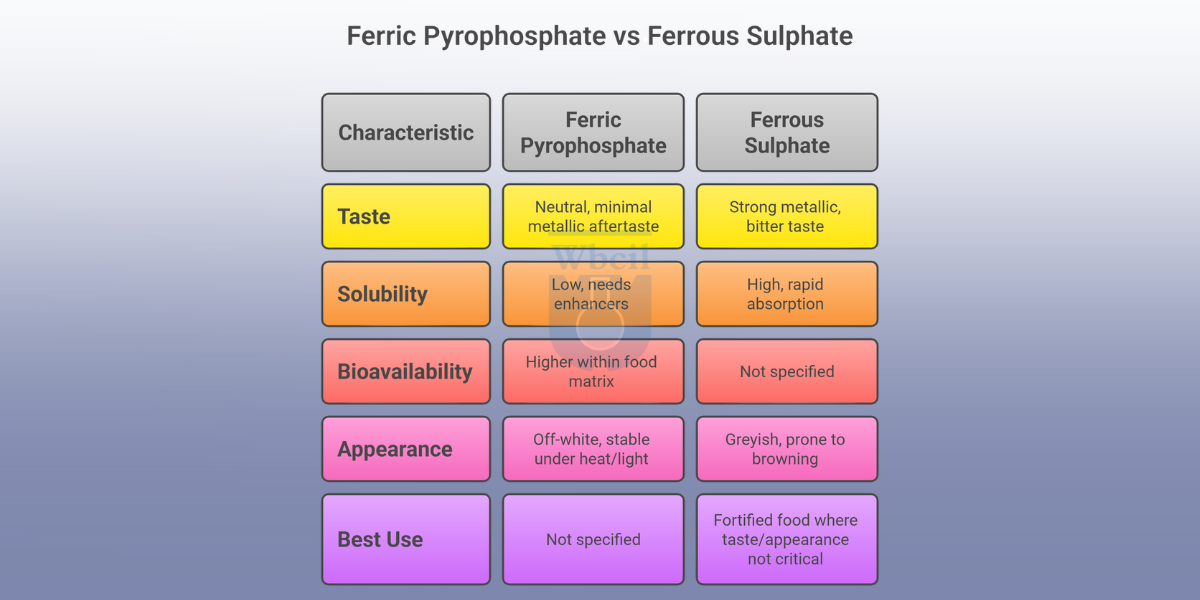
Ferrous compounds have a higher baseline absorption; however, these compounds tend to disrupt the taste and colour of food products. It is evident in dairy and rice products as they have a neutral taste. On the other hand, ferric pyrophosphate, with its strong oxidative stability, makes it a credible choice for food fortification. Here’s a difference between ferrous salts, such as ferrous sulphate (FeSO4) and ferric pyrophosphate:
Ferric Pyrophosphate
● Neutral taste with minimal metallic aftertaste.
● Low solubility in water and needs enhancers for higher levels of absorption.
● Higher bioavailability and relative bioavailability within the food matrix.
● Off-white colour compound which is stable under heat and light.
Ferrous Sulphate
● Strong metallic and bitter taste, which is detectable in fortified foods.
● Greyish appearance and prone to browning.
● Ideal for fortified food where taste and appearance are not critical.
● High solubility rates with rapid absorption often lead to compromise in sensory profiles.
Partner with WBCIL for Smarter Iron Fortification
Ferric pyrophosphate offers a valuable solution for iron fortification, maintaining sensory quality and nutritional demands. Appropriate pairing of ferric pyrophosphate with co-factors optimises the overall fortification process. Therefore, with careful formulation, manufacturers can enhance the overall rate of absorption and consumer acceptance in fortified food products.
West Bengal Chemical Industries (WBCIL) is a leading manufacturer of high-quality ferric pyrophosphate, which is prevalent in food and beverage fortification. WBCIL positions itself as a Global API partner and supplies across 60+ ountries. As a leading API manufacturer, WBCIL prioritises strict ISO and GMP and WHO standards throughout the entire production process. Ferric pyrophosphate offers exceptional stability and minimal sensory impact, and its hygroscopic nature supports longer shelf life.

1. https://www.frontiersin.org/journals/nutrition/articles/10.3389/fnut.2025.1639894/full
2. https://pmc.ncbi.nlm.nih.gov/articles/PMC7882371/
3. https://link.springer.com/content/pdf/10.1007/s10534-024-00659-1.pdf
4. https://pubmed.ncbi.nlm.nih.gov/28148685/
5. https://www.cambridge.org/core/services/aop-cambridge-core/content/view/10595DEBAC33772E994EC2F345C4A87E/S0007114504000133a.pdf/a-micronised-dispersible-ferric-pyrophosphate-with-high-relative-bioavailability-in-man.pdf
Ferric pyrophosphate delivers iron without altering the flavour and taste in fortified foods. The overall low solubility and chemical stability make it a viable choice for products such as rice, cereals, and more.
Ferric pyrophosphate helps in maintaining sensory stability and prevents oxidation and metallic taste, which are common for ferrous sulfate fortified foods. Moreover, the colour and texture of the food are retained; therefore, ferric pyrophosphate is a vital compound for food products sensitive to flavour and visual changes.
Ferric pyrophosphate is an ideal choice for taste-sensitive food, and ferrous sulphate can be selected for food with higher bioavailability needs. Its balanced profile of stability and taste, making advantages, ensures fortified foods retain the integrity of the food.
Iron stability is enhanced when ferric pyrophosphate is protected with microencapsulation or liposomal technology. Such encapsulation prevents the oxidation levels during the process and storage. The addition of ascorbic acid or EDTA further supports stability and nutrient uptake.
Ferric pyrophosphate uses in supplements focus on solving sensory challenges in fortified foods by offering iron fortification without the presence of metallic aftertaste. Tablets and powdered formulations are common end products as they retain well-tolerated iron whilst maintaining potency and efficacy.