

Biopharma SHAKTI Initiative: Why WBCIL Leads the Shift
The Biopharma SHAKTI initiative marks a strategic inflexion point for India’s pharmaceutical manufacturing sector, with a clear emphasis on high-value, technically complex APIs. Regulatory authorities and global procurement bodies now evaluate structural integrity, reproducibility, and dossier completeness with greater scrutiny.
Capital allocation increasingly favours manufacturers with defined critical quality attributes, controlled impurity pathways, and validated scale consistency. The transition from volume-driven generics to science-led drug substances requires measurable analytical depth and regulatory alignment.
In this blog, the policy’s implications for complex iron API manufacturing and injectable-grade substrates are the focus of a technical analysis.
Key Takeaways:
- Capital support prioritises complex APIs with defined structural and analytical validation frameworks.
- Regulatory evaluation now centres on reproducibility, comparability, and impurity control metrics.
- Iron oligosaccharide APIs are gaining strategic importance due to high technical and compliance requirements.
Quick answer: Biopharma SHAKTI enhances technically advanced API manufacturers with validated processes and global regulatory readiness.
What Is the Biopharma SHAKTI Initiative?
The Biopharma SHAKTI initiative is a national programme to accelerate India’s ability to make high-value biologic and biopharmaceutical products.
- It was launched in the Union Budget 2026–27 with a total fund of ₹10,000 crores over five years to support advanced drug development and manufacturing [1].
- SHAKTI stands for Strategy for Healthcare Advancement through Knowledge, Technology, and Innovation, reflecting a shift toward science-intensive medicines.
- The programme aims to make India a global hub for biologics and biosimilar, expanding research, production and export capability.
- It plans to create a network of over 1,000 accredited clinical trial sites to support thorough clinical assessment and evidence-based product validation.
- The scheme will also strengthen regulatory capacity by building specialised review expertise in the Central Drugs Standard Control Organisation (CDSCO) [2].
Also read: From Micro to Nano: The Evolution of Iron Encapsulation Technology.
Why Complex Iron APIs Matter Under This Scheme
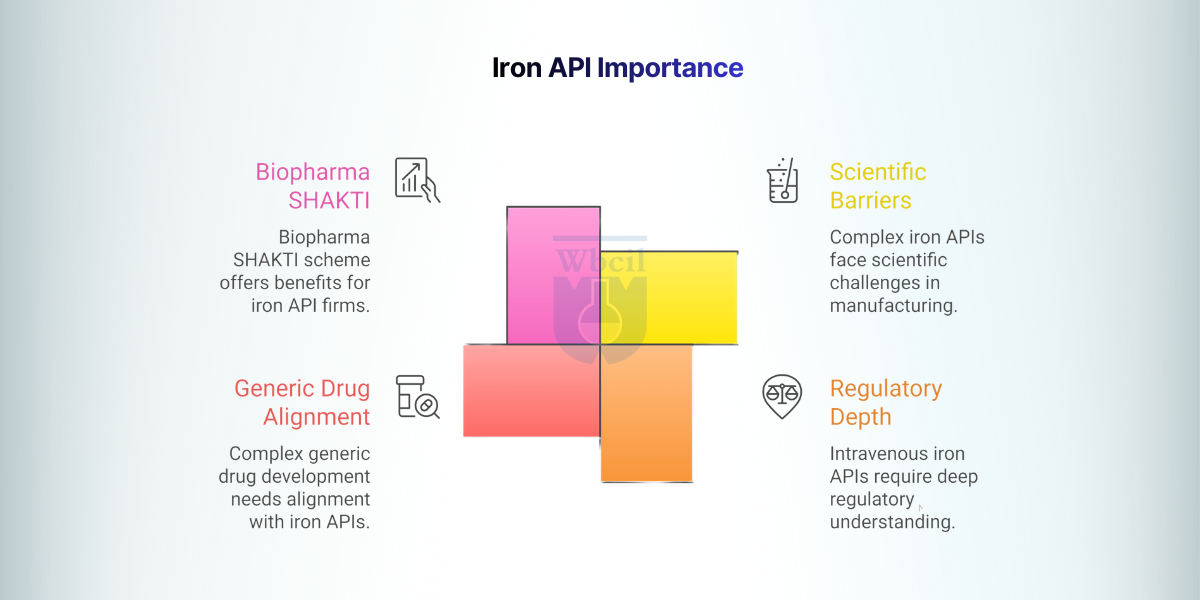
The Biopharma SHAKTI initiative prioritises advanced drug substances such as complex intravenous iron APIs due to their scientific and regulatory depth.
1. Scientific Barriers in Complex Iron API Manufacturing
Complex iron API manufacturing requires precise control over iron core structure and carbohydrate architecture. You must maintain a narrow molecular weight distribution and a defined particle size range. Even small deviations affect pharmacokinetics, safety profile, and regulatory classification.
2. Regulatory Depth in Intravenous Iron APIs Manufacturing
According to the World Health Organisation, anaemia affects about 40% of children worldwide [3]. Intravenous iron API manufacturing attracts scrutiny similar to that of biosimilar assessment in regulated markets. You must submit detailed physicochemical characterisation, impurity profile, and stability data. Free iron levels must remain within strict pharmacopoeial limits to ensure patient safety.
3. Alignment with Complex Generic Drug Development
Complex generic drug development requires structural and functional equivalence to the reference product. It is important to demonstrate comparable release kinetics and transferrin binding behaviour. Regulators evaluate API purities on the totality of the evidence, not a single chemical assay.
4. Biopharma SHAKTI Scheme Benefits for Iron API Firms
The Biopharma SHAKTI scheme benefits include regulatory capacity expansion and structured scientific review support. India ranks third globally in pharmaceutical production by volume but eleventh by value.
High-value iron APIs support value correction within this national policy framework.
Who Is WBCIL?
West Bengal Chemical Industries Limited (WBCIL) is one of India’s oldest and most established active pharmaceutical ingredient (API) manufacturers, serving global markets with precision-engineered chemical solutions.
Here’s a closer look at WBCIL:
- WBCIL has over 60 years of manufacturing expertise in APIs, fine chemicals, mineral salts, and related applications and technologies for pharmaceutical and allied industries.
- The company operates WHO-GMP, ISO, GLP, HACCP, and related compliance programmes that ensure products meet global regulatory and quality requirements across formulations.
- Its API portfolio includes iron, calcium, magnesium, potassium, and zinc salts, as well as trace elements such as copper, manganese, and chromium, for a wide range of pharmaceutical uses.
- WBCIL produces advanced iron APIs, such as ferric derisomaltose and iron isomaltoside, as well as nutraceutical ingredients tailored for modern formulation platforms.
- The company holds 16 patents for innovative synthesis methods in complex API manufacturing, which reinforce its technical edge and intellectual property strength.
Now, let’s understand the complexity of manufacturing and compliance for ferric derisomaltose, and how WBCIL addresses these challenges.
Ferric Derisomaltose API: Complexity Explained
Ferric Derisomaltose represents one of the most technically demanding iron oligosaccharide APIs in modern parenteral therapy.
- Ferric derisomaltose consists of a ferric hydroxide core tightly bound to a derisomaltose carbohydrate matrix. Minor structural deviation can alter the pharmacokinetic profile and clinical safety margins.
- In complex iron API manufacturing, the process must control particle size distribution and free iron levels within defined limits. It is critical to validate each batch through advanced analytical techniques such as NMR and XRD.
- Stability behaviour requires close moisture control due to the API’s hygroscopic nature. Controlled packaging and validated storage protocols for bulk supply are key physicochemical and functional equivalence data that are fundamental.
- In complex generic drug development, regulators assess structural comparability and release kinetics relative to reference products.
How WBCIL solves such inconsistencies:
- Higher Scalability: WBCIL standardises critical reaction parameters during scale transition to prevent molecular drift. It ensures structural reproducibility across pilot, validation, and commercial batches.
- Regulatory Documentation: Dossiers include defined critical quality attributes, impurity mapping, and comparability matrices. The documentation supports complex generic submissions in regulated jurisdictions.
- Long-term Supply Chain Standardisation: Dual-site manufacturing capability across Kolkata and Dahej reduces operational concentration risk. Structured quality systems support consistent supply for high-value injectable iron
Next, let’s explore some of the benefits of the Biopharma SHAKTI initiative for iron API firms.
Biopharma SHAKTI Scheme Benefits for Iron API Firms
The Biopharma SHAKTI initiative creates a policy climate that favours manufacturers capable of producing technically complex, regulator-ready iron APIs.
Here are some of the benefits that API firms can have with the initiative:
- Policy focus on advanced drug substances increases recognition of iron oligosaccharides as strategic assets rather than commodity salts. This shift supports stronger pricing discipline in global procurement markets.
- National backing for science-led API production improves investor perception of technically intensive manufacturers. Firms with proprietary process capabilities have greater valuation potential.
- Structured regulatory emphasis on complex molecules enhances confidence among multinational formulation partners. Established iron API manufacturers benefit from clearer alignment with compliance requirements.
- High-barrier APIs, such as ferric complexes, attract fewer qualified suppliers. Limited supplier concentration strengthens long-term contract stability.
- Capital support for advanced pharmaceutical capability signals a durable state commitment to high-margin segments. Iron API firms with established GMP infrastructure align naturally with this strategic direction.
Also read: Iron Isomaltoside API – Pharmaceutical Quality Iron Supplement.
The Impact of Biopharma SHAKTI on API Manufacturers in India
The Biopharma SHAKTI initiative introduces a structural recalibration of India’s API sector toward high-complexity chemistries that demand validated process reproducibility and dossier-grade characterisation depth. This policy direction emphasises defined critical quality attributes, impurity fingerprint mapping, polymorphic control, and statistically validated batch-to-batch consistency across commercial-scale production. Indian API manufacturers with established capability in macromolecular complexes, controlled-release parenteral substrates, and regulatory-aligned documentation frameworks gain a measurable advantage in global tender participation.
Sourcing Bulk Ferric Derisomaltose
Sourcing bulk Ferric Derisomaltose requires evaluation beyond assay purity and price benchmarking, as structural integrity, free iron control, and defined molecular weight distribution determine regulatory acceptability. Procurement teams must assess parenteral-grade compliance, validated stability data, impurity profiling, and documented comparability against reference standards to support complex injectable dossiers. Selection of a GMP-certified iron API manufacturer with proven analytical infrastructure and proprietary synthesis capability, supported by WBCIL Innovation R&D, strengthens supply reliability and regulatory confidence.
A Final Word
India’s pharmaceutical value chain now aligns more closely with high-margin, science-intensive drug substances. Advanced injectable APIs require documented structural control, validated comparability data, and consistent batch reproducibility.
Manufacturers must strengthen analytical capabilities, regulatory documentation architecture, and process-scale validation. Alignment with the Biopharma SHAKTI initiative demands sustained research investment and structured quality governance.
Established Indian manufacturers such as WBCIL reflect how long-term technical discipline and proprietary process development support durable global credibility.

Manufacturing Ferric Derisomaltose API requires controlled coordination of ferric hydroxide with derisomaltose under validated reaction conditions. Complex iron API manufacturing must ensure a defined molecular-weight distribution and strict free-iron limits to meet regulatory expectations.
Regulatory requirements for complex iron APIs include detailed physicochemical characterisation, impurity profiling, and defined critical quality attributes. Within complex generic drug development, authorities assess structural comparability and release kinetics relative to reference products.
Reducing immunogenicity in IV iron drugs depends on tight control of free iron content and stable carbohydrate encapsulation. Intravenous iron APIs must be manufactured to demonstrate consistent molecular size distribution and controlled iron release behaviour.
Ferric Derisomaltose stability data for formulation must include accelerated and long-term studies under defined storage conditions. Data should confirm structural integrity, impurity stability, and the maintenance of free iron limits throughout shelf life.
Impact of Biopharma SHAKTI on API manufacturers includes a stronger focus on high-complexity APIs and validated process control. The policy direction supports cost-effective manufacturing of iron oligosaccharides through structured regulatory alignment and long-term capital backing.