Impact of Magnesium Lactate on Syneresis & Texture in Fat-Free Yogurt
Magnesium Lactate on Syneresis and Texture in Fat-Free Yogurt
The dairy industry is currently navigating a “health-first” transition. As consumers demand low-calorie, high-protein options, fat-free yogurt has become a market staple. However, removing milk fat introduces a significant technical hurdle: the loss of structural integrity.
Without fat globules to bolster the protein network, these yogurts often suffer from poor mouthfeel and whey-off, scientifically known as syneresis.
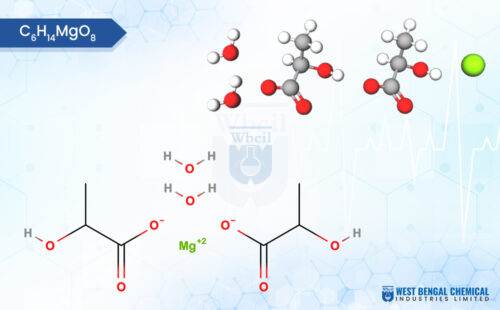
At WBCIL (West Bengal Chemical Industries Limited), we specialize in high-purity mineral salts that bridge the gap between nutritional fortification and structural excellence. Research indicates that magnesium lactate in fat-free yogurt acts as more than just a nutrient; it is a powerful functional additive.
Understanding the “Fat-Free” Dilemma: Syneresis and Texture
In full-fat yogurt, fat globules are interspersed within the casein micelle network, acting as “spacers” that prevent the protein matrix from over-contracting. In fat-free versions, the casein network is often too tight and brittle.
Key Takeaways
- Superior Syneresis Control: Magnesium lactate significantly reduces “whey-off” in fat-free yogurt by strengthening the casein protein network and increasing its water-holding capacity (WHC) by up to 15%.
- Enhanced Textural Profile: It acts as a functional “texturizer” that restores the hardness and viscosity lost during fat removal, providing a smoother mouthfeel and more stable gel structure without the need for synthetic stabilizers.
- High Bioavailability & Stability: As an organic mineral salt, it offers superior solubility and bioavailability compared to inorganic alternatives (like MgO), while simultaneously supporting the metabolic activity and stability of starter cultures during fermentation.

What is Syneresis?
Syneresis is the expulsion of whey from the yogurt gel. It occurs when the protein network collapses, squeezing out the liquid trapped within. For a consumer, this appears as an unappetizing layer of water on top of the product. Syneresis control in fat-free yogurt is the primary challenge for dairy technologists seeking to maintain a clean label while ensuring a premium experience.
How Magnesium Lactate Reduces Syneresis
The introduction of divalent cations, specifically magnesium, plays a critical role in stabilizing the dairy matrix. Unlike harsher salts, magnesium lactate reduces syneresis by modifying the way casein micelles interact during fermentation.
1. Strengthening the Casein Cross-Linking
Magnesium ions facilitate “salt bridges” between phosphate groups in the casein molecules. This creates a more elastic, resilient gel. Data suggests that at a concentration of 0.1% to 0.2% fortification, the water-holding capacity (WHC) of the yogurt increases by up to 15%.
2. Stabilization of the Hydration Layer
Lactate anions are highly compatible with dairy systems. Compared to inorganic salts like magnesium chloride, magnesium lactate is organic and less likely to cause protein “salting out.” This ensures that the hydration layer around the proteins remains intact, trapping water effectively within the matrix.
Yogurt Texture Improvement Without Fat
Texture is a multi-dimensional attribute involving hardness, viscosity, and adhesiveness. Without fat, yogurt often feels “thin” or “chalky.” Yogurt texture improvement without fat is achievable through strategic mineral choice.
Hardness and Viscosity Metrics
In rheological studies, the magnesium lactate fortification effect on yogurt hardness and viscosity shows a positive correlation.
- Viscosity: Fortified samples often display a smoother flow curve.
- Hardness: The gel strength (measured in Newtons) increases because the magnesium ions help form a more continuous and uniform protein network.
| Attribute | Control (Fat-Free) | Fortified (0.15% Mg Lactate) |
| Syneresis (%) | 28% | 18% |
| Viscosity (mPa·s) | 1200 | 1450 |
| pH Stability | 4.2 | 4.4 |
Mineral Fortification in Dairy Products: Choosing the Right Salt
When manufacturers look for the best mineral fortification for improving fat-free yogurt texture, they often compare magnesium salts.
Magnesium Salts vs. Magnesium Lactate for Yogurt Fortification
Magnesium Oxide/Carbonate: These have low bioavailability and can cause a gritty texture or a “chalky” aftertaste.
Magnesium Sulfate: Often imparts a bitter metallic note that interferes with the delicate flavor of yogurt.
Magnesium Lactate: Offers high bioavailability, a neutral flavor profile, and superior solubility. It is the gold standard for mineral fortification in dairy products because it supports both the health claims and the physical structure of the food.
Starter Culture Stability in Fortified Yogurt
A common concern in fortification is whether the mineral will inhibit the growth of Lactobacillus bulgaricus and Streptococcus thermophilus.
Starter culture stability in fortified yogurt is actually enhanced by magnesium. Magnesium is a known cofactor for several glycolytic enzymes in lactic acid bacteria. This means that adding magnesium lactate can actually support the fermentation process, leading to a more consistent pH drop and a finer curd structure.
Formulation Strategy to Reduce Whey-Off in Fat-Free Yogurt
To achieve the best results, a formulation strategy to reduce whey-off in fat-free yogurt should follow these steps:

Why Choose WBCIL Food Grade Magnesium Lactate?
As a leading magnesium lactate supplier for dairy applications, WBCIL provides a high-purity, FCC-grade product designed specifically for sensitive food matrices. Our WBCIL food grade magnesium lactate is manufactured under stringent quality controls, ensuring:
- Ultra-low heavy metal content.
- Superior solubility in cold and warm milk.
- Neutral sensory profile that does not mask yogurt aromatics.
Conclusion
The data is clear: magnesium lactate is a dual-purpose powerhouse for the dairy industry. It satisfies the consumer’s need for functional, mineral-rich foods while solving the manufacturer’s headache regarding texture and syneresis. By reinforcing the protein matrix at a molecular level, it allows for a fat-free product that doesn’t feel “free” of quality.

No. Unlike magnesium sulfate or chloride, magnesium lactate has a neutral flavor profile, making it ideal for delicate dairy applications.
Yes. In fact, it is highly effective in Greek yogurt to further stabilize the dense protein structure and prevent liquid separation during storage.
By improving the water-holding capacity and supporting starter culture stability, magnesium lactate helps maintain a consistent texture throughout the product’s shelf life, reducing the “aging” effect of whey-off.
Magnesium lactate is generally recognized as safe (GRAS) and is viewed as a mineral fortificant, which aligns well with consumer-friendly labeling.