Potassium Acetate Uses: Strategic API Choice Beyond Chloride
Potassium acetate is one of those compounds that quietly powers some of the most critical processes in modern science, medicine, and industry, yet it rarely receives the attention it deserves. From stabilising IV fluids in intensive care units to preserving refrigerated seafood and buffering cosmetic formulations, its functional range is genuinely broad.
If you work in pharmaceuticals, food manufacturing, agriculture, or molecular biology, understanding this compound in depth can meaningfully inform your sourcing, formulation, and application decisions.
In this blog, we break down potassium acetate uses from its clinical role in IV therapy to food additive applications.
Key Takeaways:
- Potassium acetate is metabolically alkalinising, making it clinically distinct from potassium chloride in IV and TPN use.
- As a food additive, E261 carries no numerical ADI, indicating an exceptionally well-established safety profile.
- In agriculture, it outperforms potassium chloride for chloride-sensitive crops without acidifying the soil over time.
Quick Answer: Potassium acetate is a versatile potassium salt used in IV fluids, food preservation as E261, cosmetic pH buffering, DNA extraction protocols, and agricultural nutrition.

Potassium Acetate vs Potassium Chloride in IV Fluids
Potassium acetate and potassium chloride are both IV potassium replacement agents used to correct hypokalemia. However, they differ significantly in their metabolic effects, clinical indications, and compatibility profiles.
Here is a tabular representation to understand the difference between the two:
| Parameter | Potassium Acetate | Potassium Chloride |
| Metabolic effect | Acetate is metabolised to bicarbonate, mildly alkalinising | Chloride load may contribute to hyperchloremic acidosis |
| Primary indication | Hypokalemia with concurrent metabolic acidosis or chloride restriction is needed | Standard hypokalemia replacement; hypokalemic metabolic alkalosis |
| Preferred in TPN | Yes, frequently used in parenteral nutrition to limit Cl⁻ load | Less preferred in TPN; used, but potassium acetate is favoured |
| Key clinical consideration | Preferred when chloride restriction is necessary (e.g., hyperchloremia, renal tubular acidosis) | First-line in most clinical settings; corrects hypokalemia with concurrent hypochloremia or alkalosis |
Beyond critical medical therapies, versatile potassium acetate uses help you stabilise commercial food products and preserve cosmetic formulas.
Potassium Acetate Uses in Food & Cosmetics
Potassium acetate functions as a pH-lowering preservative in processed foods, including sauces, soups, and snack products. It inhibits bacterial, yeast, and mould growth by creating an acidic environment hostile to microbial activity.
EFSA affirms that it carries no numerical ADI, as acetate salts are rapidly metabolised and do not accumulate in the body.
1. Sodium Reduction and Low-Sodium Food Formulation
Potassium acetate serves as a sodium-free alternative to sodium acetate and sodium diacetate in low-sodium food manufacturing. It provides a comparable antimicrobial effect without raising sodium intake, though a slight metallic taste may occur at higher concentrations. It makes E261 a key reformulation tool as manufacturers respond to the WHO’s global sodium reduction guidelines.
2. Antimicrobial Efficacy in Refrigerated Seafood and Meat Products
Potassium acetate combined with potassium lactate enhanced the sensory quality and extended the shelf life of refrigerated catfish fillets. Treated fillets showed lower psychrotrophic plate counts on days 7, 10, and 14 of storage at 4°C [2]. Sodium acetate at 1% concentration reduced aerobic plate counts by 0.6-0.7 log units, extending microbiological shelf life to 12 days.
3. pH Buffering Function in Cosmetic Formulations
Potassium acetate acts as a buffering agent in personal care products, stabilising pH within ranges compatible with the skin’s acid mantle. A study of 66 cosmetic preparations found that only 23 had an appropriate pH of ≤5.5, highlighting the continued underappreciation of pH control in barrier-protective formulations [3].
4. Skin Barrier Support and the Acid Mantle Relationship
Acidic skin surface pH regulates stratum corneum homeostasis, barrier permeability, keratinocyte differentiation, epidermal lipid function, and the skin microbiome. A 4-week randomised study found pH 4 emulsions superior to pH 5.8 formulations for moisturising efficacy and lipid lamellae regeneration [4]. Potassium acetate’s buffering capacity makes it a functionally meaningful ingredient in barrier-focused skincare products.
Also read: Biopharma SHAKTI Initiative: Why WBCIL Leads the Shift

Specialised Uses: DNA Extraction & Agriculture
Potassium acetate serves critical specialised roles beyond food and medicine, functioning as a precision reagent in molecular biology’s DNA extraction protocols and as a multifunctional agricultural input that affects soil chemistry, crop physiology, and microbial ecology.
Here are two potassium acetate uses you must know:
DNA Extraction
- Protein precipitation agent: Potassium acetate is used in the alkaline lysis method of plasmid DNA extraction, where it precipitates denatured proteins, genomic DNA, and SDS complexes, leaving purified plasmid DNA in the supernatant.
- Optimal concentration and pH: A potassium acetate solution at pH 4.8, typically prepared at 3M or 5M concentration, is the standard formulation used in step 3 of the widely cited Birnboim-Doly alkaline lysis protocol.
- Mechanism of selectivity: The acetate ion lowers pH sharply upon addition to the alkaline lysate, re-naturing plasmid DNA while irreversibly aggregating chromosomal DNA fragments and proteins into a distinct white precipitate.
Agriculture
- Chloride-sensitive crop nutrition: Potassium acetate is particularly valuable for chloride-sensitive crops, including tobacco, avocado, citrus, and berry fruits, where potassium chloride fertilisation causes leaf scorch, chloride toxicity, and measurable yield suppression.
- Soil pH neutrality advantage: Unlike potassium chloride, which acidifies soils over repeated applications, potassium acetate’s acetate anion is metabolised by soil microorganisms into CO₂ and water, leaving a comparatively neutral to slightly alkaline residual effect.
- Foliar absorption efficiency: Foliar-applied potassium acetate is absorbed through the leaf cuticle more efficiently than ionic potassium salts, with acetate’s character facilitating membrane permeability and reducing the surface tension barrier at the leaf surface.
Also read: How WBCIL Supports Custom Pharmaceutical Formulation for New Brands.
Sourcing a Potassium Acetate Bulk API Supplier
Sourcing a potassium acetate bulk API supplier requires rigorous evaluation of manufacturing credentials, regulatory compliance, and supply chain reliability. WBCIL (West Bengal Chemical Industries Limited) is a well-established potassium acetate bulk API supplier, offering GMP-compliant production, pharmacopoeial-grade material conforming to IP/BP/USP specifications, and documented traceability from raw material intake through finished batch release.
When procuring potassium acetate at bulk scale, buyers should verify Certificate of Analysis parameters, including assay purity, heavy metal limits, pH range, and water content. Moreover, supplier audits, regulatory filing support, and cold-chain logistics capability are also critical factors.
Final Thoughts
Understanding the full spectrum of potassium acetate uses empowers professionals across pharmaceuticals, food science, and agriculture to make safer, more informed decisions. Always cross-reference pharmacopoeial specifications and regulatory approvals relevant to your specific application before finalising any formulation. When procuring at bulk pharmaceutical grade, partnering with a GMP-compliant manufacturer with documented batch traceability makes a measurable difference in product quality. WBCIL is one such brand with a well-established presence in this space.

- PubChem. Potassium acetate. [online] pubchem.ncbi..
- Kin, S., Schilling, M.W., Smith, B.S., Silva, J.L., Kim, T., Pham, A.J. and Campano, S.G. (2011). Potassium Acetate and Potassium Lactate Enhance the Microbiological and Physical Properties of Marinated Catfish Fillets. Journal of Food Science, 76(4), pp.S242–S250.
- Wohlrab, J. and Gebert, A. (2018). pH and Buffer Capacity of Topical Formulations. pH of the Skin: Issues and Challenges, [online] 54, pp.123–131.
- Kilić, A., Masur, C., Reich, H., Knie, U., Dorothee Dähnhardt, Dähnhardt‐Pfeiffer, S. and Abels, C. (2019). Skin acidification with a water‐in‐oil emulsion (pH 4) restores disrupted epidermal barrier and improves structure of lipid lamellae in the elderly. The Journal of Dermatology, 46(6), pp.457–465.
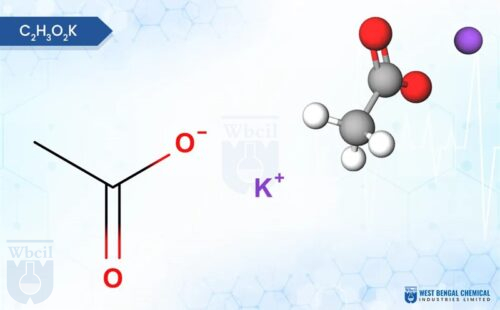
Potassium acetate is a compound with remarkably broad utility, spanning clinical medicine, food technology, cosmetics, molecular biology, and agronomy. Its functional versatility stems from its ionic dissociation into K⁺ and acetate⁻, each carrying independent biological and chemical activity in different systems.
The critical distinction lies in the anion; acetate is metabolically active and alkalinising, while chloride is physiologically inert in acid-base terms. This chooses between the two a clinical decision driven by the patient’s acid-base status, not just their potassium deficit.
Regulatory bodies globally evaluate food additives on a tiered safety spectrum, and potassium acetate sits at the most favourable end, with no quantitative intake restriction deemed necessary. Its metabolic fate is identical to naturally occurring acetate in the body, which significantly underpins its favourable toxicological profile.
Its role is purely physicochemical; it exploits the differential renaturation behaviour of plasmid versus chromosomal DNA under acidic conditions to achieve selective separation. No other common reagent replicates this combination of sharp pH drop and ionic precipitation in a single addition step.
The preference is rooted in plant physiology; some crops have genetically low chloride tolerance thresholds that potassium chloride routinely exceeds, regardless of application rate. Potassium acetate sidesteps this entirely by delivering potassium via an anion that the soil ecosystem naturally processes, leaving no phytotoxic residue.