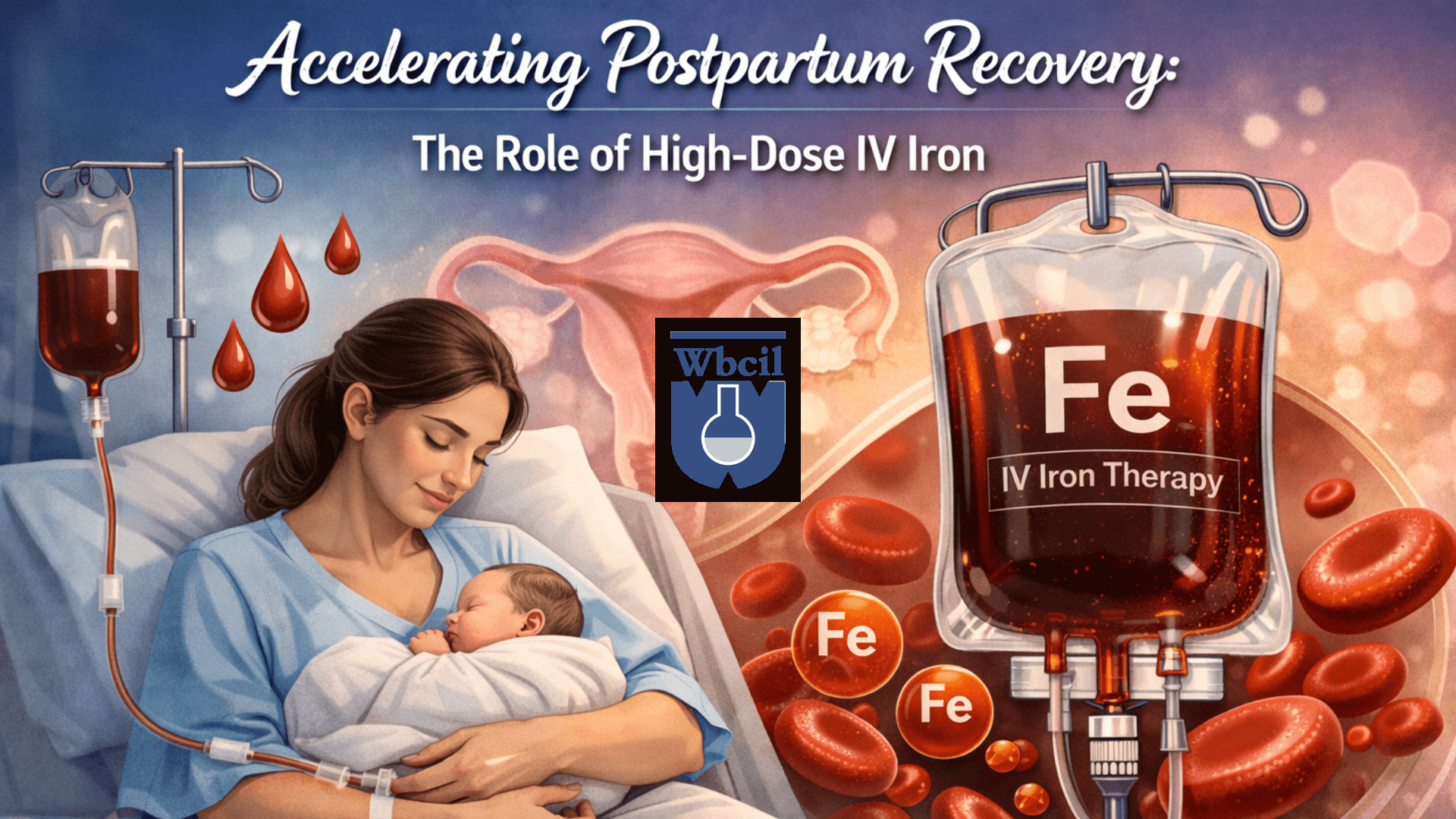
The Role of High-Dose IV Iron In Accelerating Postpartum Recovery
Unseen Struggles of Life After Birth
She’s just done something incredible. She carried, nurtured, and brought a new life into the world. But now just three weeks after giving birth, she struggles to climb a single flight of stairs without needing to stop halfway. Her arms feel heavy when holding her baby. Her mind is so clouded that she can’t even finish her own sentences without losing track. Her family calls it “baby blues.” Her doctor says it will go away. It doesn’t — because the problem isn’t emotional. It’s physical.
This is the Postpartum Shadow. It describes severe iron deficiency anaemia (IDA) that impacts about 10 to 27 per cent of women in wealthier countries and as many as 50 per cent of women in poorer regions after giving birth. It is not a mental health issue but a blood condition. Yet, countless mothers going through the tough challenges of the first 12 weeks after delivery, often called the “fourth trimester,” still face this condition being overlooked, under-treated, and underestimated.
Doctors now see IV iron as the go-to treatment to help women recover from moderate-to-severe postpartum IDA. This post examines why oral iron supplements often do not work well, explains how high-dose IV iron works in the body, and highlights the importance of using top-quality, pharmaceutical-grade iron for every mother who receives this treatment.
“I told my midwife it felt like I was sinking in slow motion,” says a 31-year-old new mother from Kolkata who lost about 900 mL of blood during an emergency C-section. “Three days after getting the IV iron treatment, I started to feel normal again after months.”
Key Takeaways:
- The regulatory evaluation of liposomal delivery systems is a critical process that ensures complex lipid-based formulations meet the same rigorous safety and efficacy standards as traditional pharmaceuticals.
- To achieve market approval, manufacturers must provide extensive physicochemical characterization, including data on particle size, morphology, and encapsulation efficiency, to confirm the structural integrity of the vesicles.
- By adhering to these strict pharma manufacturing standards and quality-by-design principles, companies like WBCIL guarantee that their liposomal products offer predictable, high-performance nutrient delivery.
Why the “Wait and See” Method Fails?
Why does IV iron work quicker than oral tablets for postpartum recovery?
Doctors often prescribe ferrous sulfate tablets and tell patients to wait a few weeks because this approach stems from older pharmacological ideas. These ideas existed before we understood how iron loss works after childbirth. A protein called Divalent Metal Transporter-1 (DMT-1) controls how non-heme iron is absorbed in the gut. This transporter sits in the lining of the small intestine and can handle so much iron at once. After childbirth, stress on the body causes problems like inflammation, increased hepcidin levels, and slow digestion. These issues reduce the effectiveness of this transporter.
This leads to what’s called an “Oral Bottleneck.” Even if a new mom takes her 200 mg ferrous sulfate pills twice a day, her body might absorb only 3 to 8 mg of iron. With this limited absorption, it could take 12 to 16 weeks to fix a 30 to 40 g/L drop in haemoglobin, which is pretty common with moderate postpartum anaemia. All the while, she’s breastfeeding around the clock, dealing with extreme tiredness, and recovering from either a surgical wound or a tear. Her body simply can’t afford to wait four months to recover.
IV iron helps new mothers recover faster by removing delays. It sends elemental iron straight into the bloodstream as a stable complex. This method skips the gut and its barriers, allowing the body to access the entire dose for the bone marrow and the reticuloendothelial system.
Using IV therapy to treat iron deficiency after childbirth: Shifting from passive supplements to hands-on clinical care
The change in approach is essential. Taking iron through oral supplements relies on the gut working . Giving iron through intravenous therapy for postpartum anaemia makes sure the iron gets delivered. The World Health Organisation, along with the Royal College of Obstetricians and Gynaecologists and the Society for Maternal-Fetal Medicine, all recommend using high-dose IV iron. Their guidelines suggest it for postpartum haemoglobin levels under 80 g/L, or even under 100 g/L when symptoms are present, depending on specific protocols.
Treating iron deficiency after childbirth with IV therapy offers an overlooked but important benefit: improving the mother’s mental well-being. Extreme exhaustion can disrupt bonding with the baby, raise the chance of postpartum depression, and weaken the mother’s ability to notice her baby’s needs. Tackling the core biological issue instead of just its psychological effects shows where IV iron treatment proves its clinical worth for postpartum recovery.
Understanding High-Dose Treatment
Ferric Carboxymaltose to treat postpartum iron deficiency: How its carbohydrate coating makes a difference
People use different intravenous iron formulations, but these are not all the same. Older iron types like iron dextran, iron sucrose, and ferric gluconate needed small doses given often because they carried a risk of releasing unstable iron. This uneven release pattern, often called a “spike-and-crash” effect, reduced the amount that could be given in a single treatment and made it more difficult for doctors to handle.
Ferric Carboxymaltose (FCM) marks a major advancement. A strong carbohydrate structure surrounds its ferric iron core. This structure is a stable non-reducing carboxymaltose polymer. It helps control how iron is absorbed and released into plasma transferrin. This design makes it possible to give a single infusion of up to 1000 mg of elemental iron in 15 minutes. Unlike high-molecular-weight iron dextran, it does not carry the same risk of anaphylactoid reactions.
The importance of Ferric Carboxymaltose to treat postpartum iron deficiency is hard to ignore. One infusion can replace a full 12-week oral iron course in just one doctor’s visit. A new mother managing a newborn, breastfeeding, and recovering from delivery benefits from this. It’s not just convenient. It brings a big change in her care.
When given, the FCM complex is absorbed by macrophages in the liver, spleen, and bone marrow, which are part of the reticuloendothelial system. The iron enters the intracellular iron pool, where it either gets stored by attaching to ferritin or is handed over to transferrin to be used in making new red blood cells. You can measure peak serum ferritin within 24 hours after the infusion, and the production of new red blood cells begins to show in about 3 to 5 days.
Intravenous iron therapy to treat postpartum anaemia: The process of restoring haemoglobin
The pharmacokinetics of FCM in postpartum women have been well studied through the important FERINJECT study in patients with iron deficiency anaemia and those with non-dialysis-dependent chronic kidney disease (FIND-CKD), as well as several obstetric-specific randomised controlled trials. For postpartum anaemia, taking a single 1000 mg dose (or splitting it into two doses a week apart for larger deficits) results in:
In 4 weeks, haemoglobin levels rise by 20–30 g/L, compared with the 10–15 g/L increase seen with oral iron during the same period. Serum ferritin goes from low levels (often under 15 mcg/L after childbirth) to healthy levels (over 100 mcg/L) within just 2 weeks. Iron stores remain stable at 12 weeks, while oral supplements often lead to a decline in breastfeeding mothers.
Doctors have studied intravenous iron therapy using FCM for postpartum anaemia in direct comparisons with oral ferrous sulfate. Well-known studies like the BELIEVE trial and the Cochrane meta-analysis on injectable versus oral iron for postpartum anaemia show that it works better. It improves haemoglobin levels, reduces patients’ fatigue, and improves overall quality of life. Using IV iron to recover after childbirth is not some new idea. It is the proven choice for treating moderate to severe cases.
Safety and Effectiveness for Today’s Mothers
Is it safe to receive high-dose IV iron during breastfeeding?
Breastfeeding moms often ask this when their doctors recommend IV iron to recover after having a baby. Strong clinical research offers a confident answer: yes, it is safe.
The mammary gland physiology controls iron levels in breast milk, and maternal blood iron levels, within normal ranges, do not affect this regulation much. A 2020 systematic review in Breastfeeding Medicine looked at iron levels in breast milk before and after women received Ferric Carboxymaltose to treat postpartum iron deficiency. They found no major increase in milk iron levels at 24 hours, 72 hours, or even 7 days after the infusion.
This makes sense biologically. Iron enters breast milk through a specific receptor-based process in mammary cells. These transport systems work from the mother’s blood iron levels. Even if the mother has a surge of iron in her bloodstream, these mechanisms keep iron in breast milk steady.
More , a mother recovering from severe IDA produces better quality and more consistent breast milk and has the physical ability to engage in more frequent and sustained nursing sessions. The indirect benefit to the infant — through a recovered and energized mother with balanced hormones — outweighs any theoretical risk from a negligible change in milk iron composition.
How long does it take for IV iron to work postpartum?
The timeline of IV iron for postpartum recovery unfolds in two phases that are essential to communicate to patients: the subjective lift and the objective restoration.
The subjective lift often begins within 3 to 7 days. Patients report a clear reduction in the “cognitive fog,” improved sleep quality (to the degree newborn schedules allow), and a meaningful increase in physical stamina. This early improvement happens because of the rapid saturation of tissue iron stores — myoglobin in muscles, cytochromes in mitochondria — which restores cellular energy production before full haemoglobin correction occurs.
The objective restoration — measurable haemoglobin increase to above 110 g/L — occurs by weeks 2 to 4. Complete replenishment of ferritin stores is confirmed at the 6-to-8-week postpartum follow-up in most protocols. IV iron for postpartum recovery thus delivers both an immediate functional benefit and a durable biochemical correction that oral iron cannot match in speed or reliability.
The WBCIL Edge: Purity in Every Milligram
The clinical outcomes described above — the rapid haemoglobin correction, the safety in breastfeeding, the single-dose convenience — are achievable when the API at the core of the formulation meets the highest standards of pharmaceutical quality. The carbohydrate shell of Ferric Carboxymaltose is not a simple excipient. It is a critical quality attribute. Variations in molecular weight distribution degree of carboxymaltose substitution, or residual endotoxin levels can translate into adverse infusion reactions, batch failures, and compromised clinical outcomes.
This is the foundation of the WBCIL Iron API Series. West Bengal Chemical Industries Limited (WBCIL) has developed its iron API portfolio — including Ferric Carboxymaltose, Iron Sucrose and Ferric Derisomaltose — under a Quality by Design (QbD) framework that ensures critical quality attributes are controlled at the process design level, not just at final release testing.
As a WHO-GMP certified Bulk Ferric Carboxymaltose API supplier, WBCIL subjects every batch of FCM API to physicochemical characterization including multi-angle light scattering (MALS) for molecular weight profiling coupled plasma mass spectrometry (ICP-MS) for trace metal purity, and endotoxin testing below 1 EU/mL per European Pharmacopoeia standards. The result is an API that global formulators can rely on for batch-to-batch consistency regulatory filings across ICH-compliant markets, and the biological predictability that IV iron for postpartum recovery demands.
As a Pharmaceutical grade Iron Sucrose manufacturer, WBCIL applies the same rigor to its sucrose-based iron formulation — a product that remains used in resource-limited settings and in patient populations where FCM may be contraindicated. WBCIL manufactures the Iron Sucrose API with controlled synthesis conditions that maintain the correct polynuclear iron(III)-oxyhydroxide sucrose complex structure. This ensures the correct pharmacokinetic release profile and minimizes free iron in the final formulation.
Global formulators developing intravenous iron products for maternal health programs choose WBCIL as their Bulk Ferric Carboxymaltose API supplier because regulatory compliance, supply chain reliability and scientific transparency are not optional at this level of clinical application. When IV iron for postpartum recovery is being administered to a new mother in a hospital infusion suite, the API behind that vial must carry no compromises.
To Wrap Up: Reclaiming the Joy of Motherhood
The fourth trimester is one of the most biologically and demanding periods in a human life. New mothers deserve more than reassurance. They deserve accurate diagnosis, evidence-based intervention and rapid biological recovery that allows them to be present for themselves and their newborns.
IV iron for postpartum recovery — through high-dose Ferric Carboxymaltose — represents the most powerful clinical tool available to achieve that recovery. It bypasses the oral bottleneck, delivers a complete and bioavailable iron dose in a single clinical encounter, and produces measurable hemoglobin improvements within days to weeks rather than months. It is safe for breastfeeding mothers. It is supported by a strong clinical evidence base. And it has a transformative effect on patients who experience it.
The shift from “surviving” to “thriving” in the fourth trimester begins with asking the right question: does this mother’s exhaustion stem from a mood disorder or a blood disorder? For many, the answer changes everything. And the treatment — high-dose IV iron for postpartum recovery — should be formulated only from pharmaceutical APIs that meet the highest global standards of purity, consistency, and safety.
WBCIL is proud to supply the pharmaceutical industry with the high-purity iron APIs that power next-generation maternal health products. Whether you are a pharmaceutical formulator developing an IV iron product for the institutional market, a contract manufacturer scaling up a WHO-prequalified iron formulation, or a global health organization building maternal anemia programs, the WBCIL Iron API Series is your foundation for clinical confidence.
Partner with WBCIL today. Contact our technical team to request API specifications regulatory dossiers, and batch analysis reports for our Ferric Carboxymaltose and Iron Sucrose APIs.

- https://pubmed.ncbi.nlm.nih.gov/17924777/
- https://www.cochranelibrary.com/cdsr/doi/10.1002/14651858.CD003922.pub3/full
- https://www.nature.com/articles/jp2014197
- https://www.who.int/publications/i/item/9789241506649
- https://www.rcog.org.uk/guidance/browse-all-guidance/green-top-guidelines/blood-transfusion-in-obstetrics-green-top-guideline-no-47/
- https://www.liebertpub.com/doi/10.1089/bfm.2020.0051
- https://www.ncbi.nlm.nih.gov/books/NBK501569/
- https://clinicaltrials.gov/ct2/show/NCT01429948
- https://onlinelibrary.wiley.com/doi/full/10.1002/ajh.23614
- https://www.mdpi.com/2072-6643/12/5/1230
- https://www.ema.europa.eu/en/ich-q8-r2-pharmaceutical-development-scientific-guideline
- https://www.who.int/teams/health-product-and-policy-standards/standards-and-specifications/norms-and-standards-for-pharmaceuticals/guidelines/production
- https://www.edqm.eu/en/european-pharmacopoeia-ph-eur-
https://www.mdpi.com/2076-3417/10/18/6393
https://www.sciencedirect.com/journal/journal-of-pharmaceutical-sciences
While peak hemoglobin levels are typically measured at 2–4 weeks, many patients report significant improvements in energy and cognitive fog within 3 to 7 days of intravenous iron therapy for postpartum anemia. The early subjective lift is due to rapid replenishment of tissue iron stores (myoglobin, cytochromes) before full erythropoiesis is complete.
The primary high-dose IV iron benefits for new mothers include rapid restoration of iron stores (ferritin), immediate support for physical and cognitive recovery, avoidance of the gastrointestinal side effects common with oral tablets (constipation, nausea, bloating), and the convenience of a single-session treatment that does not rely on daily patient adherence.
Oral iron is limited by the saturable active transport capacity of the duodenal DMT-1 transporter, which is further downregulated by postpartum inflammation and elevated hepcidin. IV iron for postpartum recovery bypasses these barriers entirely, delivering 100% of the elemental iron dose directly to the bloodstream for immediate use by erythroid progenitor cells in the bone marrow.
Yes. Clinical studies on Ferric Carboxymaltose for postpartum iron deficiency consistently show that iron concentrations in breast milk do not increase significantly following maternal infusion. Mammary gland iron transport is tightly regulated by receptor-mediated mechanisms that are independent of maternal serum iron levels, making IV iron for postpartum recovery safe for nursing mothers.
WBCIL is a WHO-GMP API manufacturer operating under a Quality by Design (QbD) philosophy. Our WBCIL Iron API Series undergoes rigorous physicochemical characterization — including MALS molecular weight profiling, ICP-MS trace metal analysis, and Pharmacopoeial endotoxin testing — to ensure high purity, low free-iron toxicity, and maximum batch-to-batch stability for global pharmaceutical formulators.