
Liposomal Magnesium and Muscle: API Gap Sports Brands Miss
The relationship between magnesium and muscle is one of the most searched topics online right now. Most brands claiming to sell magnesium for muscle recovery are doing so with APIs the body can barely absorb. A widening gap between what brands promise and what the underlying API can actually deliver is quietly eroding product credibility across the sports supplement category. At this juncture, liposomal delivery offers a genuine solution but only when backed by a scientifically validated manufacturing technology.
Key Takeaways
- Magnesium powers ATP and is important for neuromuscular function.
- Serum levels don’t reflect true deficiency of magnesium in athletes.
- Liposomal magnesium is more potent than conventional magnesium APIs
- LipoEdgeTM liposomal magnesium is a solution to the bioavailability problem.
Quick Answer: Most magnesium supplements fail athletes not because of the science, but because of the API. Liposomal delivery can fix this absorption gap that conventional formulations can’t.

The Physiological Role of Magnesium in Muscle Function
Magnesium for muscle health is non-negotiable, and it begins at the cellular level. Magnesium’s physiological role is immense. It serves as a cofactor for more than 300 enzymatic reactions in the human body, most of which occur in skeletal and cardiac muscle tissue [1]. This biochemical knowledge is essential for establishing the relationship between magnesium and muscle function, which formulators use in performance nutrition.
Magnesium’s Role in Energy Metabolism & Contraction
Every molecule of ATP that powers muscular contraction is bound to Mg²⁺ to be biologically active [1]. Without sufficient intracellular magnesium, ATP cannot function. This means every rep and every sprint is directly gated by the muscle cell’s access to this mineral.
Beyond ATP, magnesium regulates calcium channels at the sarcolemma, which control muscle fibre contraction and relaxation. It also modulates the sodium-potassium ATPase pump required for efficient neuromuscular functioning.
The link between magnesium and muscle protein synthesis is not peripheral; it is load-bearing.
Why Athletes Have Higher Magnesium Demands
Exercise significantly increases magnesium loss through sweat and urinary excretion. But the high physiological demands of training increase ATP turnover, heighten lactic acid buffering, and amplifyxidative stress. All of this depletes magnesium reserves at a rate typical dietary intake can’t match. For athletes in high-volume training phases, the gap in magnesium and muscle recovery is real and measurable.
Signs of Magnesium Deficiency Athletes Ignore
Magnesium deficiency has many signs, but most go unaddressed because they closely mirror generalised training fatigue. Common symptoms to watch for:
- Muscle cramps and involuntary twitching, particularly nocturnal leg cramps.
- Persistent recovery delays beyond the expected 48–72-hour window.
- Chronic fatigue despite proper sleep.
- Decrease in aerobic and anaerobic performance thresholds.
- Poor sleep quality, as magnesium regulates GABA and cortisol levels [2].
Even if an athlete has normal serum values, they may still have functional deficits in magnesium and muscle recovery. This makes supplementation strategy and the quality of the API behind it extremely important.
The Bioavailability Problem: Why Most Magnesium Supplements Fall Short
The API form of magnesium largely determines how much of the administered dose actually reaches the intracellular compartment where magnesium and muscle function is realised. And this is precisely where most sports nutrition products fail.
Magnesium oxide/citrate and glycinate are widely used API forms, but they rely entirely on transporter-mediated intestinal absorption that saturates quickly and leads to poor bioavailability.
But the industry keeps using inferior forms because they are cheap and shelf-stable. The API gap in the sports nutrition category is as much an economic problem as a technological one. Most brands lack access to scientifically validated liposomal manufacturers capable of producing a properly encapsulated, commercially scalable magnesium API, leading to quality failures in the current generation of products.
Why Is Liposomal Magnesium Better for Muscle Recovery?
Liposomes encapsulate magnesium within phospholipid bilayers that protect the mineral from the enzymatic activity and pH shifts of the GI environment, allowing it to transit the gut intact. Liposomes are absorbed via the lymphatic system [3], bypassing intestinal transporter saturation that limits absorption of conventional oral forms. Once in systemic circulation, the phospholipid shell facilitates direct membrane fusion and intracellular delivery.
Clinically, this translates to greater bioavailability at lower doses and more consistent post-dose tissue magnesium levels. For magnesium and muscle recovery claims, this is important, as more complete and faster cellular repletion of magnesium is required for greater physiological activity.
The API Gap: Where Sports Brands Get It Wrong
The API gap in the magnesium supplement category runs deeper than formulation preference. It extends to the quality, validation, and documentation of the API itself, and it undermines every magnesium and muscle claim a brand makes when the ingredient behind it cannot be technically substantiated.
Liposomal as a Label vs Liposomal as a Technology
A considerable portion of products currently marketed as “liposomal magnesium” would not survive independent technical review. True liposomal encapsulation requires controlled particle sizing, defined lamellarity, encapsulation efficiency, and stability data across commercial shelf life. Without these, a product is not liposomal; it is an emulsion. For brands building a premium magnesium and muscle recovery product, sourcing from a supplier that can’t provide a CoA is a scientific and regulatory liability.
LipoEdge™ By WBCIL: Closing the Gap
For sports nutrition brands ready to close the API gap with a technically validated liposomal magnesium ingredient, West Bengal Chemical Industries Limited (WBCIL) delivers exactly that through its LipoEdge™ platform.
This formulation choice provides superior structural stability over conventional forms, an important characteristic for sports nutrition formats. Every commercial batch undergoes particle size characterisation, encapsulation efficiency testing, and ICH-compliant stability validation before release, guaranteeing that what the label says about magnesium and muscle delivery reflects what the ingredient actually does.
WBCIL brings 64+ years of pharmaceutical manufacturing heritage, 16–18 granted patents, WHO-GMP/cGMP/ISO and HACCP certifications, and active supply relationships with 4,000+ customers across 30+ countries. Choosing WBCIL as your liposomal magnesium API manufacturer means more than a certified supply chain. It means access to formulation support, technical data packages for label substantiation, regulatory documentation, and a manufacturing partner whose quality systems fulfil international pharmaceutical standards. For brand owners and procurement teams serious about the science behind magnesium and muscle performance, this is what a defensible API supply relationship delivers.
What to Look for When Sourcing a Liposomal Magnesium API
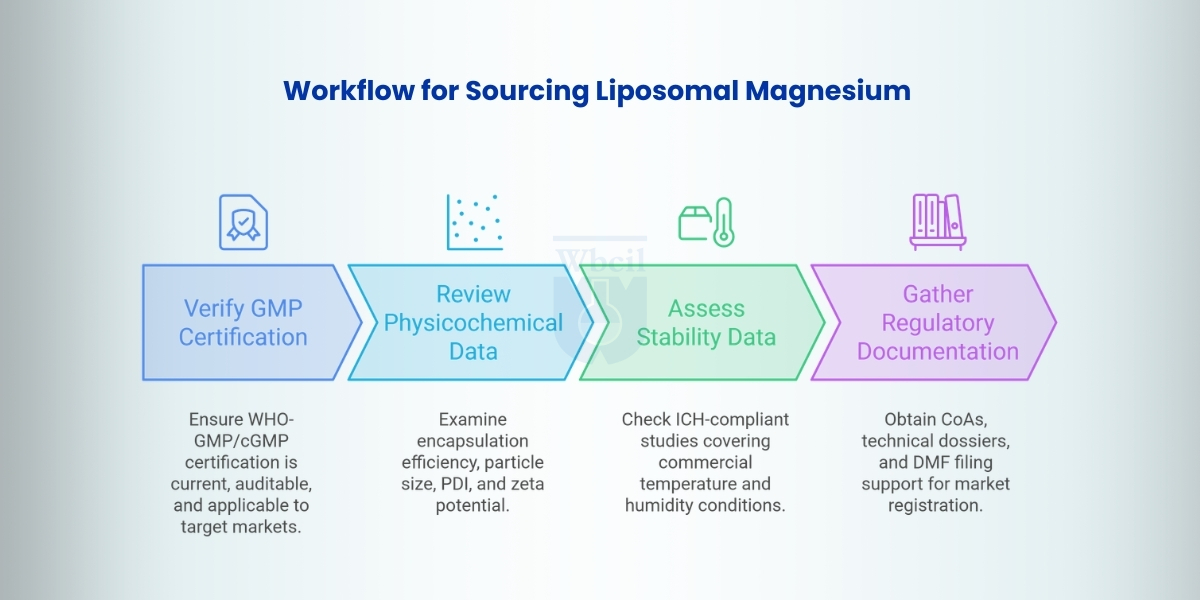
Before committing to any liposomal magnesium API manufacturer, procurement teams and formulators should verify:
- WHO-GMP/cGMP Certification: Current, auditable, and applicable to your target markets
- Physicochemical characterisation Data: Including encapsulation efficiency, particle size, PDI, zeta potential
- Stability Data: ICH-compliant studies covering commercial temperature and humidity conditions
- Regulatory Documentation: CoAs, technical dossiers, and DMF filing support for market registration
Final thoughts
The science connecting magnesium and muscle performance, recovery, and long-term adaptation is well established. While the choice of API determines the performance, the delivery strategy must be optimised as well. Liposomal technology can close the API gap. A liposomal magnesium API backed by a scientifically validated manufacturing process is a boon to sports nutrition brands.
If you are ready to build on a validated foundation, connect with WBCIL and explore what LipoEdgeTM liposomal magnesium API can do for your next formulation.

- Jahnen-Dechent, W., & Ketteler, M. (2012). Magnesium basics. Clinical kidney journal, 5(Suppl 1), i3–i14. https://doi.org/10.1093/ndtplus/sfr163
- Pickering, G., Mazur, A., Trousselard, M., Bienkowski, P., Yaltsewa, N., Amessou, M., Noah, L., & Pouteau, E. (2020). Magnesium Status and Stress: The Vicious Circle Concept Revisited. Nutrients, 12(12), 3672. https://doi.org/10.3390/nu12123672
- Cai, S., Yang, Q., Bagby, T. R., & Forrest, M. L. (2011). Lymphatic drug delivery using engineered liposomes and solid lipid nanoparticles. Advanced Drug Delivery Reviews, 63(10-11), 901–908. https://doi.org/10.1016/j.addr.2011.05.017
Magnesium activates ATP that powers muscle contraction. It also regulates calcium channels and protein synthesis, making it necessary for both performance and muscle recovery.
Conventional magnesium APIs rely on intestinal transporters for absorption that saturate quickly, delivering very little of the administered dose. Thus, reducing bioavailability.
Liposomal encapsulation protects magnesium through the GI tract and enables lymphatic absorption, bypassing the transporter. This delivers magnesium directly into cells where ATP synthesis and muscle repair actually occur.
LipoEdge™ liposomal system undergoes rigorous testing and ICH-compliant stability validation for batch-level precision. It drastically improves bioavailability, making it a preferred choice for sports nutrition brands.
