

Liposomal Glutathione API: Mitigating Peptide Oxidation
Glutathione’s therapeutic value and its formulation failure share the same origin: the reactive thiol group on its cysteine residue that makes it biologically active also makes it structurally fragile in the GI tract. Standard oral glutathione has a bioavailability below 1%, and clinical data confirm that even 3,000mg doses fail to raise plasma glutathione levels in healthy adults. This is a structural failure, not a dosing problem. The scale of this gap is precisely what makes liposomal glutathione peptide protection the most clinically significant advancement in glutathione delivery to date.
In this blog, we examine why glutathione oxidises, how liposomal encapsulation resolves it mechanistically, and what API sourcing decisions determine formulation outcome.
Key Takeaways:
- Glutathione’s thiol group oxidises to inactive GSSG in the GI tract, making standard oral bioavailability fall below 1%.
- Liposomal encapsulation delivers intact GSH to the cytosol via endocytosis, bypassing jejunal enzyme degradation entirely.
- API-grade liposomal glutathione requires verified purity of 98-99.5%, encapsulation efficiency data, and pharmacopoeial compliance before formulation commitment.
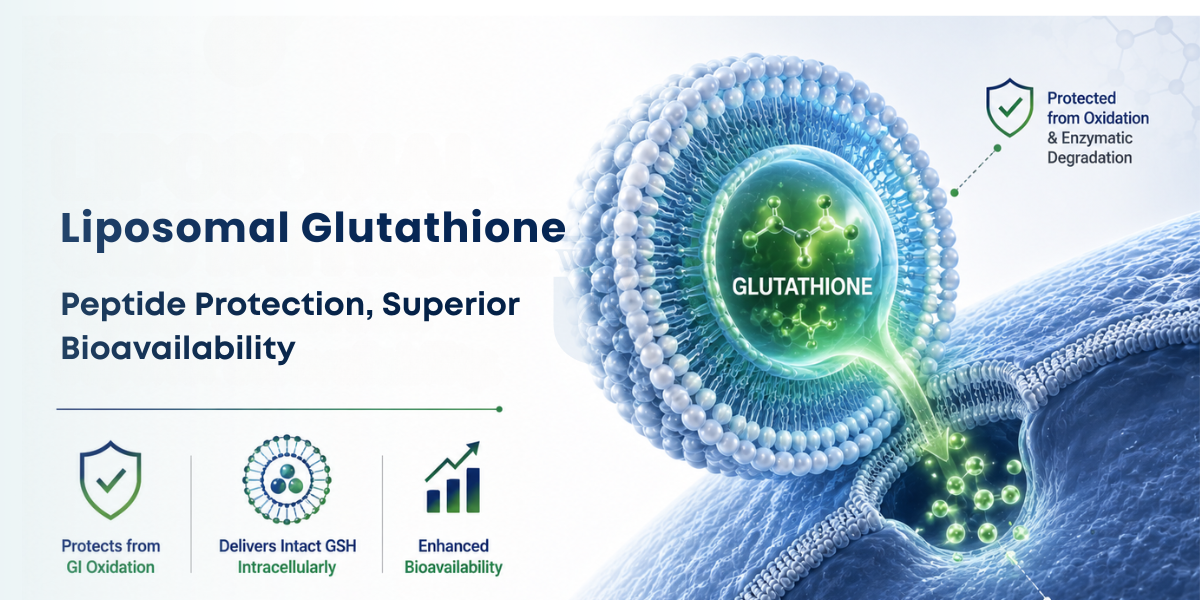
Quick Answer: Liposomal glutathione protects the peptide from GI oxidation via phospholipid encapsulation, delivering intact GSH intracellularly where standard oral forms consistently fail.
Why Glutathione Is Uniquely Vulnerable to Oxidation
Glutathione’s vulnerability to oxidation is not incidental; it is a direct consequence of the same molecular feature that makes it biologically active as an antioxidant.
- Glutathione’s molecular structure contains an active sulfhydryl group (-SH) on the cysteine residue, which is susceptible to oxidation from external environmental factors, including light, humidity, and high temperature- the same group responsible for its antioxidant activity.
- Once the thiol group is oxidised, reduced glutathione (GSH) converts to glutathione disulfide (GSSG), the inactive form, rendering the molecule clinically inert before it reaches systemic circulation.
- The thiol group of GSH is susceptible to γ-glutamyl transpeptidase in the jejunum and is oxidised to GSSG, resulting in loss of antioxidant activity.
- Glutathione’s oral bioavailability is below 1% due to enzymatic degradation and poor gastrointestinal absorption, meaning the vast majority of a standard oral dose never reaches target tissues in active form.
- Early studies found that a single oral dose of up to 3,000mg failed to increase plasma glutathione levels in healthy volunteers, establishing that the problem is structural, not a dosing matter that can be resolved by simply increasing quantity.
How Liposomal Encapsulation Protects Glutathione From Peptide Oxidation
Liposomal encapsulation addresses glutathione’s oxidation vulnerability at the structural level, not by modifying the molecule, but by isolating it from the environment that destroys it.
- The liposome protects the peptide from being destroyed by stomach acid and digestive enzymes, creating a sealed lipid environment around the sulfhydryl group that prevents oxidative contact with GI tract contents, moisture, and enzymatic activity before absorption occurs.
- By encapsulating GSH within phospholipid vesicles, liposomal delivery prevents the molecule from entering the jejunal fluid, where GGT enzyme activity converts active GSH to inactive GSSG, the primary site of degradation for unprotected oral glutathione.
- Liposomal delivery enables direct delivery of intact GSH to the cytosol, bypassing metabolic bottlenecks; the phospholipid vesicle fuses directly with the intestinal cell membrane, delivering glutathione intracellularly rather than releasing it into the lumen where oxidation would resume.
- The lipid bilayer provides a degree of chemical shielding, making liposomal powder more adaptable in liquid and semi-solid formats compared with free glutathione, meaning protection extends beyond the GI tract to the formulation environment itself during manufacturing and storage.
- Unlike standard oral glutathione, which is broken down into glutamate, cysteine, and glycine before absorption and does not reliably reassemble into GSH intracellularly, liposomal strategies deliver intact GSH directly to the cytosol, optimising clearance of xenobiotics and sustaining the cellular redox environment.
Also read: Why Experts Call Glutathione the Body’s Most Powerful Antioxidant [2025 Guide]
Clinical Evidence: Liposomal Glutathione Bioavailability vs Standard Oral Forms
The clinical gap between liposomal and standard oral glutathione is not marginal; it is measurable across multiple independent study designs and biomarker categories.
A 2026 study published in the British Journal of Nutrition found that liposomal glutathione achieved a 6-fold higher peak plasma concentration compared to plain glutathione, alongside 1.9-fold higher cellular uptake at six hours, with plasma retention sustained above 500 ng/mL at 24 hours, a bimodal absorption pattern conventional oral forms cannot replicate. Separately, clinical validation confirms that liposomal GSH at 500- 1000 mg per day increases whole blood glutathione by 30-40% within two weeks [1]. Standard oral glutathione, by contrast, is broken down in the gut, and while the amino acids are absorbed, they do not reliably translate into higher circulating glutathione. The evidence collectively positions liposomal delivery not as an incremental improvement over standard oral forms, but as a categorically different absorption mechanism.
How to Preserve Liposomal Glutathione From API to Finished Product
Liposomal glutathione peptide protection does not end at encapsulation; glutathione peptide oxidation remains an active risk throughout the entire manufacturing, packaging, and distribution chain, and the formulation strategy must account for every stage.
- Glutathione molecules are intrinsically sensitive to oxidation when exposed to heat, light, air, and moisture; liposomal encapsulation enhances stability, but proper storage conditions remain essential to maintain potency. Exposure to temperatures above 8°C accelerates GSH-to-GSSG conversion, directly undermining glutathione bioavailability in the finished product.
- Refrigeration at 2-8°C post-opening slows oxidation to 2-5% per day compared to 10-15% per day at room temperature, a stability differential that directly determines whether the finished formulation retains clinical efficacy at point of use.
- Packaging formats that limit oxygen exposure, including sachets, HDPE drums, and foil pouches, help maintain long-term glutathione activity, a specification that must be locked at the API sourcing stage, not added as an afterthought during finished product development.
- To improve glutathione oxidation stability within multi-ingredient formulations, antioxidant co-ingredients such as vitamin C and vitamin E provide a secondary oxidative buffer, but cannot compensate for inadequate encapsulation efficiency or compromised phospholipid purity at the API level.
- Liposomal glutathione may interact with strong oxidisers or high-pH components in multi-ingredient formulas, making excipient compatibility testing and process condition verification mandatory before finalising any finished product formulation that includes liposomal glutathione API.
Sourcing Pharmaceutical-Grade Liposomal Glutathione API
For manufacturers formulating liposomal glutathione, API quality is the variable that determines whether the finished product delivers clinical outcomes or label claims alone. Pharmaceutical-grade liposomal glutathione requires verified purity of 98–99.5%, documented encapsulation efficiency, pharmacopoeial compliance (USP/EP/JP), and batch-specific CoA documentation- minimum non-negotiable benchmarks before any formulation commitment. The manufacturing process matters equally: solvent-free production and phospholipid purity directly determine whether the lipid bilayer structurally protects the thiol group under real formulation and storage conditions.
WBCIL’s liposomal glutathione API is built on patented solvent-free green liposomal technology, WHO-GMP and cGMP certification, and 17 active patents, giving B2B buyers the regulatory and formulation infrastructure this technically demanding ingredient requires.
Final Thoughts
The glutathione bioavailability problem is structural, and liposomal glutathione peptide protection is the only delivery architecture that addresses it at the molecular level rather than compensating for it downstream. For manufacturers, the actionable priority is straightforward: verify encapsulation efficiency, lock cold chain and packaging specifications at the API sourcing stage, and treat excipient compatibility testing as a mandatory pre-formulation step. Stability must be engineered from the API inward; retrofitting it after formulation is locked is a clinical and commercial liability. Manufacturers evaluating GMP glutathione API suppliers will find that companies like WBCIL, combining patented solvent-free liposomal technology with WHO-GMP certification, set the benchmark this ingredient demands.

- Prasad KN, Chandrashekar C, Karthik Y, Vasantha GG, Phadnis S. Liposomal glutathione outperforms plain glutathione in uptake, cell regeneration and systemic availability: evidence from cellular and human models. British Journal of Nutrition. 2026;135(9):956-963.
The thiol group degrades via γ-glutamyl transpeptidase in the jejunum, converting active GSH to inactive GSSG before reaching systemic circulation; increasing the dose does not resolve this.
No. Encapsulation reduces but does not eliminate the risk of oxidation. Refrigeration at 2-8°C, oxygen-barrier packaging, and light protection remain mandatory post-encapsulation.
A 2026 British Journal of Nutrition study confirmed liposomal glutathione achieved 6-fold higher peak plasma concentration and 1.9-fold higher cellular uptake than plain glutathione.
USP, EP, or JP grade depending on target market, alongside batch-specific CoA, MSDS, and documented encapsulation efficiency, before any formulation commitment.
Yes, vitamin C provides a secondary antioxidant buffer, but cannot compensate for inadequate encapsulation efficiency or compromised phospholipid purity at the API level.
