
Liposomal Glutathione for Skin Brightening: API Insights
Formulators working on skin brightening products know the frustration of an active ingredient that looks compelling on a specification sheet but underdelivers in the finished product. Glutathione has strong clinical rationale for melanin regulation, yet conventional oral and topical forms lose most of their activity before reaching the melanocyte layer where brightening actually occurs. The problem is not the molecule — it is the delivery architecture, and liposomal glutathione for skin brightening exists precisely to solve that structural gap. For cosmeceutical and nutraceutical manufacturers in India developing anti-ageing serums, brightening supplements, or dual-format skin health products, the sourcing decision for your glutathione API determines whether your product closes that gap or merely claims to.
In this blog, you will find a mechanism-level breakdown of how phospholipid encapsulation protects glutathione from degradation, how it inhibits tyrosinase through three distinct pathways, and what encapsulation specifications actually separate pharmaceutical-grade bulk supply from commodity claims.
Key Takeaways
- Conventional glutathione is cleaved by gastric peptidases before systemic absorption, making delivery architecture the formulation priority.
- Liposomal glutathione inhibits tyrosinase through copper chelation, pheomelanin shift, and ROS-mediated MITF suppression simultaneously.
- Encapsulation efficiency above 80% is the minimum pharmaceutical-grade threshold for cosmeceutical-grade liposomal glutathione bulk supply.
Quick Answer: Liposomal glutathione for skin brightening works by encapsulating reduced glutathione within a phospholipid bilayer that protects it from gastric degradation, delivers it via endocytosis into melanocytes, and inhibits tyrosinase through copper chelation and pheomelanin shift — with clinical trials confirming measurable melanin index reductions within four to eight weeks at validated oral doses.
Why Conventional Glutathione Fails as a Skin Brightening Ingredient
Liposomal glutathione for skin brightening addresses a problem that begins before the ingredient ever reaches the skin: conventional oral glutathione does not survive the gastrointestinal tract in a form that can act on melanocytes.
Glutathione is a tripeptide composed of glutamic acid, cysteine, and glycine. Its active site is the sulfhydryl group on the cysteine residue, and that group is chemically vulnerable. Gastric peptidases cleave the tripeptide bond on contact, breaking glutathione into its constituent amino acids before it reaches the small intestine. What arrives in systemic circulation is not glutathione; it is free amino acids that the body reassembles into glutathione intracellularly at whatever rate cellular demand permits.
The clinical consequence is significant. Studies using oral doses of 500 mg per day showed only modest, variable increases in plasma glutathione levels across subjects, with the melanin index reduction measurable only under controlled spectrophotometric conditions after four weeks of consistent supplementation [1].
For cosmeceutical formulators, this failure mode is not a dosing problem. It is a structural delivery problem. High-bioavailability skin-brightening ingredients must reach keratinocytes and melanocytes at a concentration sufficient to inhibit tyrosinase activity. Conventional glutathione, regardless of dose, cannot consistently reach that threshold via oral administration or unprotected topical application.
The stratum corneum presents an equally significant barrier for topical routes. Glutathione is hydrophilic and has a molecular weight above 300 Da — both properties that restrict passive diffusion across the skin’s lipid barrier without a delivery vehicle.
How Liposomal Glutathione Inhibits Tyrosinase to Brighten Skin
Liposomal glutathione for skin brightening works through three distinct, sequential mechanisms at the melanocyte level — not through a single pathway, which is why it outperforms conventional tyrosinase inhibitors that act at only one point in the melanogenesis cascade.
Mechanism 1: Copper Chelation at the Tyrosinase Active Site
Tyrosinase is a copper-dependent enzyme. It requires two copper ions at its active site to catalyse the conversion of tyrosine to DOPA and then to DOPAquinone — the precursor of eumelanin. Glutathione directly chelates these copper ions, temporarily deactivating the enzyme without damaging melanocyte integrity. This is a reversible, competitive inhibition mechanism that does not carry the cytotoxic risk of hydroquinone-based inhibitors.
Mechanism 2: Pheomelanin Shift
Glutathione reacts with DOPAquinone directly, diverting it toward pheomelanin synthesis rather than eumelanin. Pheomelanin produces a lighter, yellow-red pigment in place of the dark brown-black eumelanin responsible for hyperpigmentation. This pigment-type shift produces visible brightening at the cellular level without suppressing melanin production entirely.
Mechanism 3: ROS Scavenging and MITF Suppression
UV radiation generates reactive oxygen species that activate the Microphthalmia-associated Transcription Factor (MITF), the primary transcriptional regulator of tyrosinase gene expression. Glutathione neutralises these ROS before MITF activation occurs, reducing stress-induced melanogenesis at the gene regulation level. A randomised, double-masked, placebo-controlled trial confirmed that oral glutathione in both reduced and oxidised forms significantly lowered melanin index and reduced visible pigmentation changes over the study period [2].

Formulating Stable Anti-Aging Serums with Liposomal Glutathione
Liposomal glutathione for skin brightening performs in anti-ageing serums at a level that free glutathione cannot match, because the phospholipid bilayer solves three formulation stability problems simultaneously.
| Formulation Challenge | Free Glutathione Behaviour | Liposomal Glutathione Behaviour |
| Oxidation in aqueous serum base | Serum base Sulfhydryl group oxidises to GSSG within days at ambient temperature | Phospholipid bilayer creates an oxygen barrier, preserving reduced GSH |
| pH compatibility with serum actives | Unstable below pH 3.5 and above pH 7.5; narrows formulation window | Inner vesicle microenvironment maintains GSH stability independently of outer base pH |
| Compatibility with preservatives | Reacts with common preservative systems, causing sulfurous off-odour | Encapsulation prevents direct contact with preservatives in the outer base |
| Penetration through stratum corneum | Hydrophilic molecule blocked by lipid barrier; low transdermal flux | Liposome fuses with stratum corneum lipids, delivering payload into viable epidermis |
| Stability in presence of vitamin C | Competing antioxidants create unstable redox environment in free form | Encapsulation isolates GSH from competing actives until cellular delivery |
| Shelf life in finished serum | Degrades within 4–8 weeks without antioxidant protection system | Validated accelerated stability data shows encapsulation integrity above 80% at 40°C |
For cosmeceutical formulators building anti-ageing serums targeting hyperpigmentation alongside collagen support and oxidative defence, liposomal glutathione is the only delivery format that addresses all five formulation challenges above without requiring a separate stabilisation system. The lipid vesicle functions as both the delivery vehicle and the stability architecture.
High-bioavailability skin-brightening ingredients in a serum format must also survive the manufacturing process. HPLC analysis of liposomal glutathione formulations has confirmed recovery rates of 98–102% with intra-day and inter-day analytical differences below 4%, confirming batch-to-batch payload consistency achievable under validated manufacturing conditions [3].
Encapsulation Efficiency Standards for Cosmetic-Grade Liposomal Glutathione API
Liposomal glutathione for skin brightening is only as effective as the encapsulation system protecting it. For cosmeceutical formulators evaluating bulk API supply, encapsulation efficiency is the primary quality differentiator between a pharmaceutical-grade liposomal raw material and a commodity liposomal claim.
What Encapsulation Efficiency Measures
Encapsulation efficiency (EE%) quantifies the proportion of glutathione payload successfully enclosed within the phospholipid bilayer versus the total glutathione added during manufacturing. An EE% of 80% means 80 grams of every 100 grams of glutathione added is inside the liposome and protected from oxidation, digestive degradation, and premature release in the serum base.
Why Below 70% EE% Is Not Acceptable for Cosmeceuticals
Free (unencapsulated) glutathione in a bulk liposomal ingredient behaves like conventional glutathione in your formulation: it oxidises, reacts with preservatives, and contributes off-odour without contributing to bioavailability. A supplier reporting 50–60% EE% is delivering a product where nearly half the active is already unprotected before your manufacturing process begins.
WBCIL’s Encapsulation Specification
Sourcing WHO-GMP certified liposomal glutathione from WBCIL provides formulators with a pharma-grade liposomal glutathione raw material with encapsulation efficiency above 80%, particle size below 200 nm, and zeta potential more negative than −30 mV — all validated by DLS, HPLC, and FTIR characterisation and confirmed under ICH Q1A-compliant accelerated stability conditions at 40°C and 75% RH for six months [4].
Request the full Certificate of Analysis and batch-specific HPLC data before finalising any liposomal glutathione bulk supply agreement.
What to Verify When Sourcing Pharmaceutical-Grade Liposomal Glutathione
Liposomal glutathione for skin brightening is a formulation-critical ingredient, and the API specifications you verify at the sourcing stage determine whether your finished product performs or degrades on shelf.
- Encapsulation efficiency above 80% confirms the active reduced glutathione is protected inside the vesicle. Below this threshold, free unencapsulated GSH oxidises in your serum base and creates sulfurous off-odour without contributing to tyrosinase inhibition.
- Particle size between 100–200 nm enables effective stratum corneum fusion and transdermal delivery into the viable epidermis. Particles above 300 nm sit on the skin surface where glutathione oxidises before cellular uptake occurs.
- Zeta potential more negative than −30 mV confirms colloidal stability across your product shelf life. A value drifting toward zero signals aggregation and inconsistent brightening outcomes across the batch.
- Reduced GSH to GSSG ratio confirmed by HPLC at bulk delivery. Without this, your supplier cannot confirm the tyrosinase-inhibiting activity of the ingredient you are formulating with.
- WHO-GMP and cGMP certification enables regulated market registration across India, the EU, GCC, and Southeast Asia without reformulation or additional site audits.
- Sourcing WHO-GMP certified liposomal glutathione from a vertically integrated manufacturer with published characterisation data gives your cosmeceutical a technical foundation that commodity suppliers cannot provide.
Final Thoughts
Liposomal glutathione for skin brightening delivers clinically substantiated results only when the encapsulation specifications behind your bulk API are verified before sourcing, not after formulation begins. Request encapsulation efficiency above 80%, particle size between 100–200 nm, zeta potential more negative than −30 mV, GSH to GSSG ratio by HPLC, and six-month accelerated stability data at 40°C and 75% RH as non-negotiable sourcing criteria. Batch-specific data against each parameter is the difference between a performance claim and a verified specification. For Indian and export market registration, WHO-GMP and cGMP certification from your supplier determines whether your regulatory dossier clears without reformulation costs. A brand that sources verified, pharmaceutical-grade liposomal glutathione builds a brightening product position that published data supports and commodity competitors cannot replicate.

- Stanescu, C.; Chiscop, I.; Boev, M.; Stanescu, G.D.; Matei, M.N. Glutathione in Skin Aging and Tissue Regeneration: A Systematic Review of Molecular Mechanisms, Redox Modulation, and Biomedical Implications. Molecules 2026, 31, 981.
- Weschawalit S, Thongthip S, Phutrakool P, Asawanonda P. Glutathione and its antiaging and antimelanogenic effects. Clin Cosmet Investig Dermatol.
- BOC Sciences (2024). BOC nanoTM glutathione liposomes. [online] Bocsci.com. Available at: https://www.bocsci.com/services/boc-nanotm-glutathione-liposomes.html [Accessed 25 July 2026].
- WBCIL (2025). Liposomal glutathione manufacturer | high bioavailability. [online] West bengal chemical industries limited. Available at: https://www.wbcil.com/liposomal-technology/liposomal-glutathione/ [Accessed 25 July 2026].
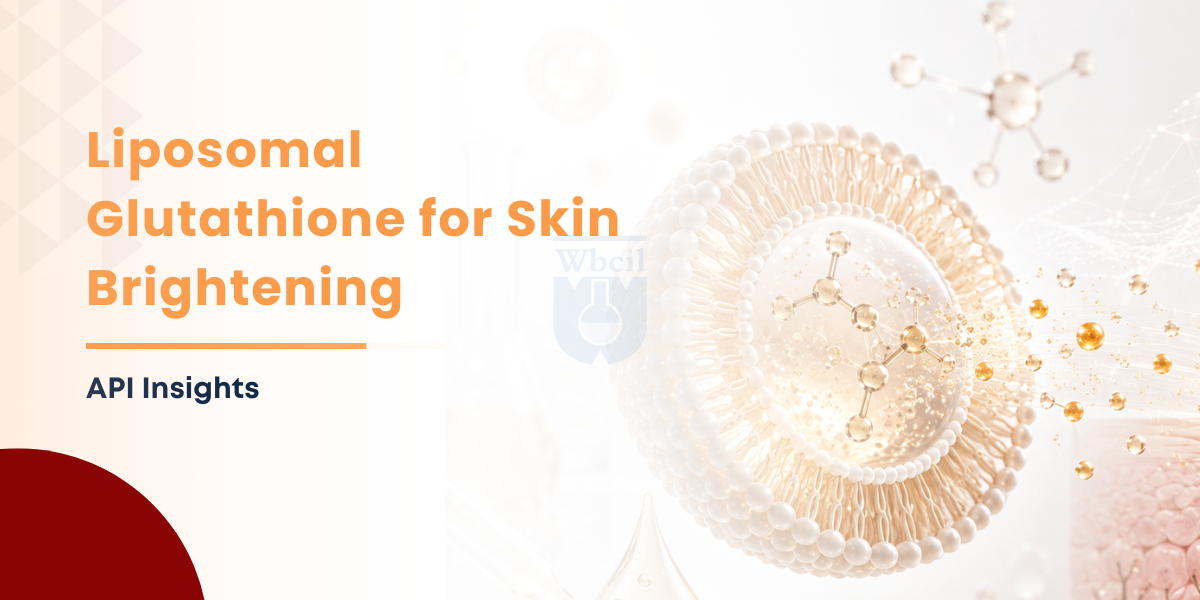
Liposomal encapsulation protects glutathione from gastric peptidase degradation, delivering it intact to melanocytes. Phospholipid vesicles fuse with stratum corneum lipids, enabling transdermal delivery that conventional glutathione cannot achieve.
Pharmaceutical-grade liposomal glutathione requires encapsulation efficiency above 80% confirmed through HPLC and DLS characterisation. Suppliers reporting below 70% deliver product where nearly half the active is unprotected before formulation begins.
Glutathione inhibits tyrosinase through copper chelation at the active site, pheomelanin pigment shift, and ROS-mediated MITF suppression simultaneously. This three-pathway mechanism outperforms single-target tyrosinase inhibitors commonly used in conventional brightening formulations.
Yes, phospholipid encapsulation prevents sulfhydryl oxidation, preservative reactions, and pH incompatibility that destabilise free glutathione in serum bases. Validated accelerated stability data confirms encapsulation integrity above 80% at 40°C throughout commercial shelf life.
Request encapsulation efficiency above 80%, particle size between 100-200nm, zeta potential more negative than −30mV, and GSH to GSSG ratio by HPLC. Six-month accelerated stability data at 40°C and 75% RH confirms export-market regulatory dossier readiness.
