
Why Particle Size Determines API Efficacy: A Nano Primer
Developing an effective medicine involves far more than selecting the right active pharmaceutical ingredient (API). Even the most potent molecule may fail if it does not dissolve, disperse or absorb efficiently. This is where particle size reduction in pharmaceutics becomes one of the most important formulation strategies. By engineering particles at the micro- or nanoscale, pharmaceutical scientists can significantly improve dissolution, bioavailability and product consistency.
Key Takeaways
- Particle engineering influences API dissolution, absorption and therapeutic efficacy.
- Smaller particles provide a larger surface area for faster drug release.
Multiple size reduction technologies are available depending on API characteristics. - Controlled milling improves formulation performance while maintaining product quality.
- Nanotechnology continues to redefine modern pharmaceutical development.
Quick Answer: Particle size reduction in pharmaceutics improves drug performance by increasing the surface area available for dissolution. Faster dissolution often enhances bioavailability, dose consistency and therapeutic effectiveness, particularly for poorly water-soluble APIs.
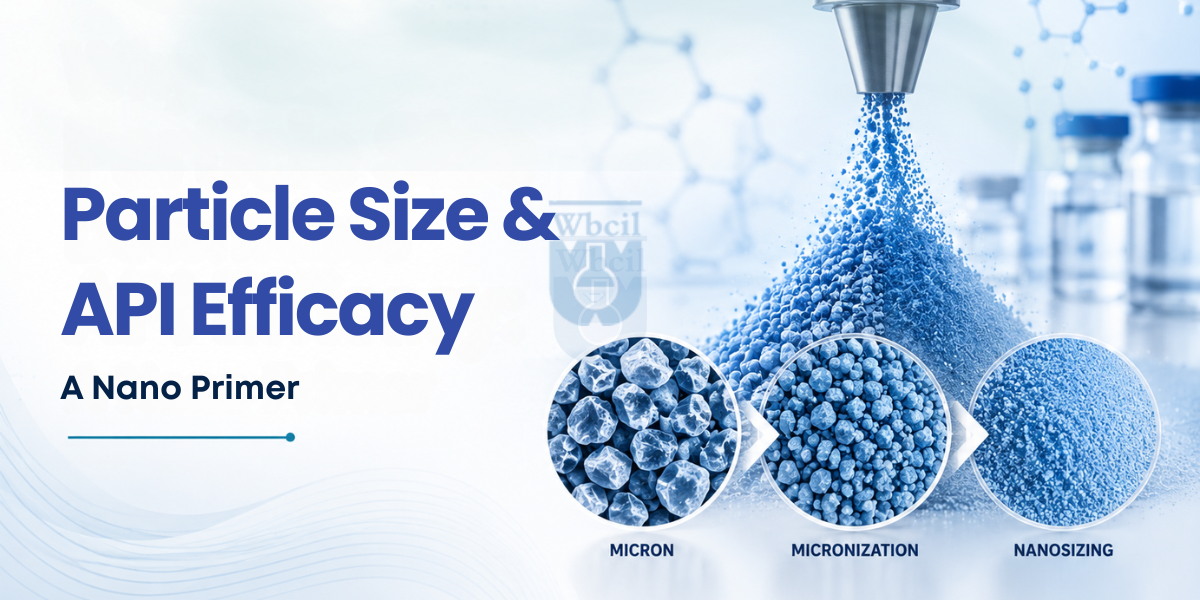
Why Particle Size Matters in Pharmaceutical Development
More than 70% of newly discovered drug molecules show poor aqueous solubility. Many promising therapeutic candidates fail during development because they dissolve too slowly within the gastrointestinal tract or at the site of administration.
Minimising particle size addresses this challenge without changing the chemical identity of the drug molecule. Instead, it modifies the physical characteristics that govern dissolution, dispersion and absorption. Consequently, particle size reduction in pharmaceutics has become a fundamental tool in developing oral, topical, inhalation and injectable drug products. Particle engineering is now integrated into nearly every stage of pharmaceutical development, from early formulation screening to commercial manufacturing.
Understanding the Science Behind Particle Size
Particle size determines the amount of surface area exposed to biological fluids.
- As particles become smaller:
- Surface area increases.
- Dissolution becomes faster.
- Drug absorption improves.
- Dose uniformity becomes more consistent.
- Therapeutic response becomes more predictable.
These relationships are explained by the Noyes–Whitney equation, which demonstrates that dissolution rate increases with increasing surface area. This principle explains why modern formulation scientists invest significant effort in particle size reduction in pharmaceutics when developing poorly soluble medicines.
Mechanism of Size Reduction
Understanding the mechanism of size reduction is essential before selecting an appropriate manufacturing technology. Different APIs respond differently to mechanical stress depending on their crystal structure, hardness and brittleness. Most pharmaceutical milling processes reduce particle size through one or more of the following mechanisms.
Compression
Particles are compressed between two surfaces until fractures occur. Compression is commonly observed during roller milling and high pressure processing.
Impact
High-speed collisions generate sufficient force to fracture particles into smaller fragments. Impact milling is widely used for brittle pharmaceutical materials.
Attrition
Particles become smaller through friction generated between moving surfaces or neighbouring particles. Attrition produces relatively uniform particle size distributions under controlled conditions.
Shear
Shearing forces segregate particle layers by applying opposing mechanical movements. This approach is particularly useful for soft materials that deform before fracturing. The pharmaceutical milling systems often combine multiple mechanisms simultaneously.
Selecting the appropriate mechanism of size reduction rely on the physicochemical properties of the API and the desired particle characteristics.
Particle Size Reduction of Active Pharmaceutical Ingredients
Modern drug development increasingly relies on Particle Size Reduction of Active Pharmaceutical Ingredients to enhance formulation performance without modifying molecular structure. Reducing particle size can enhance:
- Dissolution rate
- Oral bioavailability
- Suspension stability
- Blend uniformity
- Content uniformity
- Patient dose consistency
These improvements often minimise formulation complexity while increasing manufacturing efficiency. Particle engineering also enables lower therapeutic doses for certain APIs by improving drug absorption.
Why Particle Size Distribution Determines API Dissolution Rate
An equally important consideration is why particle size distribution determines API dissolution rate rather than simply measuring average particle size. Two formulations may possess identical mean particle sizes but very different size distributions.
A broad particle size distribution can lead to:
- Variable dissolution profiles
- Segregation during blending
- Uneven drug release
- Reduced batch reproducibility
Conversely, a narrow distribution promotes predictable dissolution behaviour and greater manufacturing consistency. Modern pharmaceutical quality systems therefore monitor complete particle size distributions instead of relying on average particle diameter.
Micronisation vs Nano Milling for Poorly Soluble APIs
Selecting the appropriate technology requires understanding micronization vs nano milling for poorly soluble APIs. Both the approaches reduce particle size but serve different formulation objectives [1].
| Micronisation | Nano Milling |
| Particle size typically 1–10 µm | Particle size generally below 1000 nm |
| Improves powder flow | Maximises dissolution |
| Lower processing cost | Higher processing complexity |
| Suitable for many conventional APIs | Ideal for poorly soluble APIs |
| Mature manufacturing technology | Advanced nanotechnology platform |
Nano milling offers substantially greater surface area, making it particularly valuable for Biopharmaceutics Classification System (BCS) Class II and Class IV drugs. However, micronisation remains an effective solution for numerous established pharmaceutical products because of its simplicity and scalability.

Technologies Used for Particle Size Engineering
Several advanced technologies are available for pharmaceutical particle engineering. The choice depends on API characteristics, target particle size and formulation requirements. Common approaches include:
- Jet milling
- Ball milling
- Wet media milling
- High-pressure homogenisation
- Cryogenic milling
- Spray drying
- Supercritical fluid processing
Each technique offers unique advantages regarding particle morphology, scalability and energy efficiency. For pharmaceutical manufacturers, selection of the appropriate process needs balancing product performance, manufacturing cost and regulatory expectations.
How Smaller Particles Improve Drug Performance
Particle engineering benefits pharmaceutical formulations in multiple ways.
- Faster Dissolution. Smaller particles expose more surface area to biological
- fluids, increasing dissolution rate and accelerating drug release ensuring
- Faster Dissolution.
- Improved Bioavailability. Enhanced dissolution frequently leads to greater systemic absorption, especially for poorly soluble APIs.
- Better Blend Uniformity. Uniform particle size reduces segregation during powder blending and tablet compression.
- Greater Dose Accuracy. Consistent particle characteristics enhance content uniformity and reduce variability between dosage units. These benefits explain why particle size reduction in pharmaceutics still remains as one of the most widely applied formulation strategies across the pharmaceutical industry.
Impact of API Particle Size on Solid Dosage Content Uniformity
One overlooked advantage of impact of API particle size on solid dosage content uniformity is its influence on manufacturing consistency. Tablets and capsules must contain the labelled amount of API in every dosage unit. Even slight variations can compromise therapeutic efficacy and regulatory compliance.
Large particles often segregate from excipients during blending due to differences in size and density. This segregation results in uneven API distribution within the powder blend. Carefully engineered particle sizes enhance powder homogeneity, ensuring better content uniformity throughout production. Particle size optimisation also enhances:
- Powder flow during tablet compression
- Uniform die filling
- Blend stability during transport
- Reduced batch-to-batch variability
- Consistent tablet hardness and dissolution
For highly potent APIs, maintaining a narrow particle size distribution becomes even more critical because minor segregation can significantly alter the delivered dose.
Controlling Amorphous Content During Pharmaceutical Jet Milling
Although particle size reduction improves dissolution, excessive mechanical energy may alter the crystalline structure of an API. Therefore, controlling amorphous content during pharmaceutical jet milling is an important consideration during pharmaceutical development. Jet milling subject particles to high velocity collisions without mechanical grinding surfaces. While this minimises contamination, excessive milling energy can partially convert crystalline materials into amorphous forms. Amorphous APIs generally dissolve faster because they possess elevated free energy.
However, they may also exhibit:
- Reduced physical stability
- Moisture sensitivity
- Particle agglomeration
- Recrystallisation during storage
Variable dissolution profiles
To minimise these risks, pharmaceutical manufacturers carefully optimise:
- Milling pressure
- Feed rate
- Residence time
- Temperature
- Particle classification
Routine analytical techniques such as X-ray diffraction (XRD), differential scanning calorimetry (DSC) and Raman spectroscopy help monitor solid state changes during processing.
How Does Particle Size Affect Active Pharmaceutical Ingredient Efficacy?
A frequently asked question is How does particle size affect active pharmaceutical ingredient efficacy? The particle size directly influences how quickly an API dissolves, becomes available for absorption and reaches therapeutic concentrations.
Smaller particles generally provide:
- Faster dissolution
- Greater bioavailability
- Improved onset of action
- More consistent plasma concentrations
- Better therapeutic response
However, smaller is not always better. Extremely fine particles may aggregate, reduce powder flow or create manufacturing challenges. The objective is therefore to identify an optimal particle size that balances efficacy, stability and manufacturability.
For many poorly soluble APIs, nanometre scale particles significantly enhance therapeutic performance while maintaining formulation stability.
Why Is Particle Size Distribution Critical in Generic Drug Formulation
Another common question is Why is particle size distribution critical in generic drug formulation?
Generic medicines must demonstrate pharmaceutical equivalence and bioequivalence to the reference product. Differences in particle size distribution may alter dissolution behaviour, resulting in different absorption profiles.
Maintaining comparable particle characteristics helps achieve:
- Similar dissolution rates
- Equivalent bioavailability
- Consistent therapeutic outcomes
- Regulatory compliance
- Reliable manufacturing reproducibility
Consequently, particle size analysis forms an integral component of pharmaceutical quality-by-design (QbD) strategies and regulatory submissions.
What Is the Difference Between Micronisation and Nanosizing in API Development?
Many formulation scientists ask, What is the difference between micronisation and nanosizing in API development? Although both techniques reduce particle size, their objectives differ considerably.
Micronisation typically produces particles between 1 and 10 micrometres. It primarily improves powder handling, blend uniformity and moderate dissolution enhancement. Nanosizing reduces particles below one micrometre, often within the 100–500 nm range. This dramatically increases surface area and significantly enhances dissolution and bioavailability, particularly for BCS Class II and IV drugs.
The selection depends on several factors, including:
- Drug solubility
- Therapeutic dose
- Desired release profile
- Manufacturing feasibility
- Cost considerations
Each technology has an established role in modern pharmaceutical development.
How Do Manufacturing Teams Control Polymorphic Transitions During Milling?
A critical formulation challenge is: How do manufacturing teams control polymorphic transitions during milling?
Mechanical stress generated during milling may transform one crystal form into another. Such polymorphic transitions can alter dissolution rate, stability, compressibility and even therapeutic performance. To minimise unwanted crystal transformations, manufacturers employ several control strategies:
- Careful optimisation of milling parameters
- Temperature monitoring throughout processing
- Controlled milling duration
- Selection of suitable milling technology
- Real-time process analytical technology (PAT)
- Routine solid-state characterisation
Analytical techniques including XRD, DSC and Fourier-transform infrared spectroscopy (FTIR) are commonly used to confirm crystal integrity throughout product development and commercial manufacturing.
Future Trends in Pharmaceutical Particle Engineering
Particle engineering proceeds to evolve with advances in pharmaceutical nanotechnology. Emerging innovations include:
- Continuous particle manufacturing
- AI-assisted process optimisation
- Smart process analytical technologies
- Nanocrystal drug delivery
- Hybrid lipid-nanoparticle systems
- Precision particle engineering for personalised medicine
These technologies are expected to improve manufacturing efficiency while enabling more complex drug delivery platforms for poorly soluble molecules [2].
Why Choose WBCIL?
Developing pharmaceutical-grade APIs requires precise control over particle characteristics and manufacturing consistency. WBCIL particle size engineering capabilities support pharmaceutical innovation through advanced milling technologies, comprehensive particle characterisation and scalable manufacturing solutions.
With expertise in particle engineering and pharmaceutical process development, WBCIL helps researchers and manufacturers optimise API performance while maintaining quality, reproducibility and regulatory compliance.
Also read: Nano-Copper API: The Antimicrobial Mineral Pharma Ignores
Final Thought
The success of an API depends not only on its chemical structure but also on its physical characteristics. Among these, particle size reduction in pharmaceutics plays a pivotal role in improving dissolution, bioavailability, blend uniformity and overall therapeutic efficacy.
From conventional micronisation to advanced nanotechnology, particle engineering enables pharmaceutical scientists to overcome formulation challenges associated with poorly soluble drugs while maintaining manufacturing quality. As drug molecules become increasingly complex, particle size reduction in pharmaceutics will continue to drive innovation across oral, topical, inhalation and injectable dosage forms. By combining scientific understanding with advanced engineering technologies, pharmaceutical manufacturers can develop safer, more effective and more consistent medicines for patients worldwide.

- Merisko-Liversidge E, Liversidge GG. Nanosizing for oral and parenteral drug delivery: a perspective on formulating poorly-water soluble compounds using wet media milling technology. Advanced drug delivery reviews. 2011 May 30;63(6):427-40.
- Van Eerdenbrugh B, Van den Mooter G, Augustijns P. Top-down production of drug nanocrystals: nanosuspension stabilization, miniaturization and transformation into solid products. International journal of pharmaceutics. 2008 Nov 19;364(1):64-75.
Particle size reduction in pharmaceutics is the process of decreasing API particle dimensions to improve dissolution, bioavailability, formulation performance and manufacturing consistency.
The primary mechanisms include compression, impact, attrition and shear. Most pharmaceutical milling technologies employ a combination of these mechanisms.
Not always. While smaller particles generally improve dissolution, excessive reduction may increase aggregation, instability or manufacturing complexity. Optimisation is therefore essential.
Poorly water soluble APIs, particularly BCS Class II and IV compounds, often show significant improvements in dissolution and oral bioavailability after nanosizing.
Common analytical techniques include laser diffraction, dynamic light scattering (DLS), microscopy and image analysis, depending on the particle size range.
A controlled particle size distribution improves powder flow, blend homogeneity, tablet compression, content uniformity and dissolution consistency.
