


Liposomal CoQ10: The Bioavailability Fix for Statins Demand
Every statin prescription that lowers cholesterol also depletes a molecule the heart muscle depends on for energy. Statins block the mevalonate pathway, the same route that produces both cholesterol and CoQ10, leaving statin users with a deficit that standard supplements rarely close. Conventional crystalline CoQ10 absorbs at as little as 4%, so a statin user with already-suppressed CoQ10 levels gains very little from a poorly formulated supplement.
In this blog, you will find a science-backed breakdown of why CoQ10 bioavailability enhancement via liposomal phospholipid encapsulation is the most clinically substantiated answer to that formulation gap.
Key Takeaways
- Statins deplete plasma CoQ10 by approximately 40%, making delivery efficiency the priority over dose.
- Crystalline CoQ10’s failure to disperse reduces oral bioavailability by up to 75% before any other variable applies.
- Liposomal encapsulation bypasses fat-dependent absorption and delivers measurably higher plasma CoQ10 levels.
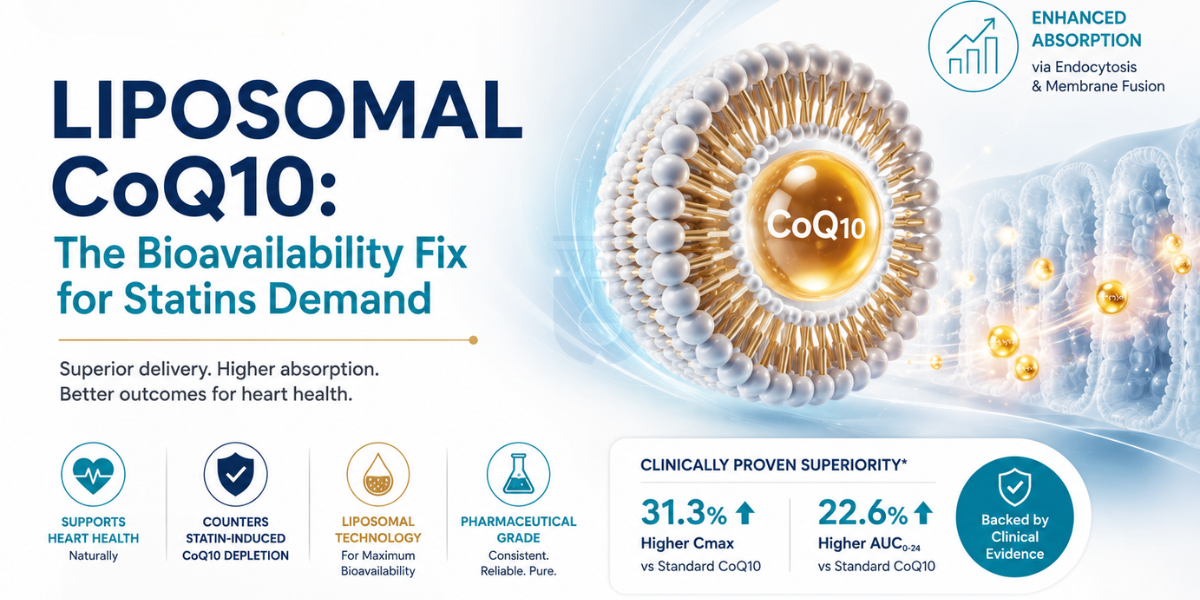
Quick Answer: Statins deplete CoQ10 via the mevalonate pathway, and conventional crystalline CoQ10 supplements absorb poorly, with as low as 4% bioavailability, making liposomal phospholipid encapsulation the most clinically supported delivery format for statin support and cardiac health formulations, with peer-reviewed RCT data showing 31.3% higher peak plasma concentration versus standard CoQ10 at an identical dose.
How Statins Deplete CoQ10, and Why Standard Supplements Fall Short
CoQ10 bioavailability enhancement becomes a clinical priority the moment a patient starts statin therapy, because statins do not just lower cholesterol. They cut CoQ10 synthesis through the same biochemical pathway.
- Statins competitively block HMG-CoA reductase, the rate-limiting enzyme in the mevalonate pathway. That pathway produces both cholesterol and CoQ10, so blocking it depletes both at once.
- A double-masked, placebo-controlled study found that simvastatin and pravastatin, each at 20 mg daily, produced approximately a 40% reduction in plasma CoQ10 levels in both healthy volunteers and hypercholesterolaemic patients. [1].
- Statins also reduce circulating LDL, the primary lipoprotein carrier for CoQ10 in the bloodstream. Lower LDL means reduced CoQ10 transport to cardiac and skeletal muscle tissue, a secondary depletion effect that operates independently of synthesis inhibition.
- Conventional crystalline CoQ10 supplements address the depletion on paper. In practice, unformulated CoQ10 achieves oral bioavailability as low as 4% because its crystalline structure and high molecular weight severely restrict its dispersion in the gastrointestinal tract.
- For a statin user with already-depleted baseline CoQ10 levels, a poorly absorbed supplement delivers too little, too inconsistently. The formulation gap, not the dose, is the actual clinical problem your product needs to solve.
Also read: All You Need to Know About WBCIL’s Liposomal CoQ10.
The Structural Barrier: Why Crystalline CoQ10 Cannot Reach Its Target
CoQ10 bioavailability enhancement starts with understanding why the raw molecule fails to be absorbed before any formulation decision is made.
| Barrier | What It Means for Absorption |
| High molecular weight (863 Da) | Too large for passive diffusion across intestinal walls |
| Crystalline polymorphic structure | Crystals resist dissolution in gastrointestinal fluid |
| Near-zero aqueous solubility | No dispersion without fat and bile salts present |
| Dietary fat dependency | Absorption drops sharply in fasted or low-fat conditions |
| Crystal dispersion failure | Skipping this step alone cuts bioavailability by 75% [2] |
How Phospholipid Encapsulation Solves the CoQ10 Absorption Problem
CoQ10 bioavailability enhancement via phospholipid encapsulation works by replacing every absorption barrier that crystalline CoQ10 cannot cross with a delivery pathway the intestinal epithelium recognises and accepts.
Phosphatidylcholine, the primary lipid in a liposomal bilayer, mirrors the structure of human cell membranes. When CoQ10 embeds within this bilayer, it exists in a pre-dispersed, amorphous state. The crystal dissolution problem that cuts conventional CoQ10 bioavailability by 75% does not apply here. The phospholipid shell protects CoQ10 from gastric acid, bile salt attack, and enzymatic breakdown during transit through the stomach. By the time the liposome reaches the small intestine, the payload remains intact.
Absorption then occurs through two routes unavailable to standard CoQ10 — endocytosis and direct membrane fusion with enterocytes. Both pathways bypass the bile-mediated micelle formation that makes conventional CoQ10 fat-dependent and variable across fed and fasted states.
A 2025 double-blind, placebo-controlled, randomised crossover trial registered with India’s Clinical Trials Registry (CTRI/2024/04/066483) confirmed that liposomal CoQ10 produced a 31.3% higher Cmax and 22.6% higher AUC0-24 versus standard CoQ10 at an identical 100 mg dose (p < 0.001) [3].
For statin-support formulators, this matters at the product level. A higher, more consistent plasma concentration at the same dose means your label claim holds across your consumer population, not just under fed-state lab conditions.
Clinical Evidence for Liposomal CoQ10 in Cardiac and Statin
CoQ10 bioavailability enhancement is not a theoretical exercise; the clinical evidence for CoQ10 in cardiac populations provides formulators with a substantiated platform on which to build statin-support and heart-health products.
The foundational trial is Q-SYMBIO, a randomised, double-blind, placebo-controlled multicentre study across 420 patients with moderate-to-severe chronic heart failure. Patients received CoQ10 at 100 mg three times daily or placebo, alongside standard therapy, for 2 years. Major adverse cardiovascular events occurred in 15% of the CoQ10 group versus 26% of the placebo group (HR=0.50, p=0.003) [4].
That outcome data matters to your product strategy for one specific reason: it was achieved with a bioavailable, well-absorbed CoQ10 formulation at a consistent plasma threshold. Conventional crystalline CoQ10 cannot reliably reach or sustain that threshold. Liposomal CoQ10 can.
For statin-support formulas, the clinical rationale compounds further. Statins deplete CoQ10 via the mevalonate pathway. A statin user’s baseline CoQ10 is already suppressed before supplementation begins. A poorly absorbed supplement widens that gap. A high-bioavailability liposomal format closes it. Consistently, across fed and fasted states, without requiring dietary fat co-ingestion.
When your brand targets cardiac health or statin support, the sourcing decision for your CoQ10 API directly determines whether your product can deliver the plasma levels the clinical evidence demands.
What to Verify When You Source a Pharmaceutical-Grade Liposomal CoQ10 API
CoQ10 bioavailability enhancement is only as reliable as the API specifications behind the liposomal system you source, and the gap between a credible supplier and a commodity claim is measurable.
Four parameters determine whether a liposomal CoQ10 API performs in your finished product. Encapsulation efficiency must exceed 70%, the accepted pharmaceutical benchmark. Particle size must sit between 100 and 200 nm for effective cellular uptake. Zeta potential must read more negative than −30 mV to confirm colloidal stability and prevent aggregation during storage and transit. Accelerated stability data at 40°C ± 2°C and 75% RH must show encapsulation efficiency holds above that threshold for at least six months.
WBCIL’s LipoEdge™ Liposomal CoQ10, characterised and published in the International Journal of Pharmaceutical Science Invention, recorded an encapsulation efficiency of 81.51%, particle sizes of 133.9–150.2 nm, and zeta potentials of −31.87 mV to −37.21 mV, with EE% remaining consistently above 81% across six months of accelerated stability at 40°C [5]. For Indian and export-market sourcing, also verify WHO-GMP, cGMP, ISO, HACCP, and FSSAI certifications. These determine whether your regulatory submissions proceed without reformulation per market.
Final Thoughts
CoQ10 bioavailability enhancement is not a premium add-on for advanced supplement lines; it is the minimum requirement for any statin-support or cardiac health product that needs to perform at a clinically relevant plasma threshold. If you source conventional crystalline CoQ10, you accept that up to 75% of your label claim may never reach systemic circulation, and that absorption will vary unpredictably across your consumer base depending on meal timing and fat co-ingestion.
The formulation decision, specifically whether you use a pharmaceutical-grade liposomal CoQ10 API with verified encapsulation efficiency, controlled particle size, and published stability data, determines whether your product closes the statin-depletion gap or merely appears to. Before you finalise your CoQ10 sourcing, request the full characterisation dossier from your supplier: encapsulation efficiency above 80%, particle size between 100–200 nm, zeta potential more negative than −30 mV, and six-month accelerated stability data at 40°C.

- Deichmann R, Lavie C, Andrews S. Coenzyme Q10 and statin-induced mitochondrial dysfunction. Ochsner J. 2010 Spring;10(1):16-21. PMID: 21603349; PMCID: PMC3096178.
- Mantle, D. and Dybring, A. (2020). Bioavailability of Coenzyme Q10: An overview of the absorption process and subsequent metabolism. Antioxidants, 9(5), p.386. doi:10.3390/antiox9050386.
- Jäger R, Purpura M, Godavarthi A, Ceylan HI, Balcombe ST, Chandrappa A, Tinsley GM. Impact of liposomal delivery on coenzyme Q10 absorption: a double-masked, placebo-controlled, randomised trial. Front Nutr. 2025 Sep 17;12:1605033. doi: 10.3389/fnut.2025.1605033. PMID: 41041129; PMCID: PMC12486408.
- DiNicolantonio JJ, Bhutani J, McCarty MF, O’Keefe JH. Coenzyme Q10 for the treatment of heart failure: a review of the literature. Open Heart. 2015 Oct 19;2(1):e000326. doi: 10.1136/openhrt-2015-000326. PMID: 26512330; PMCID: PMC4620231.
- Banerjee, P.G., Paul, A., Chakraborty, A. and Kundu, S., 2025. Advanced Liposomal CoQ10 formulation by WBCIL: A step forward in cardiovascular nutraceutical therapy. Int. J. Pharm. Sci. Invent., 14, pp.140-155.
Liposomal encapsulation bypasses crystalline dispersion failures delivering CoQ10 through endocytosis achieving measurably higher plasma concentrations consistently.
Statins block the mevalonate pathway simultaneously reducing both cholesterol and CoQ10 synthesis causing approximately 40% plasma depletion.
High molecular weight, near-zero aqueous solubility, and crystalline structure collectively reduce conventional CoQ10 oral bioavailability by up to 75%.
Clinical evidence from Q-SYMBIO demonstrates CoQ10 supplementation reduces major cardiovascular events supporting cardiac and statin-support formulation development significantly.
Encapsulation efficiency exceeding 80%, particle size between 100-200nm, zeta potential more negative than −30mV, and six-month accelerated stability data are required.
