

Liposome vs Phytosome: Formulator Supplement Buying Guide
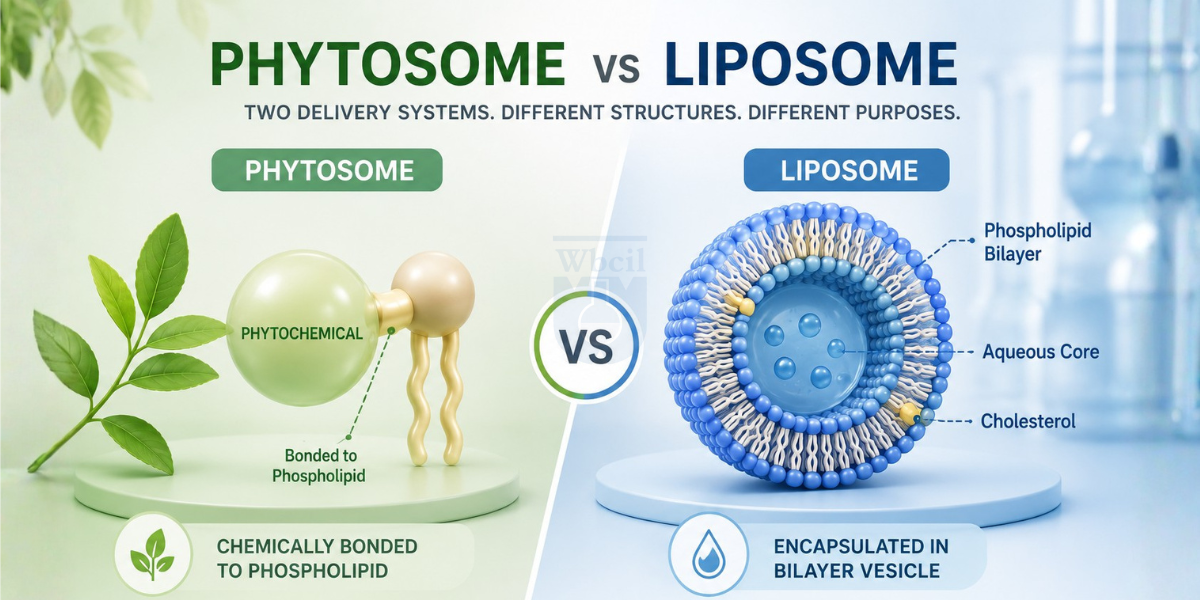
Choosing the wrong delivery system at the API sourcing stage is one of the most costly formulation mistakes a manufacturer can make. The phytosome vs liposome decision is not about superiority; it is about chemical compatibility with the active being delivered. Phytosomes bond the active to phosphatidylcholine through hydrogen and polar interactions; liposomes physically encapsulate it within a bilayer vesicle. A botanical polyphenol in a liposome and a water-soluble mineral in a phytosome will both underperform, regardless of dose or label claim.
In this blog, we break down the structural differences, clinical evidence, and the formulation decision framework B2B buyers need before committing to either delivery system.
Key Takeaways:
- Phytosomes chemically bond the active to phosphatidylcholine; liposomes physically encapsulate it- two structurally distinct mechanisms.
- Phytosome technology suits lipophilic botanical polyphenols; liposomal delivery is best for water-soluble minerals, vitamins, and peptides.
- The active ingredient’s molecular properties, not cost or preference, must determine which delivery system is selected.
Quick Answer: Phytosomes chemically bond botanical actives to phosphatidylcholine; liposomes physically encapsulate actives in a bilayer vesicle, the active’s solubility profile determines which delivery system is appropriate.
Liposome Structure: How the Phospholipid Bilayer Vesicle Works
Understanding the difference between phytosome vs liposome starts with the liposome’s foundational architecture, a spherical phospholipid bilayer vesicle with an aqueous interior core that can carry both water-soluble and fat-soluble actives within a single delivery system.
- Bilayered liposomal structures form through the self-assembly behaviour of phospholipids in aqueous environments when dispersed in water and subjected to energy inputs such as heating, sonication, or homogenization.
- Cholesterol positions itself in the membrane with its hydroxyl group oriented toward the aqueous surface, with the aliphatic chain aligned parallel to the acyl chains, reducing bilayer permeability and improving drug retention during GI transit.
- Due to their amphipathic phospholipid composition, liposomes encapsulate both hydrophilic and hydrophobic therapeutic agents: water-soluble actives in the aqueous core and fat-soluble actives within the membrane bilayer itself.
- Unilamellar vesicles contain a single bilayer, while multilamellar vesicles consist of multiple concentric bilayers, a structural variable that directly controls drug release rate, absorption profile, and formulation suitability across dosage formats.
- The spherical shell encapsulates an aqueous interior containing substances such as peptides, proteins, hormones, enzymes, antibiotics, antifungal and anticancer agents. It makes liposomes the structurally preferred carrier for water-soluble actives with poor gastrointestinal stability.
Where liposomes encapsulate the active, phytosomes chemically bond it, and this structural distinction changes how absorption works.
Phytosome Structure: How Phospholipid-Phytochemical Complex Is Formed
In the phytosome vs liposome debate, the phytosome’s defining structural advantage is chemical bonding; the active becomes part of the phospholipid complex.
- Phytosomes are complexes of natural active ingredients and phospholipids, where the bioactive compound becomes part of the membrane itself, not enclosed within an aqueous cavity.
- The phosphatidylcholine and plant components form a 1:1 or 2:1 molecular complex depending on the chemical bonds involved, creating a structurally defined and reproducible molecular architecture.
- The active phytochemical forms stable hydrogen bonds and polar-nonpolar interactions with the phospholipid head group in an organic solvent, making the drug an integral structural component rather than a physically entrapped molecule.
- Phytosomes contain plant-based molecules with poor solubility in biological media, like flavanones and terpenes, making them structurally appropriate for polyphenols, flavonoids, and terpenoids, not water-soluble minerals or vitamins.
- The bioactive compound of phytosomes is part of the membrane itself, which greatly increases absorption and bioavailability compared to the original unformulated component.
Also read: Nano-Emulsion vs Liposomal: Which Delivery System Wins?
Bioavailability Outcomes for Liposome vs Phytosome Delivery
The phytosome vs liposome comparison becomes clinically concrete in bioavailability data; phytosome structure determines outcome for botanical actives, while liposomal encapsulation wins for water-soluble molecules.
- Curcumin metabolite concentrations were five times higher with phytosomal vs unformulated curcumin [1]. This advantage is directly attributable to the phosphatidylcholine molecular complex defining phytosome structure.
- The optimised phytosomal formulation significantly increased systemic bioavailability sixfold. This validates phytosome technology across multiple poorly water-soluble botanical actives beyond curcumin.
- Plasma silybin levels were significantly higher after the phosphatidylcholine complex versus conventional silymarin tablets. Phytosome bioavailability advantages translate directly from animal models to human clinical outcomes.
- For iron, glutathione, vitamin C, and minerals, physical encapsulation within the aqueous core remains the only viable high-bioavailability delivery mechanism available.
- Phytosome improvements apply specifically to polyphenolic plant compounds with defined phospholipid affinity. Liposomal delivery remains the standard across water-soluble nutraceutical and pharmaceutical actives.
Phytosome vs Liposome: The Formulator’s Framework
The phytosome vs liposome decision is not a quality judgement; it is a formulation decision determined by the active ingredient’s molecular properties and target delivery format.
For B2B formulators, the decision framework below maps the critical variables that determine which delivery system is clinically and commercially appropriate before any API sourcing commitment is made.
| Decision Variable | Phytosome | Liposome |
| Active type | Lipophilic botanical polyphenols, flavonoids, terpenoids | Water-soluble vitamins, minerals, peptides, glutathione |
| Bonding mechanism | Chemical bond to phosphatidylcholine | Physical encapsulation within aqueous core or bilayer membrane |
| Particle size | Smaller, more stable micelle-like complex | 30-1000nm spherical vesicle |
| Dosage format | Tablets, capsules, solid oral formats | Liquids, soft gels, semi-solid formats |
| Cold chain required | No | Yes (liquid formats post-opening) |
| Stability profile | High, dry powder format, no refrigeration needed | Moderate, sensitive to heat, light, moisture |
Also read: Nano-Emulsion vs Liposomal: Which Delivery System Wins?
Sourcing Phytosome and Liposome APIs in India
For manufacturers sourcing both phytosome and liposome APIs from a single Indian supplier, the quality benchmarks are non-negotiable regardless of delivery system. Phosphatidylcholine purity, complexation ratio verification for phytosomes, encapsulation efficiency above 85% for liposomes, particle size data, and pharmacopoeial compliance are the minimum documentation requirements before any formulation commitment. WBCIL’s Lipoedge platform covers both delivery systems under one GMP-certified manufacturing infrastructure, backed by 17 active patents, a patented solvent-free green liposomal process, WHO-GMP and cGMP certification. This gives buyers a technically verified single-source partner for both phytosomal and liposomal ingredient categories.
Final Thoughts
The phytosome vs liposome decision sits at the intersection of formulation chemistry and commercial strategy; getting it wrong at the API sourcing stage creates a product that neither performs clinically nor justifies its price point. Phytosomes are the correct architecture for lipophilic botanical polyphenols; liposomal encapsulation is the standard for water-soluble actives where phosphatidylcholine bonding is structurally impossible. Map the active’s solubility profile first, verify encapsulation efficiency or complexation ratio documentation second, and lock the delivery system before any downstream formulation decisions are made. Manufacturers evaluating Indian API suppliers will find that WBCIL, covering both delivery systems under WHO-GMP certified infrastructure, provides the formulation depth this decision requires.

- Mirzaei, H., Shakeri, A., Rashidi, B., Jalili, A., Banikazemi, Z. and Sahebkar, A. (2017). Phytosomal curcumin: A review of pharmacokinetic, experimental and clinical studies. Biomedicine & pharmacotherapy = Biomedecine & pharmacotherapie, [online] 85, pp.102–112. doi:10.1016/j.biopha.2016.11.098.
In phytosomes, the active is chemically bonded to phosphatidylcholine and becomes part of the membrane. In liposomes, the active is physically encapsulated inside the bilayer vesicle.
Neither is universally superior. Phytosomes outperform for lipophilic botanical polyphenols like curcumin and silymarin. Liposomes lead for water-soluble actives like iron, glutathione, and vitamin C.
No. Phytosome complexation requires lipophilic botanical actives with specific phospholipid affinity. Water-soluble minerals and vitamins cannot form the hydrogen and polar bonds the phytosome structure requires.
Generally yes. Phytosomes are stable dry powder complexes requiring no refrigeration. Liquid liposomal formats are sensitive to heat, light, and moisture, requiring cold chain compliance post-opening.
For phytosomes: complexation ratio verification and phosphatidylcholine purity. For liposomes: encapsulation efficiency above 85%, particle size data, pharmacopoeial compliance, and WHO-GMP certification documentation.
