

Nano-Emulsion vs Liposomal: Which Delivery System Wins?
Choosing a carrier for a poorly soluble drug is rarely simple. Nano-emulsion vs liposomal delivery systems is one of the most common debates in formulation science, and the correct answer depends on the molecule, the route, and the budget. This blog compares both platforms on structure, bioavailability, stability, and scale-up, so that the formulators can pick a carrier with evidence rather than guesswork.
Key Takeaways
- Liposomes are bilayer microvesicles; nano-emulsions are single-phase oil droplets stabilised by surfactant.
- Nano-emulsions often show faster absorption due to their smaller, more uniform droplet size.
- Liposomes suit sensitive actives that need protection from degradation.
- Nano-emulsion manufacturing scales more easily for high-volume CDMO production.
- Storage temperature affects each system differently, so stability testing should never be skipped.
Quick Answer: Nano-emulsions generally give higher bioavailability and simpler, cheaper scale-up for lipophilic small molecules. Liposomes offer better protection for sensitive or hydrophilic actives and support targeted release. Neither wins outright; the choice depends on the drug and the delivery goal.
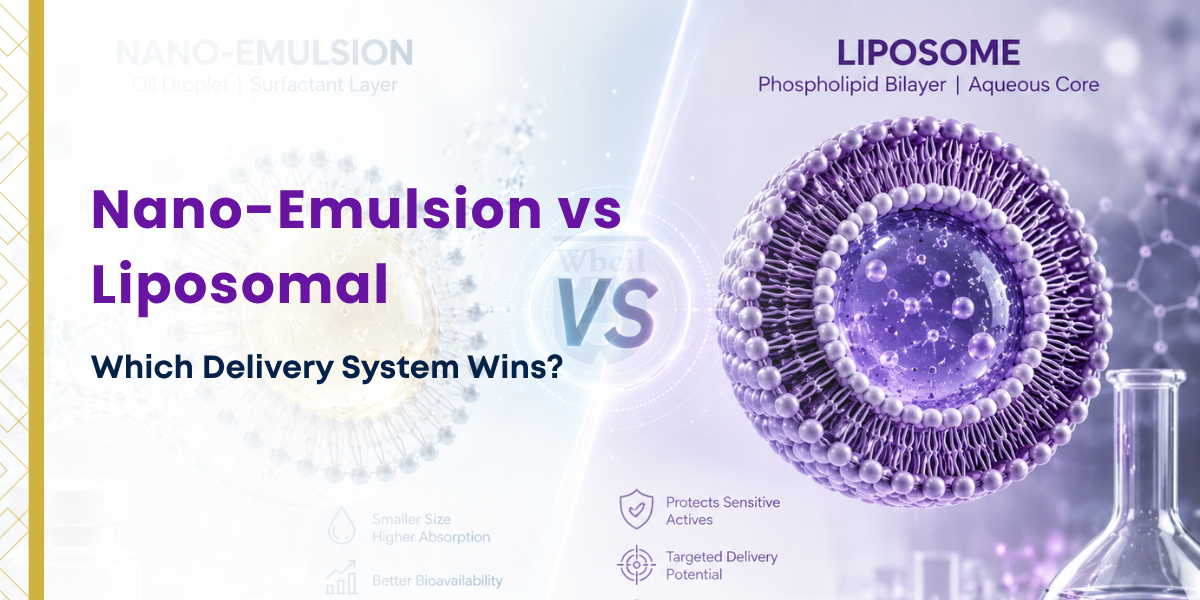
Liposome vs Nano-emulsion Structure: How Each System Is Built
A liposome is a spherical vesicle built from one or more phospholipid bilayers surrounding a watery core. This structure lets it carry both water-soluble and fat-soluble molecules at once, storing hydrophilic drugs in the aqueous core and lipophilic ones inside the bilayer itself.
A nano-emulsion, conversely, is a single layer of oil droplets dispersed in water and held stable by a surfactant film. There are no bilayer and no internal aqueous compartment, so drug loading happens mainly within the oil phase. This structural gap explains most of the performance differences covered later in this write-up, and it also drives manufacturing choices, since bilayer formation needs different equipment than simple emulsification. Formulators weighing nano-emulsion vs liposomal delivery systems usually start their assessment right here, at the level of raw particle architecture. Particle architecture also affects how each carrier behaves once inside the body. A bilayer can fuse with cell membranes or be broken down by enzymes, while an emulsion droplet is usually digested more like a dietary fat, through lipase action and micelle formation in the gut.
Liposomal vs Nano-emulsion Drug Delivery: Core Differences
The table below summarises the practical differences formulators weigh most often when comparing these two carrier types side by side.
| Feature | Liposomes | Nano-emulsions |
| Structure | Phospholipid bilayer, aqueous core | Single oil droplet, surfactant shell |
| Typical size | 50-450 nm | 20-200 nm |
| Drug loading | Hydrophilic and lipophilic | Mainly lipophilic |
| Stability | Chemical, needs cold chain often Kinetic, | Kinetically stable, and their main failure modes are droplet coalescence and Ostwald ripening. |
| Manufacturing | More complex (thin-film hydration, extrusion, sonication, sometimes microfluidics), costlier to scale | Simpler to produce (high-pressure homogenization, phase inversion) and scale more easily. |
Liposomal vs nanoemulsion drug delivery choices ultimately trade formulation flexibility against manufacturing simplicity, and that trade-off shapes most of the sections below. A formulator working with a dual-solubility active, for instance, may accept the higher manufacturing cost of liposomes simply because no other carrier can hold both drug fractions at once.
Bioavailability: Why Nano-emulsions Often Outperform Liposomes
Smaller, more uniform droplet size gives nano-emulsions a larger surface area for enzymatic breakdown and absorption in the gut. Their lipid phase can also stimulate lymphatic uptake, which bypasses first-pass liver metabolism for many lipophilic compounds. This combination is a major reason nano-emulsions perform well in oral formulations.
Nanoemulsion vs liposomal bioavailability in nutraceuticals has been studied closely, since ingredients like curcumin and CoQ10 suffer from poor natural absorption. Nano-emulsion formats frequently post higher plasma concentrations for these compounds than equivalent liposomal doses, though results vary by molecule, dose, and formulation quality. Liposomes are not without an edge here. Their bilayer can protect an unstable molecule long enough to survive the gut, which sometimes matters more than raw absorption speed. For actives that degrade quickly in gastric conditions, that protective barrier can outweigh a nano-emulsion’s faster uptake.
Stability Under Real-World Storage Conditions
Nano-emulsions are only kinetically stable, meaning droplets can coalesce over time or under heat stress, even with a well-chosen surfactant system [1]. Liposomes face a different risk profile: phospholipid oxidation and bilayer leakage, particularly if cold storage is interrupted during transport or shelf life. Thermodynamic stability of microemulsions vs nanoemulsions is a related but separate question worth clarifying here. True microemulsions form spontaneously and stay stable indefinitely, while nano-emulsions require energy input during manufacture and remain only metastable over their shelf life. Confusing the two terms is common in the scientific literature, so formulators should check droplet formation method before relying on a stability claim from a supplier or paper. Neither system is inherently more stable in every scenario. The right stability profile depends heavily on the specific formulation, packaging, and storage chain a product will move through. Real-time and accelerated stability data, rather than assumptions drawn from the general nano-emulsion vs liposomal delivery systems debate, should guide any shelf-life claim on a label.
Release Kinetics and Controlled Delivery
Controlled release kinetics liposomes vs nanoemulsions is a key factor for extended-release products. Liposomes can be engineered with PEGylated coatings or triggered release lipids, giving formulators fine control when and where a drug is released into circulation.
Nano-emulsions tend to release their payload faster, since there is no bilayer barrier to slow diffusion once the droplet reaches the site of absorption. This makes liposomes the stronger choice for products needing sustained plasma levels over many hours, while nano-emulsions suit applications where fast onset matters more than duration.
Choosing the Right System for Poorly Soluble APIs
Choosing between liposomes and nanoemulsions for poorly soluble drugs starts with the molecule’s own properties rather than a generic preference for one platform. Highly lipophilic compounds with simple stability profiles often do well in nano-emulsions, since the oil phase dissolves them easily without involving complex engineering.
For most simple lipophilic APIs, nano-emulsions offer a faster, cheaper path to market. For actives that are unstable, need targeted delivery, or combine hydrophilic and lipophilic components in one molecule, liposomes are usually worth the extra formulation effort and cost.
A short preformulation screen, covering solubility, log P, and thermal stability, usually settles the nano-emulsion vs liposomal delivery systems question for a given molecule faster than a lengthy literature study. Route selection made early, before excipient sourcing and process design begin, avoids costly rework later in development.
Lipid Nanoparticles vs Liposomes: A Related but Different Comparison
Lipid nanoparticles vs liposomes is a separate but related comparison worth a brief mention here. Lipid nanoparticles, used widely in mRNA vaccines, are solid or semi solid cores without a true aqueous compartment, unlike classic liposomes [2]. They are not the same as nano-emulsions either, though all three come under the broader lipid-based delivery umbrella.
Formulators often group lipid nanoparticle conversations alongside nano-emulsion comparisons, because the manufacturing equipment, particle sizing methods, and stability testing between the two often overlap in a CDMO setting.
Manufacturing and Scale-Up Considerations
Scalable nanoemulsion manufacturing methods for CDMOs typically rely on high pressure homogenisation or microfluidisation, both of which transfer well from small lab batches to commercial production volumes. Liposome manufacturing, by comparison, often needs solvent injection or thin film hydration steps, followed by extrusion to control vesicle size, which adds processing time and cost at scale.
For a CDMO managing multiple sponsor programmes at once, this manufacturing gap affects lead times, equipment scheduling, and tech transfer complexity as much as it affects the final formulation’s performance. Sponsors evaluating nano-emulsion vs liposomal delivery systems for a new product should ask a prospective CDMO about existing equipment for both routes, since retrofitting a plant mid programme adds real delay.
Formulation Support at WBCIL
WBCIL advanced drug delivery solutions cover both platforms, from early feasibility work through commercial scale manufacturing. Formulation teams evaluate a molecule’s solubility, stability, and target release profile before recommending a liposomal or nano-emulsion route, backed by in-house stability testing and scale-up equipment for both formats.
Also read. Liposomal Magnesium for Sleep: The Neuro API Gap in Nutra

Conclusion
Nano-emulsion vs liposomal delivery systems is not a contest with one universal winner. Nano-emulsions suit lipophilic APIs that require fast, low cost scale-up, while liposomes suit sensitive or dual solubility actives that need protection and controlled release. The right choice comes down to the molecule’s characteristics, the release profile required, and the manufacturing route a sponsor can realistically support.
A CDMO experienced in both the platforms can help match the science to the commercial goal early, before a route is locked in and harder to alter. That early alignment often saves months of rework later in development.

- Gandhi J, Shah V, Pandya R, Shah M, McClements DJ, Shah DO. Microemulsions versus nanoemulsions: A comparative overview of features, formulation, and pharmaceutical applications. Advances in Colloid and Interface Science. 2026 Mar 20:103881.
- Alfutaimani AS, Alharbi NK, Alahmari AS, Alqabbani AA, Aldayel AM. Exploring the landscape of Lipid Nanoparticles (LNPs): A comprehensive review of LNPs types and biological sources of lipids. International Journal of Pharmaceutics: X. 2024 Dec 1;8:100305.
A liposome has a phospholipid bilayer around a watery core, while a nano-emulsion is a single oil droplet stabilised by surfactant, without aqueous compartment.
Their smaller droplet size and larger surface area elevate absorption, and their lipid phase can support lymphatic uptake for lipophilic compounds.
Nano-emulsions usually suit simple lipophilic APIs best, offering faster formulation and cheaper scale-up than liposomes.
Not always. Nanoemulsions are kinetically stable and can degrade under heat stress, while liposomes face oxidation and leakage risks.
It compares both platforms against structure, bioavailability, stability, and manufacturing, since no single delivery system fits every drug or nutraceutical.
Yes, hybrid systems exist, though they add formulation complexity and are usually reserved for actives that need both protection and fast absorption.
Many do, though formulation choices like addition of antioxidant and lyophilisation can reduce cold chain dependence for some liposomal products.
