

Calcium Bisglycinate: Premier Choice for Gummies and Liquids
Calcium source selection in gummy and liquid formulations carries direct consequences for bioavailability, format stability, and regulatory positioning. Conventional calcium carbonate’s pH dependency and aqueous insolubility create formulation constraints that organic and chelated calcium forms structurally avoid. For manufacturers developing calcium for gummy supplements, the API decision determines product viability before a single excipient is specified. Calcium bisglycinate’s peptide transport absorption mechanism, superior water solubility, and gel matrix compatibility represent a measurable formulation advantage over standard calcium salts.
The blog examines the clinical evidence, formulation parameters, and sourcing criteria required before committing to a pharmaceutical-grade calcium bisglycinate API.
Key Takeaways:
- Calcium bisglycinate absorbs via peptide transport channels and is independent of gastric pH, making it reliable across sensitive patient populations.
- Its pH-buffering behaviour up to pH 10 is a genuine formulation constraint for acidic gummy and beverage matrices.
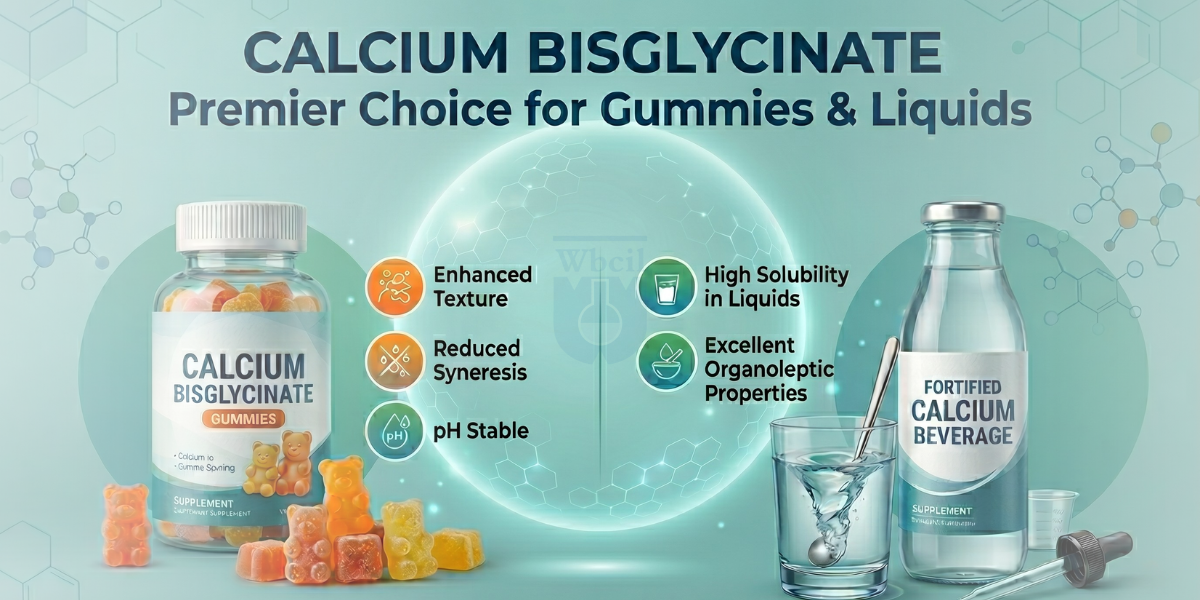
- Calcium bisglycinate reduces syneresis in gel matrices as dosage increases; a property that most competing calcium forms do not share.
Quick Answer: Calcium bisglycinate outperforms citrate and carbonate for gummy and liquid formulations on solubility, absorption mechanism, and GI tolerability.
Why Calcium Source Selection Determines Format Viability
Selecting the right calcium for gummy supplements is not an excipient decision; it is an API-level formulation decision. Moreover, the calcium source you specify determines solubility, taste, pH compatibility, and bioavailability before a single excipient is chosen.
- Calcium carbonate contains 40% elemental calcium, the highest of any calcium salt. Its aqueous solubility is only 47 mg/L at atmospheric pressure, making it incompatible with liquid and most gummy matrices [1].
- Calcium carbonate requires gastric acid for dissolution, a structural absorption constraint that citrate and chelated forms avoid entirely. Populations on proton pump inhibitors or with low stomach acid absorb calcium carbonate at reduced rates.
- Calcium citrate absorbs 27% better than carbonate under fasted conditions across multiple controlled studies. Its water solubility is higher than that of carbonate, but still lower than that of chelated calcium bisglycinate.
- A calcium API that causes sedimentation, off-taste, or pH interference fails the brief for both gummy and liquid formats.
- Calcium glycinate chelate is absorbed via intestinal peptide transport channels, bypassing the acid-dependent passive diffusion pathway that limits the absorption of carbonate and, to a lesser extent, citrate. The pH-independence is commercially significant for paediatric, elderly, and PPI-user product segments across India’s supplement market.
Also read: From Lab to Label: The API Journey from Manufacturing to Market
Calcium Bisglycinate vs Calcium Citrate for Gummies
Calcium citrate is the established default for premium gummy formulations. However, fully reacted calcium bisglycinate challenges that position on solubility, absorption mechanism, and dose efficiency.
Here is a tabular representation to understand the difference between the two:
| Parameter | Calcium Citrate | Calcium Glycinate Chelate |
| Water solubility | Moderately soluble, better than carbonate, but limited in high-concentration aqueous matrices. | Most water-soluble calcium salts are available, 205 times more soluble than citrate. |
| Bioavailability | Absorbed 29% better than carbonate under fasted conditions via passive paracellular diffusion [2]. | Absorbed 1.8 times better than citrate and 21% better than calcium citrate malate. |
| pH behaviour in food matrices | Near-neutral pH profile; does not alter matrix pH in gummy or beverage formats | Buffers food matrices up to pH 10, a critical formulation constraint for acidic gummy and RTD beverage formats [3]. |
| Taste and organoleptic profile | No significant off-notes in gummy or beverage matrices. | Mild, slightly sweet glycine taste; does not produce metallic or chalky off-notes. |
| GI tolerability for sensitive populations | No gastric acid dependency makes it suitable for the elderly and PPI users | Gentler than citrate on sensitive digestive systems; chelated structure prevents free calcium ion irritation. |
Calcium for gummy supplements performs only as well as its sensory and textural compatibility with the matrix, and chelated mineral salts behave differently from inorganic forms at every stage of gummy processing.
Organoleptic Properties and Gummy Texture Performance
Calcium bisglycinate’s formulation behaviour in gummy matrices is more nuanced than its bioavailability data suggests; its pH-buffering effect, syneresis profile, and interaction with gelling agents all carry direct consequences for texture, taste, and shelf life.
Taste Profile
Calcium bisglycinate carries a mild, slightly sweet taste from its glycine component. This is not a neutral organoleptic profile; it is a distinct sensory contribution that interacts with your flavour system. In fruit-flavoured gummies, the glycine sweetness can complement citrus and berry flavour profiles. However, in neutral or savoury functional formats, this taste profile requires consideration of flavour masking.
Syneresis Behaviour in Gel Matrices
A peer-reviewed study testing six calcium compounds in acid rennet gel matrices found that calcium bisglycinate reduced syneresis as dosage increased, a property that calcium chloride, gluconate, and lactate did not share. Calcium chloride and gluconate at equivalent doses significantly increased syneresis, making bisglycinate the superior calcium source for gel matrix stability at higher concentrations.
Gelatin vs. Pectin Matrix Compatibility
Gelatin-based gummies are acidic by nature, typically sitting at pH 3.5-5.5, a range that creates a direct interaction challenge with calcium bisglycinate’s pH-buffering behaviour up to pH 10. In pectin-based matrices, calcium plays a structurally active role: calcium ions cross-link low-methoxy pectin chains to form the gel network itself [4]. Using calcium bisglycinate as the calcium source in a pectin gummy means the same API contributes to both structural gelation and therapeutic calcium delivery, a dual function that simplifies your ingredient list.
Moisture and Shelf Life Stability
Gummy shelf life failures are typically driven by moisture migration; water activity above 0.65 promotes microbial growth, texture softening, and surface tackiness. Calcium bisglycinate’s non-hygroscopic character means it does not actively absorb atmospheric moisture during manufacturing or storage. A study on alginate-based gummy formulations confirmed that calcium-crosslinked matrices with water activity below 0.65 and syneresis below 35% met acceptable organoleptic and microbiological standards over the study period [5].

The case for soluble calcium in liquids goes beyond dispersibility; it is a formulation decision that simultaneously determines stability, patient compliance, and shelf life.
Soluble Calcium for Liquid Dosage Forms
Calcium for gummy supplements receives considerable attention, but soluble calcium for liquid dosage forms presents a distinct, more demanding formulation brief, one in which API selection determines product viability before excipient selection begins.
- Calcium bisglycinate disperses completely in aqueous matrices, inorganic salts sediment, and cloud, and produces consumer-visible precipitate in finished liquid products.
- Calcium bisglycinate buffers liquid matrices up to pH 10, a direct formulation constraint for acidic beverages, fruit drinks, and low-pH oral solutions.
- In acidic beverage matrices below pH 6.0, calcium citrate malate outperforms bisglycinate in terms of pH compatibility and taste neutrality, without sedimentation.
- Calcium bisglycinate remains stable and fully soluble in dairy matrices, confirmed in a 21-day cold storage kefir study with no sensory or consistency changes [6].
- Calcium bisglycinate’s non-hygroscopic character prevents clumping in sachet formats and preserves flowability throughout manufacturing, storage, and distribution.
Sourcing WBCIL high-purity mineral salts means accessing a calcium bisglycinate API backed by verified chelation data, CGMP certification, and multi-market regulatory documentation.
WBCIL’s High-Purity Calcium Bisglycinate API
WBCIL supplies calcium bisglycinate under the molecular formula C₄H₈CaN₂O₄. CAS 35947-07-0, molecular weight 188.11 g/mol, manufactured under CGMP and ISO certified conditions across Kolkata and Dahej facilities.
- Every batch carries identity confirmation, elemental calcium content verification, and full CoA under CGMP-certified quality control.
- WBCIL’s calcium bisglycinate API is validated for immediate-release tablets, capsules, oral syrups, and for functional beverage fortification.
- FSSAI, CDSCO, USFDA, and EU Multi-Market Regulatory Dossier Support. WHO-GMP, CGMP, ISO, and HACCP Certification Across Both Manufacturing Facilities
- WBCIL’s MSDS confirms compliance with EU Directives 98/24/EC and Commission Regulation (EU) 2020/878 for multi-market submissions.
Selecting a bulk calcium citrate API supplier with verified chelation documentation and multi-market regulatory capability is the final and most consequential step in your formulation brief.
Final Thoughts
Calcium bisglycinate’s formulation advantages in gummy and liquid matrices are well-supported by clinical and in vitro evidence, but require matrix-specific validation before procurement. Prior to finalising any bulk order, request chelation confirmation data, elemental calcium percentage within the 21% range, and ICH-compliant stability documentation from your supplier. For acidic liquid formats below pH 6.0, evaluate calcium citrate malate alongside bisglycinate; the comparative data strengthen your formulation dossier.
Sourcing calcium for gummy supplements from a WHO-GMP and CGMP certified manufacturer with multi-market regulatory dossier capability reduces post-launch compliance risk. WBCIL’s calcium bisglycinate API is supplied with full CoA and EU regulatory compliance documentation.

- Ambrogi, V. (2023). A New Challenge for the Old Excipient Calcium Carbonate: To Improve the Dissolution Rate of Poorly Soluble Drugs. Pharmaceutics, 15(1), p.300.
- Hansen, C., Werner, E., Erbes, H.-J. ., Larrat, V. and Kaltwasser, J.P. (1996). Intestinal calcium absorption from different calcium preparations: Influence of anion and solubility. Osteoporosis International, 6(5), pp.386–393. doi:https://doi.org/10.1007/bf01623012.
- Lorieau, L., Le Roux, L., Gaucheron, F., Ligneul, A., Hazart, E., Dupont, D. and Floury, J. (2018). Bioaccessibility of four calcium sources in different whey-based dairy matrices assessed by in vitro digestion. Food Chemistry, 245, pp.454–462.
- Said, N.S., Olawuyi, I.F. and Lee, W.Y. (2023). Pectin Hydrogels: Gel-Forming Behaviors, Mechanisms, and Food Applications. Gels, [online] 9(9), pp.732–732.
- Ergun, R., Lietha, R. and Hartel, R. (2010). Moisture and Shelf Life in Sugar Confections. Critical reviews in food science and nutrition, [online] 50(2).
- Pawlos, M., Znamirowska, A., Szajnar, K. and Kalicka, D. (2016). The influence of the dose of calcium bisglycinate on physicochemical properties, sensory analysis and texture profile of kefirs during 21 days of cold storage. Acta Scientiarum Polonorum Technologia Alimentaria, 15(1), pp.37–45.
Calcium bisglycinate is the most water-soluble calcium salt, 205 times more soluble than citrate, making it the primary choice for syrups and oral solutions. For acidic formats below pH 6.0, calcium citrate malate is the more pH-compatible alternative.
Calcium bisglycinate disperses more completely but buffers gummy matrices up to pH 10, requiring pH adjustment in acidic formats. Calcium citrate is organoleptically neutral and pH-compatible across most standard gummy formulations without additional intervention.
Calcium bisglycinate suits neutral to mildly acidic beverage matrices; calcium citrate malate performs better in low-pH fruit-based formats. Both eliminate sedimentation and taste problems caused by calcium carbonate in finished liquid products.
Replace inorganic calcium salts with chelated forms; calcium bisglycinate eliminates metallic taste, chalky mouthfeel, and visible sedimentation. At up to 30 mg calcium per 100g, it produces no measurable colour or consistency change in aqueous matrices.
Require batch-level chelation confirmation, elemental calcium within the 21% range, and ICH-compliant stability data. Suppliers must hold CGMP, WHO-GMP, and ISO certification with dossier capability covering FSSAI, FDA, and EMA requirements.
