Calcium Lactate Gluconate for Fortifying Clear Beverages
Suppose, your R&D team has finally nailed the formula for a calcium-fortified functional water. Clean label. Good nutrition story. Nice packaging. But the moment they scale it up and hand it to the sensory panel, the feedback comes back fast: too chalky, slightly bitter, and there is a faint grittiness settling at the bottom of the bottle.
That is not a production problem. That is a calcium source problem.
Fortifying clear beverages with calcium is one of the more technically demanding challenges in food formulation. You need a calcium salt that dissolves completely without clouding the liquid, contributes nothing to the flavour profile, and actually gets absorbed by the body when consumed. Most calcium salts fail on at least one of these three counts.
Calcium Lactate Gluconate — commonly called CLG — passes all three. And that is not a marketing claim. It is backed by chemistry, supported by food science research, and confirmed by formulators who have tried everything else first. Here is the full picture.
Key Takeaways:
- CLG Solves the Clear Beverage Calcium Problem That Other Salts Cannot
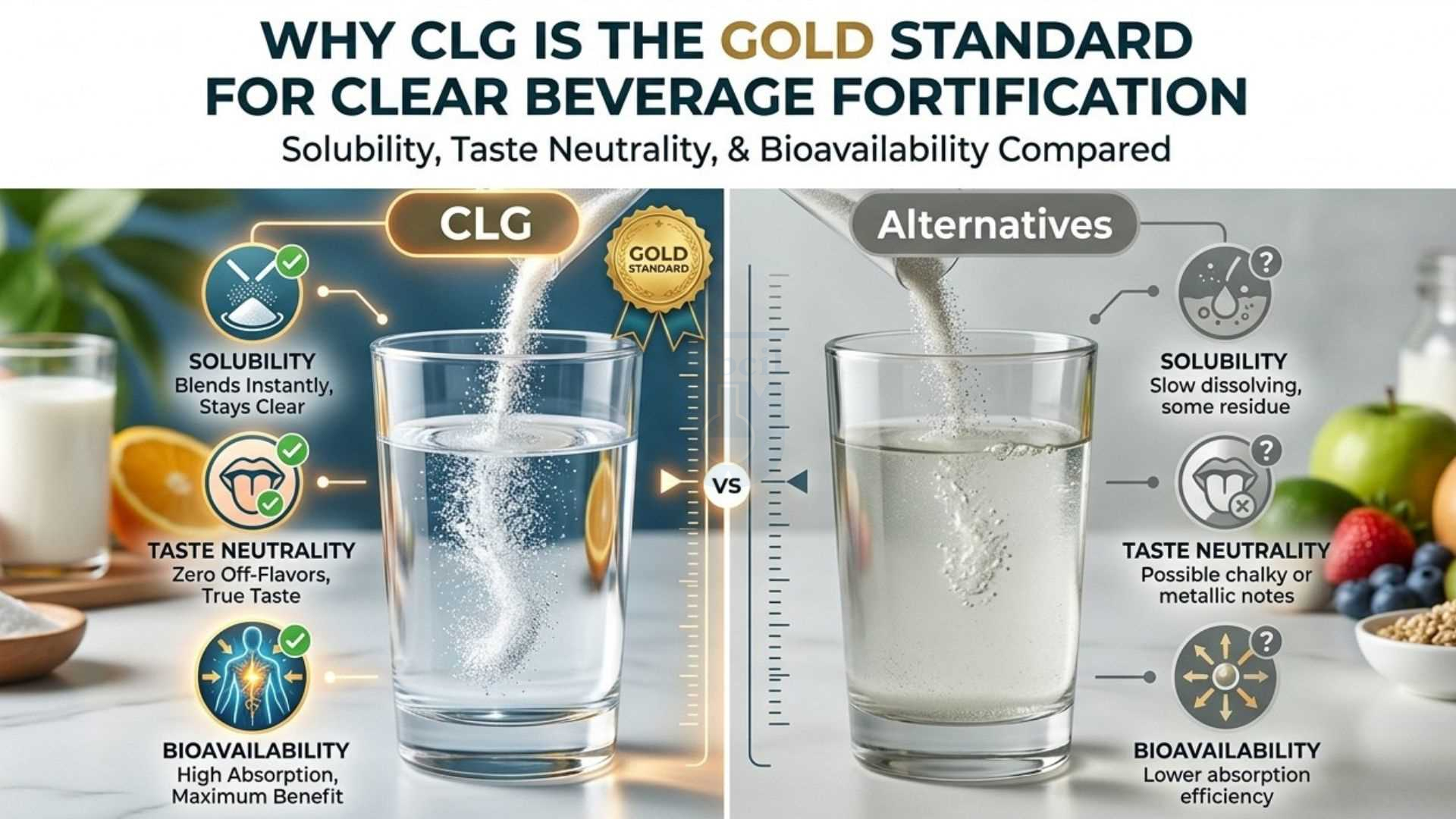
With a solubility of 20–40% in water — the highest among all common calcium salts — CLG dissolves completely in cold aqueous systems at neutral pH, producing no haze, no sediment, and no stability issues on the retail shelf. Calcium carbonate and calcium citrate simply cannot match this in a true clear beverage application. [1][2] - Taste Neutrality Means You Can Fortify Properly Without Ruining the Drink
CLG contributes no detectable bitterness, tartness, saltiness, or metallic notes — even at the concentrations needed to hit meaningful daily value claims. This is the differentiator that lets beverage brands actually fortify at therapeutic levels, rather than adding a token dose that barely registers on the nutrition panel. [3] - Good Bioavailability Completes the Picture
Solubility and taste mean nothing if the calcium does not absorb. Because CLG is an organic salt, its ionisation in the gastrointestinal tract does not depend on gastric acid — which means it delivers calcium effectively whether your consumer drinks it with a meal or on an empty morning commute. High-quality bulk CLG supply is available from WBCIL at www.wbcil.com. [1]
What Is Calcium Lactate Gluconate, and Why Is It Different?
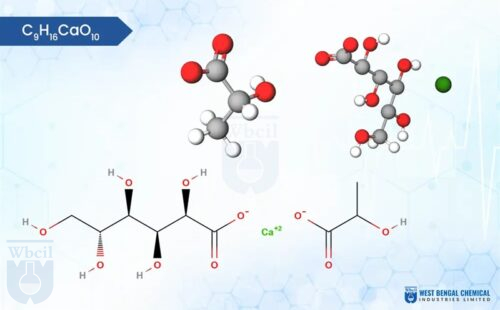
CLG is not simply a blend of calcium lactate and calcium gluconate thrown together. It is a double salt — a specific co-crystal structure of calcium, lactic acid, and gluconic acid that gives it properties neither component alone can achieve. The resulting compound, a white odourless crystalline powder, has a solubility profile that sits in a completely different category from any other common calcium salt. [1]
When you dissolve CLG in water, it ionises cleanly. There is no suspension, no haziness, no settling on the bottom of the bottle after 48 hours on a retail shelf. That behaviour — full, stable solubility in a cold aqueous system at neutral pH — is what makes it uniquely suited to clear beverage applications.
A bit of chemistry that actually matters
CLG achieves an initial solubility of 20–40% in water — far beyond what any other commonly used calcium salt can do. For comparison, calcium carbonate is essentially insoluble in water at neutral pH. Calcium citrate reaches about 1 g/L. Even calcium gluconate, one of CLG’s own parent compounds, has substantially lower solubility than the combined double salt. [1] [2]
This is not just a number. It translates directly into how much calcium you can actually get into a 250 ml functional water bottle without things going wrong — and in high-concentration syrup applications, it is the difference between a stable product and one that precipitates.
The lower elemental calcium percentage in CLG (12.5–13.5%) versus calcium carbonate (40%) is the number that sometimes gives procurement teams pause. But it is worth reframing this: you are not buying elemental calcium percentage, you are buying calcium that actually ends up dissolved in your product and then absorbed by your consumer. A high-percentage calcium salt that sits undissolved at the bottom of the bottle is delivering zero calcium to anyone.
Taste Neutrality: The Problem Nobody Talks About Enough
Ask any beverage formulator what kept them up at night during their last calcium-fortified water project, and they will probably say taste. It is the most common point of failure in clear beverage calcium fortification — and it gets worse as you increase the dose.
The taste problem with other calcium salts
Calcium chloride delivers calcium efficiently, but it has a distinctly salty and bitter character that even moderate concentrations make obvious. Calcium citrate can add a faint tartness that shifts the flavour of a fruit-flavoured water or isotonic drink in a direction the formula was not designed for. Even calcium lactate alone, at the higher concentrations needed for strong fortification claims, can introduce a slightly bitter note.
CLG is genuinely different in this regard. At concentrations used for standard beverage fortification, it contributes no detectable taste — neutral in flavour, neutral in aroma, and stable in colour. This means you can hit a meaningful label claim (say, 20–30% of the recommended daily intake per 250 ml serving) without the flavour team having to compensate with additional masking agents or reformulate the sweetener balance. [3]
Why this matters for high-concentration syrups?
One area where CLG’s taste neutrality becomes especially valuable is in concentrated calcium syrups — the kind used in dosing systems for food service, RTD production lines, or effervescent tablet applications. When you are working with a 2:1 or 4:1 concentrate, any off-note in the base salt gets amplified proportionally. CLG at these concentrations remains stable and clean.
WBCIL’s Calcium Lactate Gluconate is manufactured to ensure consistent organoleptic performance batch to batch — which matters commercially because a formulation that passes sensory at trial needs to pass sensory on the 500th production run just as reliably.
Formulator’s Note — WBCIL
“CLG has a very neutral, mild taste. This allows you to enhance the calcium percentage in your formulation — adding more powder to reach higher elemental targets — without making the beverage taste metallic or chalky. It is the gold standard for fortified juices and flavoured waters where the flavour profile must remain pristine.” — WBCIL Technical Blog, December 2025

Bioavailability: Does the Calcium Actually Reach the Body?
Getting calcium into a bottle is one challenge. Getting it into the bloodstream is another. For a fortification strategy to be meaningful, the calcium you put on the nutrition label needs to actually be absorbed.
Why organic salts outperform inorganic salts in beverage applications
Calcium carbonate is the most widely used calcium supplement globally — largely because of its low cost and high elemental calcium percentage.
But there is a catch: its absorption depends heavily on gastric acid. Studies consistently show that calcium carbonate bioavailability drops significantly when taken in the absence of food or in individuals with low stomach acid. [4]
Organic calcium salts, including the lactate and gluconate forms that make up CLG, do not have this dependency. Their solubility in the gastrointestinal tract is not pH-dependent in the same way. They ionise readily under a broader range of gastric conditions, which means the calcium is available for absorption whether the consumer drinks the beverage with a meal or on an empty stomach — the more typical scenario for functional water.
What published research says?
Research comparing calcium salt forms for beverage fortification has found that organic calcium salts demonstrate strong bioavailability performance. A crossover study published in a peer-reviewed nutrition journal found that serum calcium increased meaningfully more with organic salts (including lactate-based forms) compared to calcium carbonate, with organic salts showing a 38% higher peak increase in total serum calcium in some comparisons. [2]
For CLG specifically, its high water solubility directly facilitates ionisation in the stomach — and since ionised calcium is the form that crosses intestinal epithelial cells, better solubility directly translates to better absorption. Scientific reviews of human studies have noted that calcium lactate gluconate is both significantly and more consistently able to increase bone mineral density compared to other calcium salt forms. [1]
Published Research Reference
“The bioavailability of four different calcium salts was found to be almost identical… given an almost equivalent bioavailability of the four tested salts, we conclude that organic salts are well suited for fortification of beverages and increasing daily calcium intake.” — Scientific Research Publishing, Food and Nutrition Sciences, 2010 [2]
Regulatory Standing: CLG Is Cleared for Global Beverage Use
Before a calcium source goes into a beverage, it needs to be cleared — not just scientifically, but legally. This is an area where CLG’s track record is clean.
- The US FDA has affirmed both calcium lactate (21 CFR §184.1207) and calcium gluconate (21 CFR §184.1199) as Generally Recognized as Safe (GRAS) food substances [1]
- CLG is self-affirmed GRAS as a flavouring agent in beverages, beverage powders and dairy alternatives at up to 0.25%
- Under EU Regulation (EC) No. 1925/2006 on food fortification, both calcium lactate and calcium gluconate are on the positive list of approved mineral salts
- CLG meets the specifications of the US Pharmacopeia (USP), the Food Chemicals Codex (FCC), and EU Commission Regulation No. 231/2012
This broad regulatory clearance means CLG can be used across major export markets — US, EU, Middle East, Southeast Asia — without reformulation, which matters for brands building products for multiple geographies.
Sourcing Bulk CLG Powder for the Food Industry: What to Look For
Not all CLG on the market is the same. The compound’s performance in your formulation depends directly on the quality and consistency of the raw material — which is determined by the manufacturing process and quality controls behind it.
What WBCIL supplies?
West Bengal Chemical Industries Limited (WBCIL) supplies food-grade Calcium Lactate Gluconate manufactured under cGMP conditions with full quality documentation. Key specifications:
- Calcium content: 12.5–13.5% elemental calcium
- Appearance: White crystalline powder, odourless, tasteless
- pH (5% aqueous solution at 20°C): 6.0–8.0
- Heavy metals: Lead <1 ppm, Mercury <1 ppm, Arsenic <1.5 ppm, Fluoride <15 ppm
- Loss on drying: 5.0–10.0%
- Supplied in 20 kg polyethylene-lined paper bags; custom packaging available
WBCIL’s manufacturing facilities in Kolkata and Dahej, Gujarat, hold WHO-GMP and ISO certifications, with full batch traceability and Certificates of Analysis provided as standard. The company exports mineral salts to over 35 countries, including regulated markets in the US, EU, Middle East, and Southeast Asia.
Source CLG from WBCIL
High-purity food-grade Calcium Lactate Gluconate | cGMP & WHO-GMP certified manufacturing | Consistent batch-to-batch calcium content | Full CoA and regulatory documentation | Available for bulk supply globally | Contact: www.wbcil.com

- Heller M, et al. “Bioavailability and Solubility of Different Calcium-Salts as a Basis for Calcium Enrichment of Beverages.” Food and Nutrition Sciences, Scientific Research Publishing. 2010;1(2):53–58. scirp.org
- Straub D. “Calcium Supplementation in Clinical Practice: A Review of Forms, Doses, and Indications.” Nutrition in Clinical Practice. 2007;22(3):286–296. PMC / NCBI.
- Weaver CM, Heaney RP. “Calcium in Human Health.” Humana Press, 2006. Chapter on Food Fortification Strategies.
Calcium Lactate Gluconate (CLG) is widely considered the best calcium source for clear functional beverages because of its combination of properties.It has the highest solubility of all common calcium salts (20–40% in water), fully dissolves without causing turbidity, contributes no off-taste even at high doses, and offers good bioavailability independent of gastric acid. No other single calcium salt matches it on all three parameters simultaneously.
The difference is significant. Calcium citrate has a water solubility of around 1 g/L, which limits how much you can use in a clear beverage before running into stability issues. CLG achieves 20–40% initial solubility — roughly 200 times higher in practical terms. Additionally, calcium citrate can introduce a slight tartness at beverage-relevant concentrations, whereas CLG remains taste-neutral.
The answer is to choose a calcium salt with genuinely neutral organoleptic properties — which in practice means CLG. Avoid calcium chloride (salty-bitter), calcium carbonate (chalky), and high doses of calcium lactate alone (can be slightly bitter). CLG has no detectable taste contribution even at concentrations delivering 20–30% of the recommended daily calcium intake per serving, which is why it is the standard choice for premium fortified waters and clear functional drinks.
WBCIL (West Bengal Chemical Industries Limited) supplies food-grade Calcium Lactate Gluconate in bulk from their cGMP and WHO-GMP certified manufacturing facilities in India. The company exports to 35+ countries with full regulatory documentation, Certificates of Analysis, and custom packaging options. Enquiries and sample requests can be made at www.wbcil.com.
Yes. The US FDA has affirmed both calcium lactate (21 CFR §184.1207) and calcium gluconate (21 CFR §184.1199) as GRAS substances for food use. CLG is self-affirmed GRAS as a flavouring agent in beverages, beverage powders, and dairy alternatives. In the EU, both component salts appear on the positive list under Regulation (EC) No. 1925/2006 on food fortification. CLG meets USP, FCC, and EU specifications.