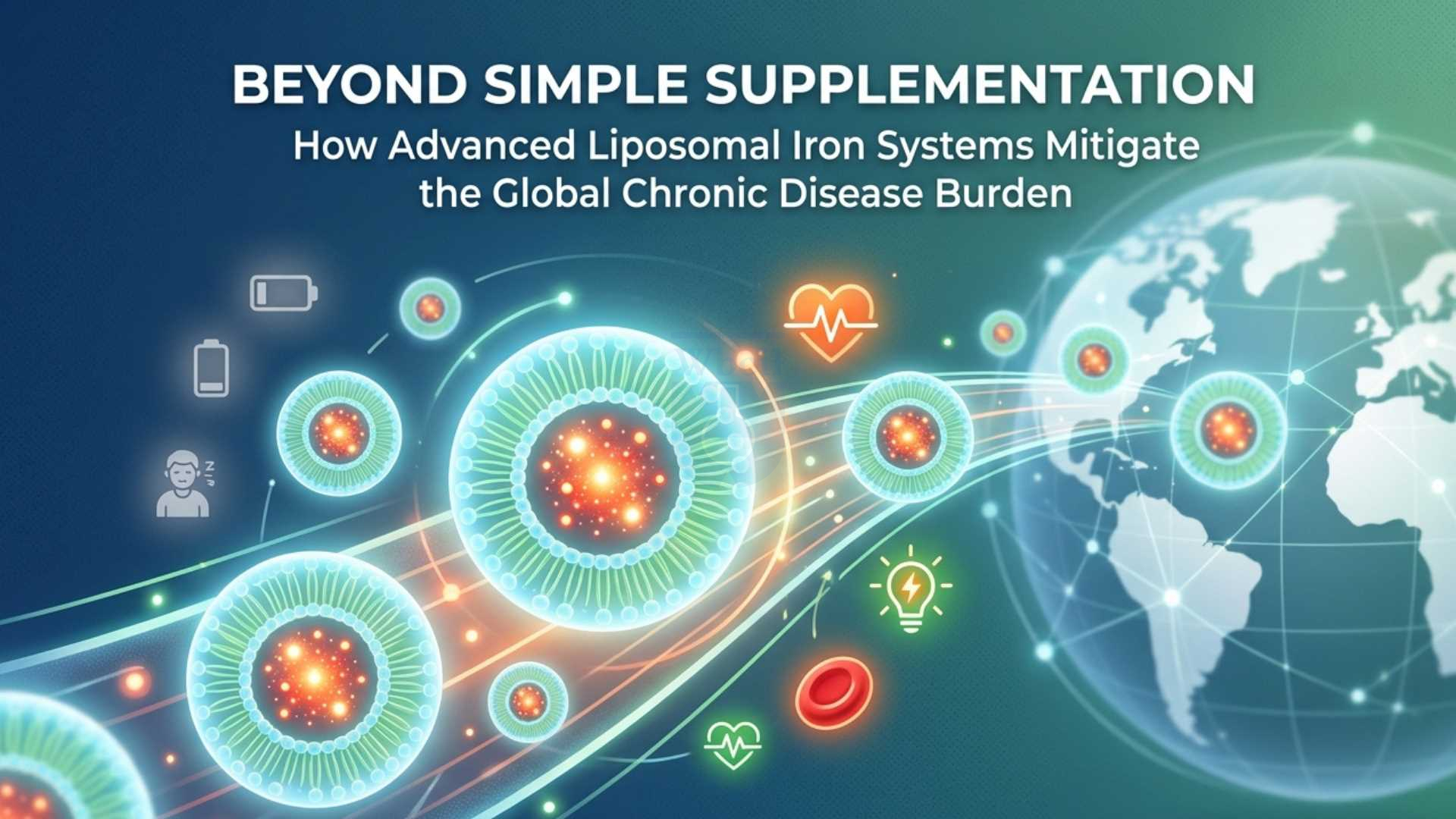
How Advanced Liposomal Iron Systems Mitigate the Global Chronic Disease Burden
Liposomal vs chelated iron efficacy is the defining metric in modern hematology, specifically as we look toward reducing global chronic disease burden through advanced nutrition. While traditional iron salts often fail due to poor tolerance, the debate surrounding liposomal vs chelated iron efficacy highlights a shift toward precision delivery.
Key Takeaways
- Liposomal vs chelated iron efficacy diverges dramatically in chronic inflammatory disease states due to liposomal iron’s unique capability to entirely bypass the hepcidin block.
- Liposomes utilize a lymphatic absorption route, allowing clinicians to achieve rapid, IV-like results without using needles.
- While standard Ferrous Bisglycinate bioavailability remains effective for general dietary deficiency, encapsulated nanotechnology provides the superior choice for iron-refractory patients.
The Global Landscape: Iron Deficiency as a Catalyst for Chronic Disease
Iron deficiency (ID) and iron deficiency anemia (IDA) affect over 2 billion people worldwide. Beyond traditional nutritional gaps, ID is increasingly recognized as a critical “impairment” that drives the global burden of disease, particularly in aging populations and those with chronic comorbidities.
- The Vicious Cycle: Chronic inflammatory states, such as Chronic Kidney Disease (CKD) and Inflammatory Bowel Disease (IBD), trigger the elevation of hepcidin [1]. This hormone degrades ferroportin, effectively preventing iron from entering the systemic circulation.
- Systemic Impact: This functional iron deficiency leads to reduced physical performance, cognitive decline, and increased all-cause mortality in elderly populations.
- A systematic review of iron supplements reveals that conventional oral treatments often fail during inflammation because they cannot bypass the hepcidin block.Liposomal vs. Chelated Iron: A Comparative Efficacy Analysis
When evaluating liposomal vs chelated iron efficacy, it is essential to understand the iron absorption pathways utilized by each. While both represent significant upgrades over traditional ferrous salts, their physiological impact differs based on the patient’s inflammatory status.
Comparative efficacy of liposomal iron versus ferrous bisglycinate
| Feature | Ferrous Bisglycinate (Chelated) | Liposomal Iron |
| Structure | Iron bound to two glycine molecules. | Iron encapsulated within a phospholipid bilayer. |
| Primary Pathway | Transporter (DMT1/peptide transporters) mediated absorption | Absorbed via M cells in Peyer’s patches via endocytosis; bypasses enterocytes [2]. |
| Hepcidin Bypass | Limited; subjected to hepcidin regulation. | Bypasses hepcidin regulation and directly enters the lymphatic system. |
| Clinical Strength | Ideal for dietary iron deficiency and pregnancy. | Superior for iron-refractory cases (CKD, IBD, Cancer). |
| Tolerability | ~25–50% mild adverse events. | <5%; profile nearly identical to a placebo. |
For example, the ferrous bisglycinate bioavailability remains high for general supplementation, but in chronic disease management, where oral iron delivery innovations are required to overcome malabsorption, liposomal vs chelated iron efficacy diverges.
The “Trojan Horse” Mechanism: Why Delivery Matters
West Bengal Chemical Industries Limited (WBCIL) emphasizes that in chronic disease, the problem isn’t just the dose but the delivery. Available iron pharmacokinetics study data suggest that the “Trojan Horse” approach is the most effective way to improve patient outcomes.
- Liposomal Encapsulation Efficiency: WBCIL’s Lipoedge technology achieves an encapsulation efficiency of ≥80%, shielding the iron molecule until it reaches optimal absorption sites.
- The Lymphatic Shunt: By utilizing M-cell endocytosis, the iron avoids the liver’s hepcidin-driven “gatekeeping”. This allows for a rapid increase in haemoglobin of 1.5–2.0 g/dL within 4 weeks, a rate previously achievable only with intravenous (IV) therapy.
- Iron Absorption Pathways: By shifting the absorption from the divalent metal transporter 1 (DMT1) to the lymphatic system, we witness the true pharmacokinetic advantages of liposomal iron in B2B manufacturing.
By shifting the absorption pathway from traditional enterocyte pathways, this ‘Trojan Horse’ mechanism highlights a major divergence in liposomal vs chelated Iron efficacy, allowing encapsulated iron to bypass systemic blocks that still restrict chelated forms.
Commercial Spotlight: WBCIL’s Pioneering R&D in Liposomal Technology
While chelated iron improves upon basic salts, it remains limited by standard intestinal pathways, therefore, optimizing liposomal delivery is how we overcome these barriers to ensure superior clinical outcomes for chronic disease patients. At West Bengal Chemical Industries Limited (WBCIL), this transition was fuelled by a singular mission: to solve the absorption and tolerance issues that heavily skew the debate on liposomal vs chelated Iron efficacy.
As a WHO-GMP certified manufacturer, we recognize that for a patient with a chronic disease, a supplement is only as good as its delivery system, and optimizing this molecular architecture is how we ensure superior clinical outcomes.
The Lipoedge Platform: Engineering Precision
Our R&D team specifically engineered the Lipoedge platform to address the extreme chemical sensitivity of minerals like iron and CoQ10. In traditional forms, iron is highly reactive, often causing oxidative stress when it comes into contact with the gastric mucosa. Lipoedge changes this narrative through three scientific pillars:
Nanometric Vesicle Optimization: We meticulously control the diameter of each liposome to ensure it is small enough to be engulfed by M-cells but robust enough to carry a meaningful payload.
Colloidal Stability: By maintaining a precise surface charge, i.e., a highly negative zeta potential of less than -30 mV, we prevent the particles from aggregating together.
Phospholipid Integrity: Utilizing non-GMO sunflower-derived phosphatidylcholine, our bilayers mimic human cell membranes, facilitating seamless fusion and absorption.
Bridging the Gap: Oral vs. IV Iron
For years, the medical community accepted a massive gap between oral and intravenous (IV) iron. Oral was considered “slow and difficult,” while IV was “fast but invasive.” WBCIL’s nanotechnology is effectively bridging this gap.
This ability to close the gap between oral and needle-based therapies is the ultimate proof of liposomal vs chelated iron efficacy, proving that advanced encapsulation can achieve IV-like clinical outcomes that traditional chelated minerals simply cannot replicate.
Our portfolio extends beyond iron to include Liposomal Magnesium, Zinc, Vitamin C, and more, all designed to the same rigorous stability protocols.
Conclusion: The Future of Iron Replacement
The shift from basic mineral salts to sophisticated nano-delivery systems represents a foundational pivot in how we approach IDA- one of the major contributors to global chronic disease burden. When we analyze liposomal vs chelated iron efficacy, it becomes clear that “more iron” is rarely the answer; rather, “smarter iron” is the mechanical necessity.
At West Bengal Chemical Industries Limited (WBCIL), we believe that the brands that lead in 2026 will be those that understand the electric language of biology. As a leader in liposomal API manufacturing, WBCIL leverages the pharmacokinetic advantages of liposomal iron in B2B manufacturing that empower brands to deliver true clinical results.
The future of hematology is not just about supplementation, it is about precision. Through the science of encapsulation, we are not just treating anemia; we are restoring quality of life, one vesicle at a time.
As we move deeper into 2026, the shift toward high-bioavailability iron sources is accelerating. At WBCIL, we are proud to lead as the best liposomal iron supplement, ensuring that the electric language of biology is respected in every molecule we produce.
Revolutionize your formulation today. Visit https://www.wbcil.com/ for more details on next-generation delivery.

Patients with CKD or IBD have elevated hepcidin, which blocks Iron Absorption Pathways in the enterocytes. Liposomal iron uses a lymphatic route to bypass this block, whereas chelated iron still relies on cellular pathways sensitive to hepcidin. This is a core determining factor in Liposomal vs Chelated Iron Efficacy.
No. Because the iron core is fully sequestered within a lipid bilayer, there is no direct contact with sensory receptors in the mouth.
While not a universal replacement, clinical data suggests it can delay or eliminate the need for IV administration in selected iron-refractory patients.
A systematic review of Iron supplements shows that both liposomal and chelated iron exhibit absorption rates 3 to 5 times higher than conventional ferrous sulfate.
In a healthy gut, ferrous bisglycinate bioavailability is excellent. However, when comparing liposomal vs chelated Iron efficacy, data favors the liposomal form in patients with high inflammation or gastric sensitivity.
Yes, it is a flagship product. Our West Bengal Chemical Industries Limited API List includes pharmaceutical-grade minerals like Liposomal Iron, Magnesium, Zinc, Calcium etc.
Liposomal technology eliminates the harsh metallic taste and severe gastrointestinal side effects (like nausea, constipation, and stomach pain) common with traditional iron supplements, making the treatment easy to tolerate over long periods and dramatically improving patient compliance in chronic anemia.