Solid vs Liquid Liposomes: Stability & Logistics Guide
Pharmaceutical manufacturers face a critical decision when selecting liposomal delivery formats that balance therapeutic efficacy with practical distribution requirements across diverse market conditions. The solid vs liquid liposomes debate extends beyond laboratory performance to encompass real-world challenges such as temperature fluctuations during transport, limitations in storage infrastructure, and shelf-life economics. Liquid formulations offer immediate usability but require strict cold chain management, which many emerging markets cannot reliably guarantee throughout the supply network. Solid formats eliminate refrigeration dependencies but require additional processing steps that increase initial manufacturing complexity and capital investment.
In this guide, you will discover how formulation chemistry, stability science, and distribution logistics determine which format best serves your specific pharmaceutical applications.
Key Takeaways:
- Liquid liposomes are prone to hydrolysis and oxidation, limiting their shelf-life to 12-24 months under refrigeration.
- Solid formats achieve 36-60 months of stability at room temperature through freeze-drying or spray-drying processes.
- Application requirements and target-market infrastructure determine the optimal format selection for pharmaceutical manufacturers.
Quick Answer: Solid liposomes offer 36-60 month stability at room temperature, whereas liquid forms require refrigeration and have 12-24 month shelf-life limits.
What Are Liquid and Solid Liposome Formulations?
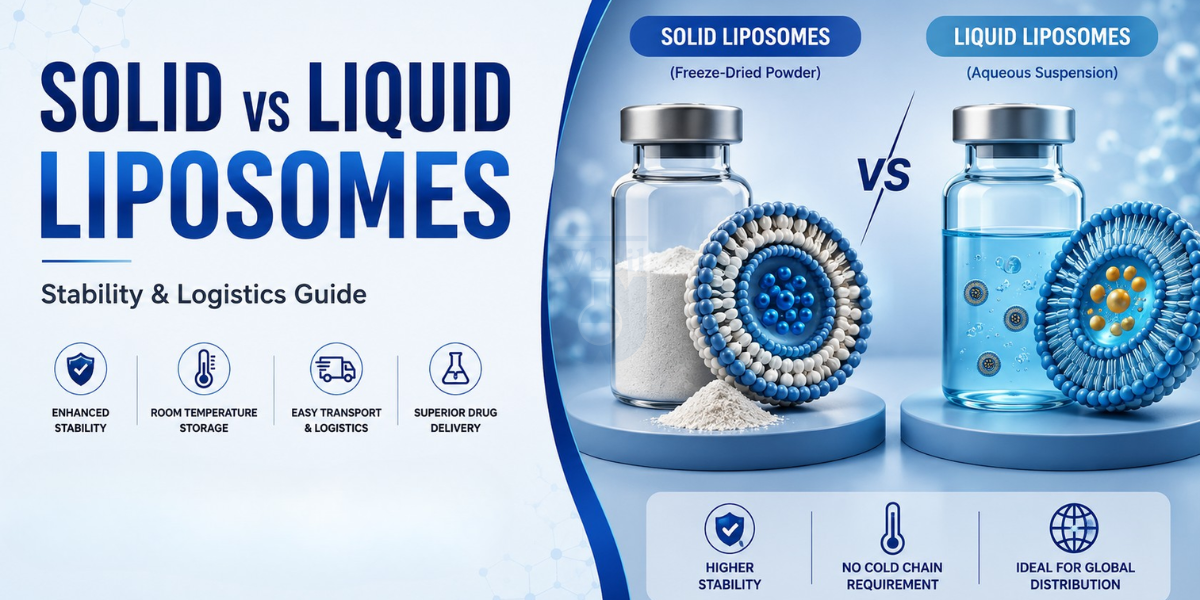
Liquid liposomes exist as aqueous dispersions where phospholipid vesicles float in water-based solutions. These spherical structures contain an inner water core surrounded by lipid bilayers. Manufacturers prepare them through high-pressure homogenization or thin-film hydration methods. The format allows immediate use without reconstitution steps. However, you need refrigerated storage at 2-8°C to maintain vesicle structure and prevent cargo leakage from the encapsulated compounds.
Solid liposome formats include freeze-dried powders, spray-dried particles, and proliposome granules that form vesicles upon contact with water. Freeze-drying removes water by sublimation under vacuum conditions while preserving lipid structure with cryoprotectants such as trehalose or sucrose. Spray-drying converts liquid suspensions into dry powders by rapidly evaporating the solvent at controlled temperatures.
Both methods extend shelf-life beyond 36 months at room temperature. WBCIL produces both formats for pharmaceutical and nutraceutical applications.
Why Liquid Liposomes Face Storage Stability Problems
The solid vs liquid liposomes debate centres on a fundamental issue: aqueous dispersions undergo chemical and physical degradation that compromises product efficacy over time, particularly in warm climates where temperature control is difficult throughout distribution chains.
- Phospholipid Hydrolysis: Water molecules attack ester bonds in phospholipid molecules, which creates lysophospholipids and free fatty acids that destabilise vesicle walls. This degradation accelerates at pH levels below 6.0 or above 8.0, and its rate doubles with every 10°C increase above standard refrigeration conditions.
- Oxidation Damage: Oxygen exposure triggers peroxidation reactions in unsaturated fatty acids, especially in egg or soy phosphatidylcholine formulations. The resulting lipid peroxides fragment the bilayer structure, causing colour changes, off-odours, and cargo leakage that significantly reduce therapeutic effectiveness.
- Phospholipid Bilayer Integrity: Individual liposomes cluster together and fuse when electrostatic repulsion decreases or mechanical stress occurs during transport. The aggregation increases particle size distribution beyond acceptable pharmaceutical specifications and reduces the surface area needed for cellular uptake and absorption.
- Temperature Excursions: Freezing creates ice crystals that puncture vesicle membranes, while heat above 25°C accelerates all degradation pathways simultaneously. Even brief temperature spikes during shipping or storage permanently damage the formulation, which explains why liposomal technology development now focuses on formats that tolerate ambient conditions without refrigeration requirements.
- Encapsulated Drug Leakage: Active pharmaceutical ingredients escape through compromised bilayers at rates of 2-5% per month in liquid formulations. This leakage means products lose potency before reaching patients, particularly in markets where cold-chain infrastructure remains unreliable or nonexistent throughout the supply chain.

How Solid Liposomes Solve Manufacturing Challenges
Pharmaceutical manufacturers adopt solid formats because they eliminate water-related degradation pathways while maintaining the structural benefits of liposome nanoparticles synthesis for drug delivery applications.
Freeze-Drying Extends Shelf-Life by Three Years
Lyophilisation removes water by sublimation at temperatures between -40°C and -50°C under vacuum. Research published in Pharmaceutics demonstrates that freeze-dried liposomes with optimised cryoprotectants maintain structural integrity for extended periods at room temperature storage [1]. The process protects phospholipids from hydrolysis, which typically degrades liquid formulations within 12-18 months at refrigeration temperatures. WBCIL applies trehalose or sucrose at specific lipid-to-sugar ratios to prevent fusion and maintain bilayer spacing during freezing.
Spray-Drying Reduces Production Time Substantially
This continuous process converts liquid liposomal suspensions into dry powder within minutes, compared to the batch cycles required for freeze-drying. The method is suitable for thermostable APIs and enables higher production rates for commercial-scale manufacturing. Studies confirm that spray-dried formulations achieve stability profiles comparable to those of freeze-dried alternatives when process parameters are properly optimised.
Room Temperature Storage Cuts Distribution Costs
Solid formats eliminate the need for a cold chain, reducing substantial expenses for refrigerated transport and specialised packaging materials. Stability studies published in ScienceDirect confirm that properly formulated dried liposomes exhibit minimal degradation under accelerated stability conditions at elevated temperatures and controlled humidity [2]. This temperature resilience proves essential for Indian manufacturers targeting markets where consistent refrigeration infrastructure does not exist throughout the supply chain.
Reconstitution Restores Original Vesicle Structure
When you add sterile water or buffer solutions to dried liposomes, vesicles reform within seconds with particle sizes matching pre-lyophilisation specifications. Quality control data show that reconstituted formulations achieve high retention of the original encapsulation efficiency when a properly selected lyoprotectant and optimal drying cycles are used during the manufacturing of liposomal API products.
Cost Analysis: Production Economics for Manufacturers
Manufacturing economics shift significantly when you evaluate total lifecycle expenses rather than just initial production costs for liposomal pharmaceutical development and commercialisation.
- Freeze-drying systems require a higher initial investment than liquid processing equipment, but spray-drying is the most capital-intensive option for manufacturers entering liposomal production.
- Research on pharmaceutical stability confirms that liquid liposomes require continuous refrigeration throughout storage and distribution, which adds recurring costs that solid formats eliminate through ambient-temperature stability.
- Liquid formulations require specialised containers with oxygen barriers and moisture protection, while solid formats use simpler packaging systems that reduce material expenses per unit across production volumes.
- Studies published in PMC journals demonstrate that solid liposomal encapsulations maintain stability for extended periods, enabling flexible production scheduling and reducing losses from expired inventory compared to shorter-lived liquid formulations.
- ICH guidelines mandate that temperature-sensitive liquid formulations undergo stability testing at multiple storage conditions, while ambient-stable solid formats require fewer testing conditions and reduce analytical expenses throughout development.
Which Format Suits Your Pharmaceutical Application?
Application requirements and target-market conditions determine whether solid or liquid liposomal formulations deliver optimal therapeutic outcomes for your specific pharmaceutical development goals.
Cancer Drug Delivery Favours Liquid Formulations for Precise Dosing
Oncology applications require precise dosage control and rapid bioavailability, where liquid liposomes excel through direct intravenous administration without reconstitution. Research published in PMC journals demonstrates that liposomal doxorubicin and other cancer therapeutics achieve superior tissue targeting when delivered as sterile liquid dispersions [3]. The format allows hospital pharmacists to prepare custom concentrations for patient-specific dosing protocols while maintaining vesicle integrity throughout preparation.
Oral Supplements Perform Better as Solid Formulations
Nutraceutical products benefit from solid liposome formulations because they withstand gastric acid exposure and provide controlled release throughout the digestive tract, enhancing absorption. Spray-dried and freeze-dried formulations maintain encapsulation efficiency above 80% during tablet compression or capsule filling processes. Your customers receive consistent potency levels without the metallic taste associated with liquid mineral supplements that contact taste receptors directly.
Topical Applications Require Format-Specific Considerations
Cosmetic and dermatological products use both formats depending on penetration requirements and product stability needs under bathroom storage conditions with high humidity and temperature fluctuations. Stability research documented in pharmaceutical journals shows that solid liposome incorporation into creams and serums provides better shelf stability than pre-formed liquid vesicles [4]. However, liquid formulations offer immediate skin penetration for time-sensitive active ingredients such as vitamin C or retinoids.
Export Markets Drive Format Selection Based on Climate
Tropical and subtropical export destinations favour solid formulations because they tolerate temperature excursions during shipping and customs delays without degrading or losing potency. European and North American markets accept both formats, as cold chain infrastructure remains reliable, but solid versions offer cost advantages for price-sensitive generic drug segments.
Regulatory Pathways Differ Between Liquid and Solid Submissions
Drug regulatory authorities require different stability data sets depending on storage recommendations, with liquid formulations requiring additional freeze-thaw studies and accelerated-temperature stability protocols compared to ambient-stable solid formulations.
Final Thoughts
Format selection requires you to weigh stability advantages against application-specific performance needs and distribution infrastructure realities in your target markets. Start by mapping your supply chain temperature control capabilities from manufacturing facility to end-user delivery points before committing to liquid formulations. Conduct accelerated stability studies at conditions matching your actual distribution environment rather than ideal laboratory settings to predict real-world shelf-life accurately. Consider hybrid approaches in which solid formats serve temperature-sensitive markets, while liquid versions address clinical applications that demand immediate administration without reconstitution delays.
WBCIL supports pharmaceutical manufacturers through this decision process, leveraging technical expertise across both formulation types and custom stability testing protocols.

- Yu JY, Chuesiang P, Shin GH, Park HJ. Post-Processing Techniques for the Improvement of Liposome Stability. Pharmaceutics. 2021 Jul 5;13(7):1023. doi: 10.3390/pharmaceutics13071023. PMID: 34371715; PMCID: PMC8309137.
- Sainaga Jyothi, V.G.S., Bulusu, R., Venkata Krishna Rao, B., Pranothi, M., Banda, S., Kumar Bolla, P. and Kommineni, N. (2022). Stability characterization for pharmaceutical liposome product development with focus on regulatory considerations: An update. International Journal of Pharmaceutics, 624, p.122022.
- Viegas C, Patrício AB, Prata JM, Nadhman A, Chintamaneni PK, Fonte P. Solid Lipid Nanoparticles vs. Nanostructured Lipid Carriers: A Comparative Review. Pharmaceutics. 2023 May 25;15(6):1593. doi: 10.3390/pharmaceutics15061593. PMID: 37376042; PMCID: PMC10305282.
- Yu JY, Chuesiang P, Shin GH, Park HJ. Post-Processing Techniques for the Improvement of Liposome Stability. Pharmaceutics. 2021 Jul 5;13(7):1023. doi: 10.3390/pharmaceutics13071023. PMID: 34371715; PMCID: PMC8309137.
Solid liposomes remove water by freeze-drying or spray-drying, eliminating hydrolysis and oxidation degradation pathways completely. The dry format preserves the phospholipid bilayer structure for 36-60 months at room temperature, without refrigeration.
Properly formulated freeze-dried liposomes reconstitute within 30-60 seconds when you add sterile water or buffer solutions. Reconstituted vesicles maintain 85-95% of original particle size and encapsulation efficiency with correct cryoprotectant selection.
Water content in liquid formulations accelerates phospholipid hydrolysis and oxidative reactions that break down vesicle membranes. Temperatures above 8°C double degradation rates, which causes drug leakage and reduces therapeutic potency significantly.
Nutraceutical and oral pharmaceutical manufacturers favour solid formats because they withstand ambient storage conditions and can be incorporated into tablets. Oncology and hospital applications continue to use liquid liposomes for direct intravenous administration without reconstitution.
Spray-drying uses rapid hot-air evaporation to remove water within minutes, compared to freeze-drying’s 24-48 hour cycle. Both methods produce stable, dry powders, but spray-drying is better suited to heat-stable compounds and offers faster production throughput.