

Why Standard ALA Fails and Liposomal Encapsulation Wins
Employing liposomal encapsulation technology in pharma completely redefines how we deliver fragile active ingredients to the human body. Liposomal encapsulation enables manufacturing labs to bypass the massive degradation barriers during digestion that have limited the therapeutic outcome of traditional oral supplements for decades.
Alpha-Lipoic Acid (ALA), or thioctic acid, is a champion antioxidant capable of scavenging free radicals in both fat and water-soluble cellular environments. For years, B2C brands marketed standard ALA for nerve health, glucose metabolism, and cellular energy. Yet, consumers were never happy! They routinely faced a frustrating reality: large doses yielded disappointing, inconsistent real-world therapeutic outcomes as raw ALA breaks down when exposed to light, heat, and stomach acid, leaving very little active compound to reach systemic circulation.
Therefore, wrapping this fragile molecule in a protective phospholipid bilayer could be a potential solution in pharma!
Key Takeaways
- Raw alpha-lipoic acid denatures at temperatures > 400C, rendering it useless during high-speed blending.
- Standard oral ALA exhibits an abysmal bioavailability of around 30% due to first-pass metabolism.
- Encapsulating the ingredient in a phospholipid matrix guards it against gastric fluids and enzyme attack.
- LipoEdge Liposomal ALA, engineered with high quality precision maximises cellular uptake and bypasses the shortcomings of traditional ALA
Quick Answer: Standard alpha-lipoic acid fails because it cannot withstand processing heat or the stomach’s harsh, acidic environment. Liposomal encapsulation technology in pharma works by protecting ALA within a biomimetic phospholipid bilayer that shields it from thermal degradation, bypasses hepatic first-pass metabolism, and enables direct fusion with cell membranes, thereby substantially increasing plasma concentrations.
The Fundamental Failures of Standard Alpha Lipoic Acid
To understand why standard alpha lipoic acid fails in supplement manufacturing, we must look directly at its chemical weaknesses.
Poor Water Solubility and Absorption Issues
ALA has a unique molecular ring structure with sulphur atoms attached to a fatty acid tail. This renders it highly lipophilic, yet it dissolves in the aqueous gastric environment. Instead of breaking down into a clear, absorbable solution, raw ALA powder clumps together in the stomach, preventing absorption across the intestinal wall.
Thermal and Oxidative Instability Problems
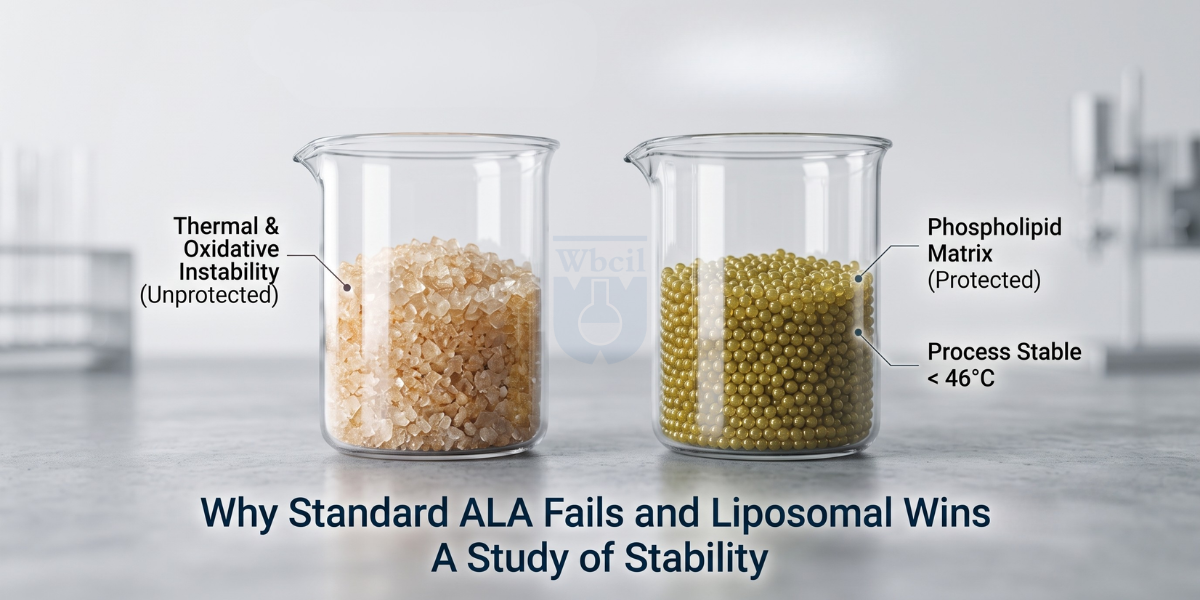
Raw ALA has an incredibly low melting point, hovering between 460C and 490C . The friction generated during standard industrial blending or high-speed tabletting easily crosses this threshold, causing the raw powder to polymerise into a gummy, insoluble plastic mass. Apart from this, ambient light and oxygen trigger rapid photo-oxidation, degrading the batch before it can be packaged.
Rapid Hepatic First-Pass Metabolism
Raw thioctic acid or ALA enters portal circulation and is immediately targeted by the hepatic beta-oxidation. This aggressive first-pass metabolism slashes its plasma half-life to a meagre 30 minutes, reducing its chances of reaching peripheral nerves or muscle tissues in therapeutic amounts.
Inconsistent Bioavailability Challenges
Standard oral ALA exhibits inconsistent absorption. Blood levels vary widely from person to person, depending on stomach acidity, food intake, and baseline liver enzyme profiles. This unpredictability makes standard ALA highly unreliable for clinical nutrition or pharmaceutical applications.
Liposomal Encapsulation Technology Breakthrough
Developing liposomal encapsulation technology in pharma to build a smarter carrier that respects human physiology was a breakthrough scientific development.
Phospholipid Matrix Protection Mechanisms
A high-purity phospholipid-based liposomal matrix made of natural lipids automatically organises into concentric spheres when hydrated under precise conditions. The hydrophobic tails turn inward, away from water, encapsulating the bioavailable thioctic acid raw material. This matrix acts as an armour, sealing the fragile antioxidant away from gastric acids and free radicals.
Controlled Release and Targeted Delivery
A liposome does not dissolve instantly in the stomach. Instead, the lipid bilayers protect the ingredients as they pass through the digestive tract and ensure a slow, steady release of the actives, preventing a sudden spike in plasma levels that would overwhelm the system and providing a continuous, metered release of the antioxidant cargo [1].
Enhanced Cellular Membrane Fusion
The real magic occurs when the liposome meets an enterocyte. Because the liposomal phospholipid bilayer mimics our own cell membranes, it completely bypasses saturable active transport pathways. The particle merges directly with the intestinal cell and, through endocytosis and passive diffusion, enters the cell intact or releases the actives slowly into the cell. This structural trick is the main mechanism for improving cellular uptake of thioctic acid via liposomes, delivering the active intact into the lymphatic circulation.
Stability Optimisation Through Encapsulation
The utilisation of liposomal encapsulation technology in pharma has significantly extended the lifespan of ALA. It stops the polymerisation reaction completely. The active molecules cannot interact with ambient oxygen, stabilising the compound against processing heat and ensuring long-term shelf storage.
Bioavailability Superiority: Clinical Evidence
Applying liposomal encapsulation technology in pharma completely flattens the volatile curves seen with standard raw powder.
Comparative Absorption Studies
Human clinical trials tracking area under the curve (AUC) profiles confirm a massive difference when looking at liposomal encapsulation vs standard alpha lipoic acid bioavailability. Liposomal encapsulation ensures a 3-fold increase in overall systemic absorption compared to unencapsulated equivalents [1, 2].
Plasma Concentration Improvements
Standard ALA creates a brief, sharp blood spike that plummets below functional levels within an hour. Liposomal delivery produces a broad, sustained concentration curve. It keeps the active antioxidant at a steady therapeutic plateau in the bloodstream for hours, providing prolonged cellular defense.
Tissue Distribution Enhancement
By entering directly into lymphatic circulation, liposomes evade early liver metabolism. The intact liposomes travel much farther through systemic circulation, delivering active thioctic acid directly to peripheral tissues, microcapillaries, and deep nerve cells that need it most.
Pharmaceutical Manufacturing and Stability Advantages
Scaling a lab concept up to an industrial facility is where most advanced supplement formulations break down. Fortunately, adopting liposomal encapsulation technology in pharma gives production teams a massive edge on the manufacturing floor. Adopting this technology in LipoEdge, allows us to ground these advanced production metrics in predictable, real-world data.
Thermal Protection During Processing
When handling solid-state liposomal ingredients, the outer phospholipid bilayer acts as a shock absorber. It cushions the inner core from the high shear and localised friction heat of industrial blenders, preventing the ALA from melting or turning sticky during processing.
Shelf-Life Enhancement Mechanisms
Liposomal encapsulation improve the shelf-life of alpha lipoic acid, by acting as an oxygen barrier. The tightly packed lipid heads create a physical barrier that prevents air and moisture from reaching the core molecules. This halts rancidity and chemical breakdown, extending shelf life from a few unstable months to several years at room temperature.
Solid Dosage Form Integration
Liposomes are not restricted to liquid formats, which are prone to leaks and microbial growth, but can be seamlessly integrated into a standard capsule. Advanced engineering allows us to convert these lipid matrices into free-flowing, dense powders that drop cleanly into automatic capsule machines without sticking or jamming.
Pharmaceutical Applications and Commercial Advantages
From a commercial viewpoint, deploying liposomal encapsulation technology in pharma allows premium brands to prove their performance claims with raw data rather than marketing buzzwords.
Diabetic Neuropathy Formulation Strategies
When formulating diabetic neuropathy supplements with liposomal ALA, maximizing peripheral nerve delivery is everything. Patients with diabetic nerve pain require stable, daily doses to manage oxidative stress in their limbs. Standard ALA supplements require high doses that trigger severe acid reflux and stomach burn. Switching to a liposomal form lets brands deliver a gentler, more effective dose that eliminates stomach irritation while providing vastly superior tissue absorption.
WHO-GMP Manufacturing Standards
Scaling up to pharma-grade liposomal ALA manufacturing requires strict manufacturing controls. Relying on validated liposomal structures makes meeting WHO-GMP protocols simple, ensuring consistent particle sizes, reliable encapsulation efficiency, and reproducible batch performance.
Scaling up to pharma-grade liposomal ALA manufacturing requires strict manufacturing controls to survive regulatory scrutiny. At West Bengal Chemical Industries Limited (WBCIL), we meet strict WHO-GMP that guarantee uniform particle sizes, dependable encapsulation efficiency, and flawless batch-to-batch reproducibility.
By matching your scaling needs with a fully optimized, reproducible production blueprint, WBCIL ensures that your commercial batches mirror our clinical prototypes with zero variance
Regulatory Documentation Support
Beyond physical stability, WBCIL provides brands with clear, verified scientific data on physicochemical characterisation and in vitro assays that meet global compliance and prove your product’s structural integrity and efficiency
Whether you are filing international registrations or facing tough regulatory clearances, WBCIL provides the rigorous, patent-backed scientific evidence needed to move your product through global compliance gates smoothly and without delay.

Final Thoughts
Standard alpha-lipoic acid fails because it simply cannot handle the physical demands of processing or the biological environment of the human body. Embracing liposomal encapsulation technology in pharma completely solves these processing and absorption pain points. At WBCIL, we recognise that next-generation product lines demand advanced, predictive delivery engineering rather than generic supplement mixing. Our LipoEdge liposomal ALA is manufactured using specialised liposomal encapsulation technology, ensuring unparalleled colloidal stability and rapid absorption metrics.
To know more, visit https://www.wbcil.com/

It maximizes water solubility, shields delicate molecules from stomach acids, evades aggressive hepatic first-pass liver metabolism, and boosts cellular uptake by merging directly with cell membranes.
The protective phospholipid shell absorbs environmental friction and heat, keeping individual ALA molecules isolated so they cannot melt, polymerise, or break down during production.
It forms a tight physical barrier that protects it from oxygen and moisture, preventing the active ingredient from degrading during long-term storage.
Yes. LipoEdge liposomal ingredients are crafted into free-flowing, non-hygroscopic powders that feed smoothly through high-speed capsule machinery without clogging or sticking.
Standard alpha-lipoic acid (ALA) possesses a low melting temperature. The mechanical friction and localised heat generated during tabletting push the raw material past this point. This causes the unencapsulated thioctic acid to polymerise into a sticky mass. Additionally, raw ALA powder is highly sensitive to ambient light and oxygen, leading to rapid photo-oxidation and loss of antioxidant potency before packaging.
