How Liposomal Encapsulation Is Revolutionizing the Shelf Life of Cosmeceutical APIs?
Some of the most powerful cosmeceutical ingredients are also the most fragile.
Retinol degrades in light. Vitamin C oxidizes quickly. Peptides break down before they reach the skin. These are not minor formulation challenges — they are the reason many high-performance skincare products fail to deliver what they promise.
Liposomal encapsulation is changing that.
This technology, originally developed for pharmaceutical drug delivery, is now reshaping how cosmeceutical brands protect, stabilize, and deliver active pharmaceutical ingredients (APIs). It is not a marketing claim. It is a structural solution to a chemistry problem.
This article explains exactly how liposomal technology works, why it matters for API stability and shelf life, and what formulators need to consider when choosing it.
Key Takeaways:
- Structural Protection: Liposomal encapsulation uses a phospholipid bilayer to create a physical shield, protecting fragile APIs like Retinol and Vitamin C from oxidation, light, and pH-driven degradation.
- Enhanced Performance: By mimicking human cell membranes, liposomes improve skin penetration and provide a controlled release, ensuring active ingredients remain potent until they reach the target site.
- Manufacturing Standards: The success of these formulations depends on technical precision, requiring manufacturers to provide documented particle size, encapsulation efficiency, and WHO GMP compliance.

What Is Liposomal Encapsulation?
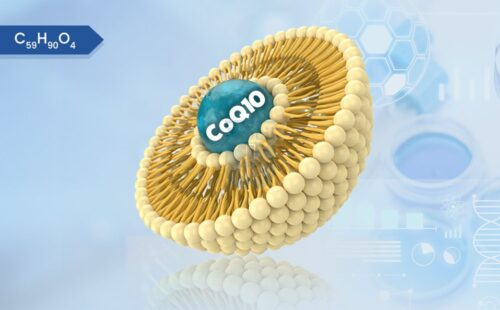
A liposome is a tiny, spherical vesicle made from phospholipids — the same type of molecules that form human cell membranes.
Phospholipids naturally arrange into a bilayer. This bilayer forms a closed shell with two distinct compartments:
A water-based (hydrophilic) core in the center
A lipid-based (hydrophobic) shell in the bilayer walls
This dual structure is what makes liposomes uniquely suited for cosmeceutical applications. A liposome can carry water-soluble actives inside its core and oil-soluble actives within its lipid bilayer — sometimes both at once.
The active ingredient is enclosed within this shell, physically separated from the outside environment. That separation is the foundation of everything liposomal technology offers.
Why Cosmeceutical APIs Are So Difficult to Stabilize?
Before understanding the solution, it helps to understand the problem.
Cosmeceutical APIs are biologically active compounds. That activity is also what makes them reactive.
Common Stability Threats
Oxidation Retinol (Vitamin A) and ascorbic acid (Vitamin C) are highly prone to oxidation. Atmospheric oxygen triggers chemical degradation and it reduces potency and sometimes generating irritant byproducts.
Photodegradation UV and visible light can break down actives like retinol, certain peptides, and plant-based polyphenols. Once degraded, they no longer function as intended.
pH Sensitivity Vitamin C (L-ascorbic acid) is stable only at a low pH (below 3.5). Peptides can hydrolyze at extreme pH levels. Formulating around this is a constant challenge.
Thermal Degradation Temperature fluctuations during storage and shipping can accelerate chemical breakdown in sensitive APIs.
Hydrolysis Water-based formulations expose certain actives to hydrolysis — a reaction where water molecules break down the chemical structure of the active ingredient.
The result of all these factors is a shorter effective shelf life, reduced efficacy at point of use, and formulators being forced to over-dose their products to compensate for expected degradation.
How Liposomal Encapsulation Improves API Stability?
Liposomes do not just carry an active ingredient. They create a controlled microenvironment around it.
1. Physical Barrier Against Oxidation
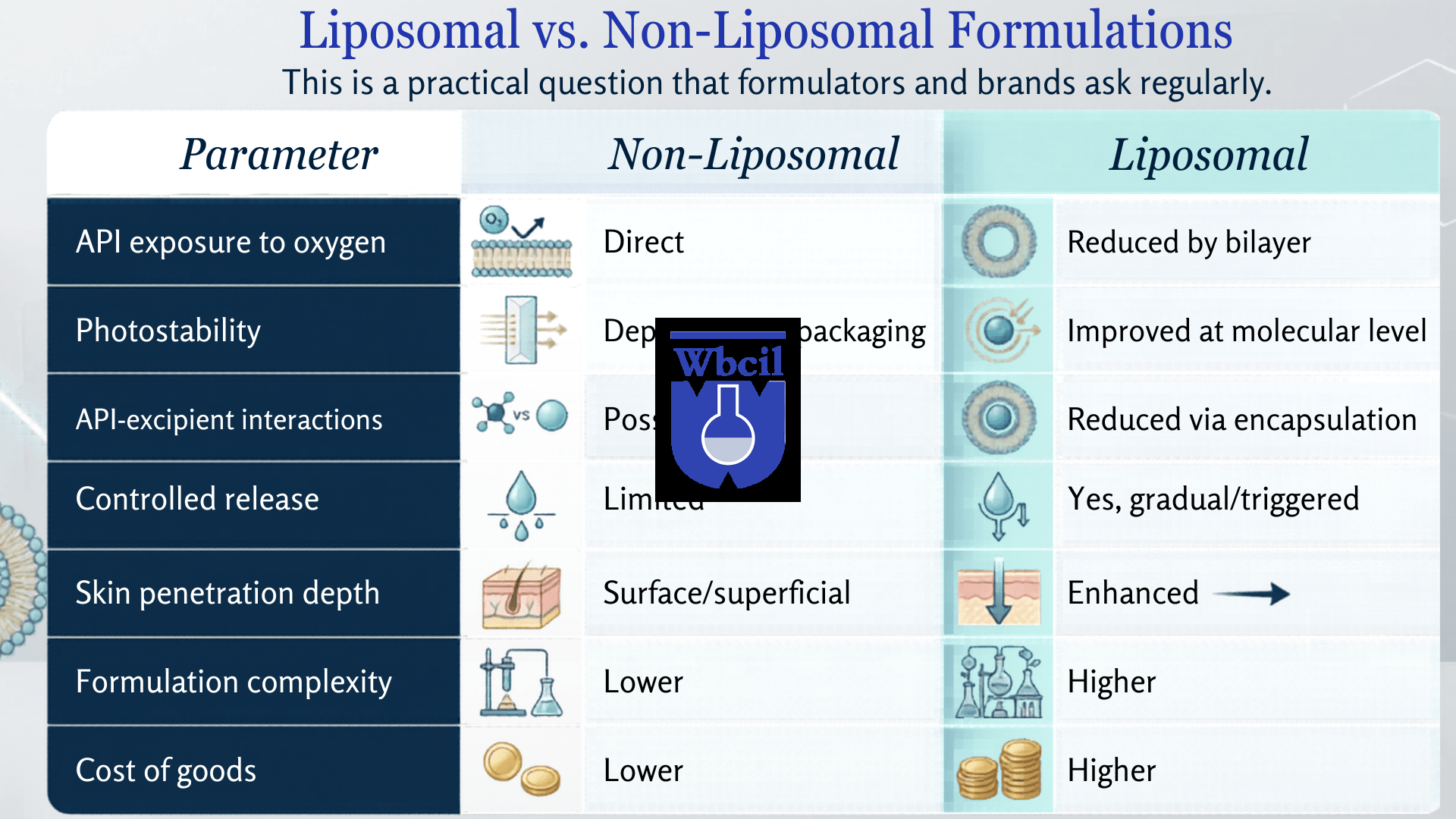
The phospholipid bilayer acts as a physical shield. It significantly limits the exposure of encapsulated actives to dissolved oxygen in the aqueous phase of a formulation.
For retinol, this is particularly important. Studies in pharmaceutical and cosmetic science have consistently shown that encapsulated retinol demonstrates slower oxidation rates compared to retinol in free form under comparable storage conditions.
This does not mean liposomes make retinol indestructible. It means the rate of degradation is meaningfully reduced — which translates directly to extended shelf life.
2. Protection from Light-Induced Degradation
Formulators can further enhance this by combining liposomal encapsulation with opaque or UV-blocking packaging. Together, these strategies provide layered photostability.
3. Isolation from Reactive Formulation Components
A complex cosmeceutical formulation contains many ingredients. Some of them react with each other.
Encapsulation separates the API from other formulation components. This is especially relevant when combining actives like vitamin C and certain metals (copper, iron) that catalyze oxidation, or when combining actives that have incompatible pH optima.
Liposomes allow formulators to keep reactive ingredients in the same product without allowing them to interact — at least until the liposome delivers its payload to the skin.
4. Controlled Release at the Site of Action
Liposomes release their payload gradually or in response to specific triggers (such as changes in skin temperature or lipid environment). This controlled release means the active ingredient is not fully exposed at once, reducing degradation from environmental factors post-application.
5. Improved Skin Penetration
The phospholipid composition of liposomes closely resembles the lipid structure of the stratum corneum. This structural similarity facilitates fusion with or passage through the skin’s outermost layer.
The result is that more of the active ingredient reaches deeper skin layers — which compounds the benefit of better preservation. It is not just about delivering more at the surface. It is about delivering a higher fraction of the intact, potent active to where it needs to work.
Liposomal Technology for Specific Cosmeceutical APIs
Liposomal Vitamin C (L-Ascorbic Acid)
Vitamin C in free form oxidizes rapidly and requires a pH below 3.5 to remain stable in aqueous formulations. This creates a formulation paradox — a low enough pH for stability is often too low for skin comfort.
Liposomal vitamin C addresses both problems. The encapsulation protects ascorbic acid from oxidative degradation. Delivery via liposome also allows higher pH in the outer formulation, as the microenvironment inside the liposome maintains appropriate conditions independently.
Several published studies in cosmetic and pharmaceutical science journals have documented improved stability and percutaneous delivery of ascorbic acid when encapsulated in liposomal systems.
Liposomal Peptides
Peptides present a different challenge. They are inherently water-soluble and do not penetrate the skin barrier easily on their own. They are also susceptible to enzymatic degradation on the skin surface.
Liposomal encapsulation protects peptides from enzymatic breakdown and improves their delivery into the epidermis. This is particularly relevant for signal peptides and carrier peptides, where depth of delivery directly determines biological activity.
Liposomal Retinol
Retinol is one of the most studied cosmeceutical actives and also one of the most unstable. Its degradation pathway under oxygen and light is well established.
Liposomal encapsulation of retinol serves two purposes simultaneously. It reduces oxidative degradation during storage, and it moderates the rate of retinol release on the skin — which also reduces the irritation that is commonly associated with free retinol at higher concentrations.
Other Unstable Cosmeceutical Actives
Liposomal delivery has been explored and applied across a range of other cosmeceutical APIs, including:
Coenzyme Q10 (Ubiquinone) — highly lipophilic, encapsulated within the bilayer
Resveratrol — prone to oxidation and photodegradation
Niacinamide — stable but benefits from enhanced dermal delivery via liposomes
Hyaluronic acid — improved skin delivery via liposomal systems
What Makes a Good Liposomal Formulation?
Key Technical Considerations
Not all liposomes are equal. Formulation quality depends on several variables.
Particle Size
Liposome size is measured in nanometers. Smaller particles (below 200 nm) are generally preferred for cosmeceutical uses. This is because they are more stable, demonstrate better skin penetration, and have a more uniform appearance in finished formulations.
Lamellarity
Liposomes can be unilamellar (single bilayer) or multilamellar (multiple concentric bilayers). The choice affects encapsulation efficiency and release kinetics. Multilamellar vesicles tend to release their payload more slowly.
Phospholipid Composition
The type of phospholipid used determines membrane fluidity, charge, and stability. Phosphatidylcholine (from soy or sunflower lecithin) is the most commonly used for cosmeceutical applications. Hydrogenated phospholipids offer greater oxidative stability but reduce membrane flexibility.
Encapsulation Efficiency
This refers to the percentage of the active ingredient actually enclosed within liposomes versus remaining free in the formulation. Higher encapsulation efficiency means better protection and more predictable release behavior.
Zeta Potential
The surface charge of liposomes (zeta potential) influences their physical stability in suspension. A zeta potential above +30 mV or below -30 mV is generally considered indicative of stable dispersion.
Best Encapsulation Method for Unstable Cosmeceutical Actives
Liposomes are not the only encapsulation technology available. Cyclodextrins, solid lipid nanoparticles, niosomes, and polymeric nanocapsules are all used in cosmeceutical formulation.
However, liposomes hold several specific advantages for unstable cosmeceutical APIs:
- Biocompatibility: Phospholipids are endogenous to human biology. This makes liposomes well-tolerated and unlikely to cause adverse skin reactions.
- Versatility: They can carry both hydrophilic and lipophilic actives — often simultaneously.
- Skin affinity: Its structural similarity to skin lipids facilitates natural interaction with the stratum corneum.
- Regulatory familiarity: Liposomal systems have an established regulatory history in pharmaceuticals, which informs their safety assessment in cosmeceuticals.
For formulators dealing with retinol, vitamin C, or peptides specifically, liposomal encapsulation remains the most scientifically substantiated approach to stability and delivery.
Sourcing Liposomal Cosmeceutical APIs: What to Look For in a Manufacturer
Formulation quality is only as good as the raw material it starts with.
When sourcing liposomal APIs for their skincare or nutraceutical brands, they should consider these factors-
- WHO GMP Compliance Good Manufacturing Practice certification is non-negotiable. It ensures consistency, traceability, and quality control across every batch.
- Particle Size Documentation A reliable manufacturer provides particle size distribution data (typically via dynamic light scattering) for each batch.
- Encapsulation Efficiency Data Ask for documented encapsulation efficiency values. This tells you how much of the active is actually inside the liposome.
- Stability Data Request accelerated and real-time stability data for the encapsulated API. This is the most direct evidence of shelf life performance.
- Technical Support Liposomal APIs sometimes require specific handling conditions (temperature, pH, compatibility restrictions). A competent manufacturer provides formulation guidance alongside the material.
Manufacturers like WBCIL — positioned as WHO GMP-compliant producers of cosmeceutical APIs — represent the type of supplier that serious cosmeceutical brands should be evaluating when building a stable, high-performance product line. When assessing any supplier in this space, always request full technical documentation and batch-specific data before proceeding.
Regulatory Considerations for Liposomal Cosmeceuticals
Liposomal cosmeceuticals occupy an interesting regulatory space.
In most markets, a cosmeceutical product is regulated as a cosmetic — not a drug. This means liposomal formulations do not require drug approval, but they must comply with cosmetic safety regulations.
Key points for formulators:
- Phospholipids used in liposomes (e.g., lecithin, phosphatidylcholine) are recognized as safe for cosmetic use.
- Claims made about liposomal products must be substantiated. Claims referencing drug-like mechanisms of action can attract regulatory scrutiny in markets like the USA, UK, MENA region and Asia.
Why Brands Should Choose West Bengal Chemical Industries Limited (WBCIL) for Liposomal Cosmeceutical APIs?
Choosing the right API supplier is as important as choosing the right technology.
West Bengal Chemical Industries Limited (WBCIL) is a WHO GMP-compliant manufacturer with an established presence in the cosmeceutical API space. For brands looking to work with liposomal encapsulated actives, WBCIL offers the kind of manufacturing foundation that serious product development demands — documented quality systems, batch-level traceability, and technical accountability at every stage of production.
What distinguishes a supplier like WBCIL is not just compliance on paper. WBCIL, 64 years old API manufacturing company in India, supports skincare brands from raw material sourcing through to finished formulation guidance.
You will hardly experience this kind of end-to-end technical partnership. It matters to us when you are working with sensitive, high-value actives where batch inconsistency directly affects product performance.
WBCIL strives for advanced research and development and introduced liposomal technology that has changed the pharmaceutical, nutraceutical and cosmeceutical industries.
WHO GMP-certified option — reducing supply chain risk while maintaining the quality standards that premium liposomal formulations require.
If you are evaluating suppliers for liposomal cosmeceutical APIs,we are here to listen to you! We will provide you all the technical documentation, stability data, and encapsulation efficiency reports — and assess them the same way you would any global-standard supplier.

- Agrawal, S. S., Baliga, V., & Londhe, V. Y. (2024). Liposomal formulations: A recent update. Pharmaceutics, 17(1), 36. https://doi.org/10.3390/pharmaceutics17010036
- Jahangir, M. A. (2022). Phytonutrients and technological development in formulations. Journal of Pharmaceutical Research Science & Technology, 6(1), 38–66. https://doi.org/10.31531/jprst.1000159
- Liu, P., Chen, G., & Zhang, J. (2022). A review of liposomes as a drug delivery system: Current status of approved products, regulatory environments, and future perspectives. Molecules, 27(4), 1372. https://doi.org/10.3390/molecules27041372
- Pasarin, D., Ghizdareanu, A.-I., Enascuta, C. E., et al. (2023). Coating materials to increase the stability of liposomes. Polymers, 15(3), 782. https://doi.org/10.3390/polym15030782
- Sharma, A., Agarwal, P., Sebghatollahi, Z., & Mahato, N. (2023). Functional nanostructured materials in the cosmetics industry: A review. ChemEngineering, 7(4), 66. https://doi.org/10.3390/chemengineering7040066
- Thorat, et al. (2025). Liposomes in cosmeceuticals. World Journal of Pharmaceutical Research, 14(23), 1973. https://wjpr.s3.ap-south-1.amazonaws.com/article_issue/c6dcfdaa2d50a6d498ecfa2a49f79f2f.pdf
- Zahran, et al. (2023). Liposomal encapsulation in food systems: A review of formulation, processing, and applications. MOST Wiedzy. https://mostwiedzy.pl/pl/publication/download/1/liposomal-encapsulation-in-food-systems-a-review-of-formulation-processing-and-applications_107321.pdf
- Lee, et al. (2025). Enhancing dermal absorption of cosmeceuticals: Innovations and techniques for targeted skin delivery. PMC. https://pmc.ncbi.nlm.nih.gov/articles/PMC12547863/
- Gupta, P. (n.d.). Nanocarriers: Overview of liposomes in the cosmeceutical industry. Apeejay Stya University. https://university.apeejay.edu/naac-files/Criterion%201/1.3.4/Reports/SPS/8%20Pearl%20Gupta.pdf
- Creative Biostructure. (n.d.). Liposomes for cosmetics: Case studies on vitamin K1 and hyaluronic acid. https://www.creative-biostructure.com/liposomes-for-cosmetic.htm