Why Research Points to Magnesium Pidolate as the Superior Form for Blood-Brain Barrier Crossing
If you have ever searched for a magnesium supplement and felt overwhelmed by the options — oxide, citrate, glycinate, threonate — you are not alone. Each form comes with its own claims, and sorting through the noise can feel like a chemistry exam.
But when it comes to brain health, one specific form keeps coming up in published research for all the right reasons: Magnesium Pidolate. And more specifically, its ability to work with — not just against — the blood-brain barrier (BBB).
Let us break this down in plain language, backed by science.
Key Takeaways
- The Form Decides the Destination
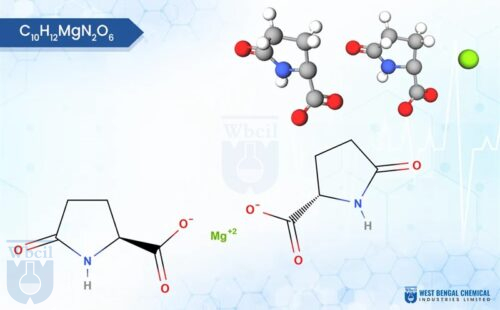
Not all magnesium can reach the brain easily. Magnesium Pidolate uses pidolic acid, which is naturally found in the brain to help it cross the brain barrier. This makes it the effective type of magnesium in brain studies. - Pidolate Strengthens the Barrier, Not Just Crosses It
Unlike types of magnesium magnesium pidolate doesn’t just cross the brain barrier. It also helps strengthen it. This is especially important for brain health and cognitive supplements. - API Quality Is Non-Negotiable for Neurological Formulations
For companies making brain health supplements the quality of the magnesium pidolate is crucial. WBCIL provides high-quality Magnesium Pidolate that meets rules and is suitable, for brain health and supplement applications.

The Blood-Brain Barrier: Why Getting Magnesium Into the Brain Is Harder Than You Think
A gatekeeper, not a gateway
The blood-brain barrier is one of the most selective physiological structures in the body. It is a tightly regulated network of specialised cells and tight junctions that controls exactly what enters the central nervous system. Essential nutrients get in. Toxins, pathogens, and poorly matched molecules largely do not.
Magnesium can cross the BBB — research confirms that it is actively transported from blood into brain parenchyma, and that cerebrospinal fluid (CSF) magnesium concentrations actually exceed those of blood plasma in healthy individuals. [1]
But the form of magnesium matters enormously for how efficiently that crossing happens. Magnesium sulphate, for instance — widely used in clinical settings — can reach the brain, but its transport efficiency and ability to protect the BBB integrity are demonstrably lower compared to organic chelates.
Not all magnesium salts knock on the same door
A landmark in vitro study using both rat and human BBB models tested multiple magnesium salts for two things: how well they reduced BBB permeability (a protective effect), and how efficiently they transported magnesium across the barrier. [2]
The result? Magnesium pidolate was the most efficient among all formulations tested — both in reducing BBB permeability and in enhancing magnesium transport through the barrier.
Published Research — PubMed (2019)
“Among various formulations tested, magnesium pidolate was the most efficient in reducing the permeability and in enhancing magnesium transport through the barrier… Magnesium pidolate performs better than sulfate also in preventing lipopolysaccharide-induced damage to in vitro generated BBB.” — Magnesium Research, 2019 [2]
The Mechanism: How Pidolic Acid Acts as a Carrier for the Brain
Most chelated minerals use their ligand simply as a vehicle — something to improve solubility or gut absorption. Pidolic acid does more. It is a key intermediate in the gamma-glutamyl cycle, the biochemical pathway that regenerates glutathione and is directly tied to glutamate metabolism in the CNS. [3]
Pidolic acid is not a passive bystander
Because the BBB expresses amino acid transporters that recognise compounds within this cycle, pidolic acid is able to engage these transporters actively — effectively acting as a ticket for magnesium to gain expedited entry into the CNS. This is sometimes described as the “trojan horse” mechanism: the brain’s own transport infrastructure is leveraged to deliver the mineral cargo.
What happens once magnesium enters the brain?
Once delivered to the CNS via the pidolate pathway, magnesium performs several critical neurological functions:
- It modulates NMDA receptor activity — blocking overactivation while enabling healthy learning and memory signalling
- Magnesium (Mg) supports GABA receptor function, which is fundamental to managing anxiety and stress responses
- It upregulates Brain-Derived Neurotrophic Factor (BDNF), a key protein linked to neuroplasticity and cognitive resilience
- It reduces neuroinflammation by modulating inflammatory pathways, protecting neurons from oxidative and inflammatory stress
A 2022 study using human brain organoids — a sophisticated 3D model derived from induced pluripotent stem cells — found that magnesium pidolate was more effective than magnesium sulphate in increasing GABA receptor levels and BDNF, while simultaneously decreasing NMDA receptor overactivation. [4]
MDPI / PMC (2022) — Human Brain Organoid Study
“5 mM of MgPid is more effective than MgSO4 in increasing the levels of GABA receptors and BDNF, and decreasing those of NMDA receptor… the presence of the BBB is essential for Mg to exert its effects on brain organoids.” — International Journal of Molecular Sciences, 2022 [4]
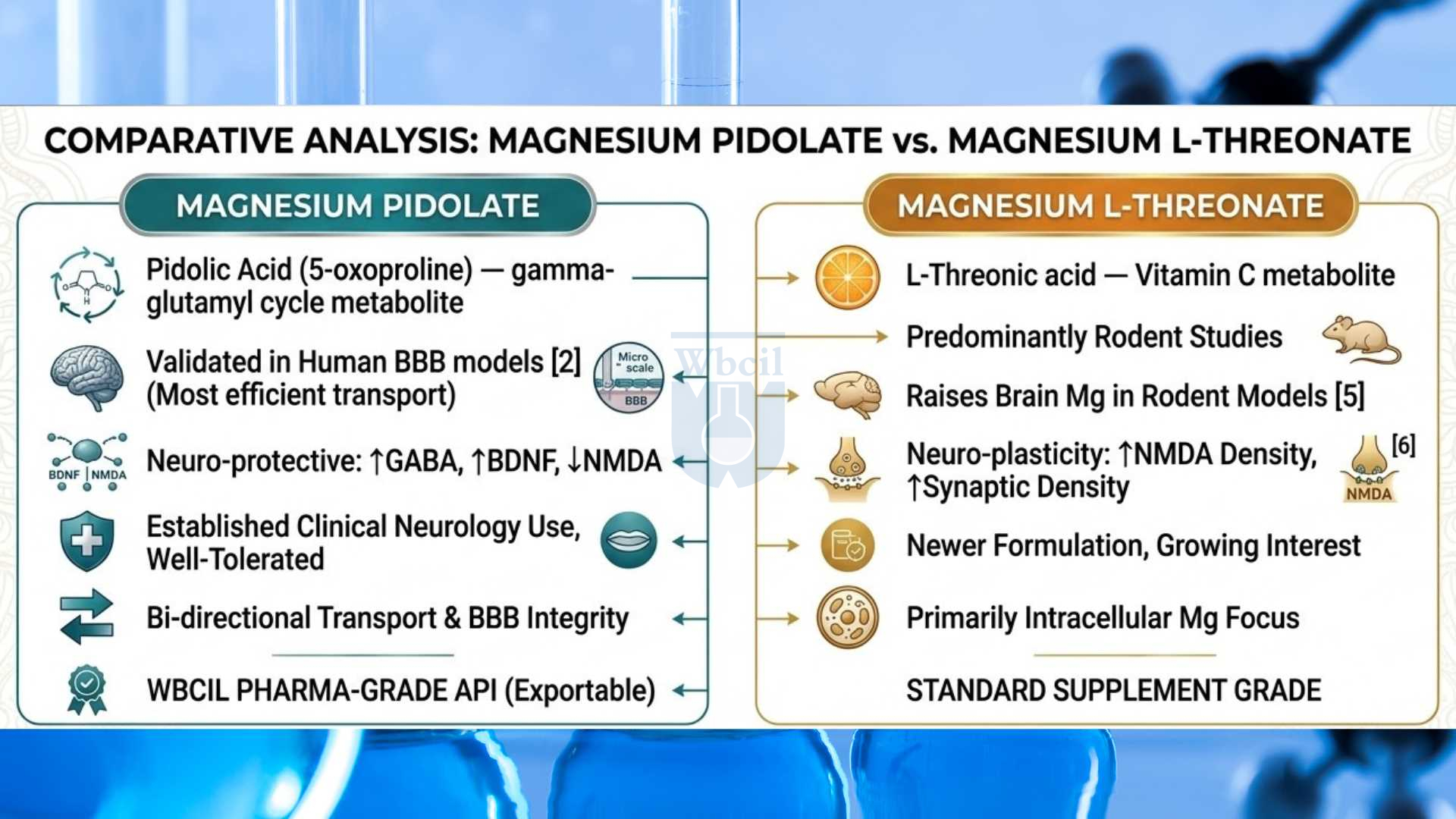
Magnesium Pidolate vs. Magnesium L-Threonate: How Do They Compare for Brain Health?
Magnesium L-Threonate (MgT) has been widely marketed as the premier brain-targeted magnesium since research out of MIT showed it could raise brain magnesium levels and improve synaptic density in animal models. [5] It remains a well-studied option. But how does it compare to Magnesium Pidolate directly?
The key distinction: Magnesium Pidolate does not simply cross the blood-brain barrier — it actively reinforces it, reducing pathological permeability while simultaneously improving magnesium delivery. That dual action is clinically meaningful for neurological conditions where BBB dysfunction itself is part of the disease picture. [6]
Formulating Magnesium Pidolate for Cognitive Health Products: What Manufacturers Need to Know
For supplement and pharmaceutical brands developing cognitive health or neurological formulations, the choice of magnesium pidolate API is not merely a sourcing decision — it is a science decision. The bioavailability, purity, and chelation stability of the raw ingredient directly determine how much magnesium reaches the brain, and in what form.
Magnesium pidolate offers formulation flexibility that makes it highly suited to a range of product formats:
- Oral sachets and powders — high magnesium content per gram, easily dispersible
- Tablets and capsules — DC-grade formats available for direct compressibility
- Paediatric and geriatric liquid formulations — good solubility and low gastrointestinal burden
- Neurological nutraceutical blends — compatible with B vitamins, Vitamin D, and adaptogenic co-formulants
Bioavailability of magnesium pidolate in formulations
Published data shows that magnesium pidolate has a bioavailability of 40-60%. The pidolic acid carrier helps make it easier to take and reduces the effect that can happen with other types of magnesium. For people with long-term conditions it’s really important that they can take their supplements without any issues.
WBCIL Magnesium Pidolate API For Manufacturers
WBCIL provides high-quality Magnesium Pidolate API for making medicines and supplements. They follow rules and have certification from the World Health Organization. Their product is suitable for making formulations for brain health and mineral supplements. If you’re interested you can find information on their website: www.wbcil.com.
Where Neurological Magnesium Therapy Is Heading: Clinical Applications
Magnesium is being studied more and more as a treatment for brain-related conditions. Research has found that having magnesium in the brain can help with various conditions, including:
- Migraine prevention: Magnesium helps with brain activity and blood platelets
- Anxiety and mood disorders: Magnesium supports certain brain receptors and helps regulate stress hormones
- Cognitive decline and age-related memory loss: Magnesium helps with brain receptors and growth factors
- Traumatic brain injury recovery: Magnesium protects the brain and helps with healing
- Sleep quality: Magnesium helps regulate sleep hormones and relaxation
In each of these cases getting magnesium to the brain is crucial. A type of magnesium that works well in the blood but not in the brain won’t be helpful. That’s where Magnesium Pidolate comes in as it has been shown to work in human brain studies.
Conclusion: Getting Magnesium to the Brain Is a Science Problem — Pidolate Is the Answer
We spend a lot of time talking about what magnesium does for the brain. We should spend equal time talking about what form of magnesium actually gets there.
Magnesium Pidolate at the Blood-Brain Barrier is not a marketing claim. It is a peer-reviewed, laboratory-validated reality — demonstrated in both rat and human BBB models, confirmed in 3D human brain organoid studies, and supported by decades of clinical neurological application. For formulators, this matters enormously. For patients, it matters even more.
As a leading Indian API manufacturer with over 60 years of pharmaceutical and nutraceutical chemistry experience, WBCIL supplies high-purity Magnesium Pidolate that meets the exacting demands of neurological formulation — backed by science, certified by WHO-GMP, and trusted by partners in over 35 countries.

- Romani A, Scarpa A. “Magnesium transport across the blood-brain barriers.” In: Vink R, Nechifor M, editors. Magnesium in the Central Nervous System.
- Sacco S, et al. “Magnesium and the blood-brain barrier in vitro: effects on permeability and magnesium transport.” Magnesium Research. 2019;32(1):1–14. PubMed PMID: 31503002.
- Jiang Y, et al. “The role of glutamate and glutamine metabolism and related transporters in nerve cells.” CNS Neuroscience & Therapeutics.
- Schiera G, et al. “The Presence of Blood-Brain Barrier Modulates the Response to Magnesium Salts in Human Brain Organoids.” International Journal of Molecular Sciences. 2022;23(9):5133. PMC9104490.
- Slutsky I, et al. “Enhancement of Learning and Memory by Elevating Brain Magnesium.” Neuron. 2010;65(2):165–177. DOI: 10.1016/j.neuron.2009.12.026.
- Zhang C, et al. “A Magtein (Magnesium L-Threonate)-Based Formula Improves Brain Cognitive Functions in Healthy Chinese Adults.” Nutrients. 2022;14(24):5235. PMC9786204.